
Car Key Battery Replacement: The Cell, the Fob and the Call-Out
Battery type by make and model from the Keysolved database, the dead-fob diagnosis that sorts a cell from a key job, and the MINI that takes no coin cell at all
Key Takeaways
- The transponder is passive and powered by induction from the coil, so a completely flat cell never stops a bladed car starting — if the engine starts and the buttons do not, the fault is radio-side and it is not a key job
- CR2032 is the safe default across most of the modern UK fleet, which is what makes the exceptions expensive: CR2025 on the VW Polo Mk6, CR2016 on the Vauxhall Vivaro 2014-2019 and the Qashqai J10 remote head key, CR1620 on the Toyota Corolla E210 flip remote
- The 2006-2014 MINI Hatch slot key takes a VL2020 rechargeable soldered to the board, not a coin cell — Panasonic rates it at 20 mAh against the CR2032's 225 mAh, charged by the car through the key slot, so there is no swap and it is a key job
- One vehicle can take two different cells: the Corolla E210 is CR1620 on the flip remote and CR2032 on the smart key, and the Qashqai J10 is CR2016 on the remote head key and CR2032 on the Intelligent Key
- Stock and order by key variant, never by model name — the database records the cell against the variant alongside frequency, blade profile and button count
- Every UK-market proximity vehicle has a flat-key backup path: a dash key slot, a marked emergency-start spot on the steering column shroud, the start button itself, or the emergency blade concealed in the housing
- Take the old cell away — RoSPA is explicit that a used button battery still carries a risk of serious injury, and car keys are among the items it names
A car key battery replacement is the cheapest job you will do all week, and the one most likely to go wrong in the diary rather than on the driveway. The customer rings and says the key has stopped working. You hear "key not working", you quote for a key, and you arrive to a fob with a flat cell in it and a customer who now believes you tried it on. Or the reverse: you treat it as a battery, fit one, and the fault is still there, because the battery was never the problem.
The cell costs less than the diesel to get there. What it is worth is the triage — knowing, from the symptom described on the phone, whether you are driving to a one-minute swap, a resynchronisation or a key job. And knowing before you leave the van which cell that vehicle takes, because they are not interchangeable and the drawer marked "fob batteries" has four sizes in it.
Every battery specification below comes from the Keysolved vehicle database, which records the cell per key variant rather than per model. That distinction carries more weight than it sounds. The Toyota Corolla and the Nissan Qashqai further down are the reason.
What a flat key actually stops
Start here, because it decides everything else. The transponder in a car key is passive. It carries no power of its own — the coil around the ignition barrel, or in the dash key slot, energises it by induction and it answers out of that borrowed field. The cell in the fob does not feed it.
So on a car with a bladed key and an ignition barrel, a completely flat battery does not stop the engine starting. Put the key in, turn it, and the immobiliser is satisfied exactly as it was the day before. What stops is the radio. The buttons do nothing, because the remote is a battery-powered transmitter working over tens of metres rather than the few centimetres the transponder needs.
That hands you a free diagnostic question before you accept the job. If the engine starts and the buttons do not work, the transponder has already proved itself. You are looking at a cell, a switch membrane or a desynchronised counter, not a key job. If a car will not start at all on a key that was fine last week, the battery is not the first thing to suspect, whatever the customer has read.
On a proximity car it is less clean but still tractable. A flat cell removes keyless entry and keyless start, because both depend on the fob transmitting. It does not remove the car. Every proximity vehicle built for the UK market has a backup path, and the database records where that path is on a good number of them. The immobiliser fault diagnosis guide covers the start-side symptoms that are genuinely immobiliser faults rather than radio faults, and it is worth separating the two before you quote.
The cells, and why they do not substitute
The designation tells you the size. On a lithium coin cell the letters give the chemistry and the digits give the dimensions: the first two are the diameter in millimetres, the last two the height in tenths of a millimetre. Panasonic's own CR2032 datasheet confirms the arithmetic — a maximum diameter of 20.0 mm, a maximum height of 3.2 mm, a nominal 3 V, a nominal capacity of 225 mAh and a weight of approximately 2.8 g, with manganese dioxide as the positive pole.
Run the same logic across the four sizes you will actually meet in car keys and the trap is obvious:
| Cell | Diameter | Height | Interchangeable with CR2032 |
|---|---|---|---|
| CR2032 | 20 mm | 3.2 mm | — |
| CR2025 | 20 mm | 2.5 mm | No — 0.7 mm thinner, lower capacity |
| CR2016 | 20 mm | 1.6 mm | No — half the height |
| CR1620 | 16 mm | 2.0 mm | No — wrong diameter entirely |
All four share a 3 V nominal output, which is why a thinner cell appears to work. It sits loose in a housing cut for a taller one, makes intermittent contact, and comes back to you three weeks later as a complaint about the programming. A CR1620 does not even fit the aperture.
Car key battery by make and model
Pulled from the database, UK-market records, by vehicle and key variant. Where a vehicle carries more than one key style, the cell is listed against the style, not the car.
| Vehicle | Key variant | Cell |
|---|---|---|
| Ford Fiesta 2017-2024 | Flip remote and smart key | CR2032 |
| Ford Focus 2018-2024 | Flip remote and smart key | CR2032 |
| Ford Puma 2019-2026 | Flip remote and smart key | CR2032 |
| Vauxhall Corsa 2019-2024 | Flip remote and smart key | CR2032 |
| Vauxhall Vivaro 2014-2019 | 2-button and 3-button remote | CR2016 |
| VW Golf 2012-2020 | Flip remote and KESSY smart key | CR2032 |
| VW Polo 2017-2025 | Flip remote and KESSY smart key | CR2025 |
| VW Transporter T6 2015-2019 | Flip remote, all button counts | CR2032 |
| Audi A3 2020-2026 | Smart key, with and without Comfort Key | CR2032 |
| Skoda Octavia 2020-2026 | Smart key | CR2032 |
| Mercedes C-Class 2014-2021 | Smart key, all W205 variants | CR2032 |
| Mercedes Sprinter 2018-2024 | Remote head key and smart key | CR2032 |
| BMW 3 Series 2018-2022 | Comfort Access smart key | CR2032 |
| MINI Hatch 2014-2023 | Smart key, 3 and 4 button | CR2032 |
| MINI Hatch 2006-2014 | Slot-type smart key | VL2020 — see below |
| MINI 2006-2014 | Remote head key | CR2032 |
| Range Rover 2022-2026 | Smart key, 5-button | CR2032 |
| Nissan Qashqai 2006-2014 | Standard 2-button remote head key | CR2016 |
| Nissan Qashqai 2006-2014 | Intelligent Key | CR2032 |
| Nissan Qashqai 2014-2021 | All three variants | CR2032 |
| Nissan Qashqai 2021-2024 | Smart key | CR2032 |
| Toyota Corolla 2018-2024 | Flip remote, non-PBS | CR1620 |
| Toyota Corolla 2018-2024 | Smart key, push-button start | CR2032 |
| Toyota Yaris 2020-2026 | Flip remote and smart key | CR2032 |
| Peugeot 2008 2019-2024 | Flip remote and Open & Go smart key | CR2032 |
| Peugeot 208 2019-2024 | Both smart key variants | CR2032 |
| Renault Clio 2019-2024 | Key card, handsfree and non-handsfree | CR2032 |
CR2032 is the safe default across most of the modern UK fleet, which is exactly what makes the exceptions expensive. Three of them are worth committing to memory.
One caveat on the Golf. The UK Mk7 and Mk7.5 record carries CR2032, and the same generation appears in the database under Australian, German and North American records at CR2025 with a different blade profile. Market variation on VAG keys is well established — the Volkswagen key programming guide covers how far it runs — so on an import or a replacement fob of unknown origin, confirm the cell against the one you take out rather than against the model.
The MINI that does not take a coin cell
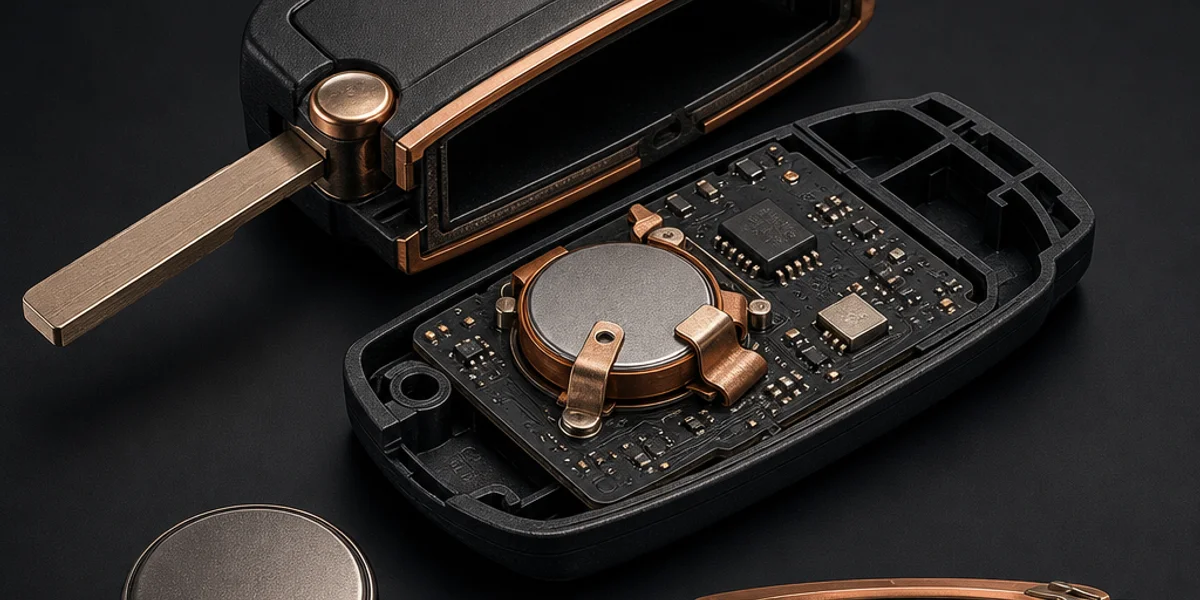
This is the one that catches people out, and it is worth knowing before the customer hands you the key rather than after. The database records the slot-type smart key on the 2006-2014 MINI Hatch as taking a "VL2020 (rechargeable, soldered to PCB — NOT a replaceable coin cell)".
That is not a CR cell at all. Panasonic lists the VL2020 as a coin-type vanadium rechargeable lithium battery with a charging voltage of 3.25 V to 3.55 V, a nominal 3.0 V, a nominal capacity of 20.0 mAh, a maximum height of 2.0 mm and a service life of approximately 1,000 charge and discharge cycles at ten per cent discharge depth. The datasheet names remote keyless entry among its applications directly.
Set that against the CR2032 and the picture is complete. Same 20 mm diameter, 1.2 mm thinner, and a capacity of 20 mAh against 225 mAh — roughly one eleventh. It is small because it is not supposed to last years on its own: the car tops it up through the key slot every time the key goes in. On the R56 that slot is also the reader coil, so the key is charged and authenticated in the same place.
Two consequences for the job:
- A CR2032 is not a substitute. It is the wrong height, the wrong chemistry and not designed to be charged. There is no coin cell swap on this key.
- A VL2020 that will no longer hold charge means a PCB repair or a replacement key, and that is a different quote and a different conversation. It is not a battery visit.
Note the companion record too. The 2006-2014 MINI remote head key is recorded at CR2032, so the R56-era MINI is genuinely two different answers depending on which key style is in the customer's hand. Establish which one it is on the phone, before you drive. The BMW and MINI key programming guide sets out the CAS generations behind both.
Where one car takes two different cells
The database records the cell per key variant, and two UK vehicles show why that is not pedantry.
Toyota Corolla E210, 2018 to 2024. The flip remote on non-push-button-start trims takes a CR1620. The smart key on push-button-start trims takes a CR2032. Same model, same years, same Texas Instruments DST-AES chip in both — and a 16 mm cell against a 20 mm one. The CR1620 is the only occurrence of that size across the vehicles checked for this article, so it is the one least likely to be in your van.
Nissan Qashqai J10, 2006 to 2014. The standard two-button remote head key takes a CR2016. The Intelligent Key on the same generation takes a CR2032. Ask whether the key has a blade that turns in a barrel or a button on the dash, and you have your answer. Get it wrong and you are fitting a cell half the required height into a CR2032 housing. The Nissan key programming guide covers the J10 to J12 architecture if the visit turns into a key job.
The practical rule is short. Order and stock by key variant, never by model name. The per-vehicle records carry the cell against the variant, alongside the frequency, the blade profile and the button count.
Starting a car whose key is completely flat
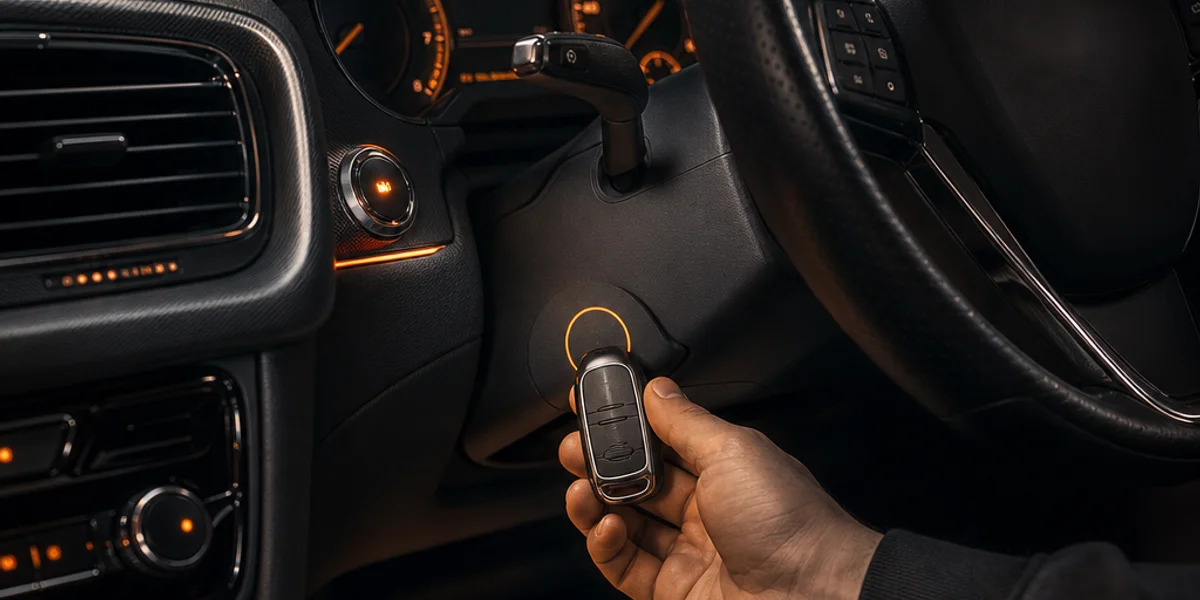
Worth knowing even though no tool is involved, because it is often the thing the customer actually needs in the first two minutes, and it buys you the goodwill for the rest of the invoice. The position varies by platform and the database records it on several.
- Confirm the vehicle and the key variant before touching anything. On a bladed car with a barrel there is nothing to do — the key turns and starts regardless of the cell.
- On an Audi A3 8Y, the record describes holding the key flat against the emergency-start antenna on the steering column shroud, marked with a key symbol, for about two seconds. Programming procedures on this platform use the same spot, which is a reliable indication of where the coil sits.
- On a Mercedes Sprinter with KEYLESS-START, the record describes the key being placed in the KEYLESS-START key slot on the dash when it cannot be read over the air, with vans of reduced antenna range using the holder in the driver's cup holder instead.
- On a Toyota Yaris XP210, the recorded routines hold the key against the start button itself until the dash lights up.
- On a proximity car with no slot and no marked spot, use the emergency blade. On the Peugeot 208 the database records the HU83 blade as "stored concealed inside the key housing for emergency door entry when battery is flat", and the Renault Clio V key card carries its VA6 blade inside the card body. That gets you into the car; starting it still needs the coil position for that platform.
- Time: 5-10 minutes, including finding the slot on a vehicle you have not seen before.
Where the database has no recorded position for a platform, do not guess at it on the customer's car. The owner's handbook has it, and reading the handbook in front of the customer costs you nothing.
The battery visit, start to finish
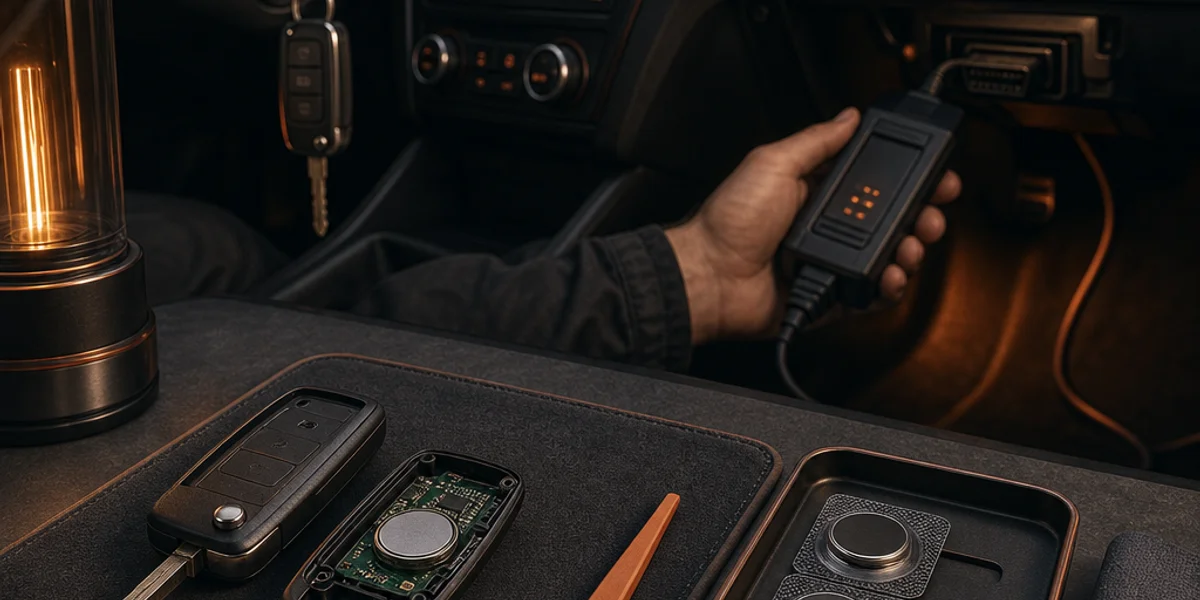
- Triage on the phone. Does the engine start? Do the buttons work at the glass and not at ten metres? How old is the car, and does the key have a blade or a button? Those four answers decide whether you take a cell, a tool or both.
- Pull the vehicle record before you leave and confirm the cell against the key variant, not the model.
- On arrival, confirm proof of ownership and photographic identification. It applies to a battery visit on a fob that also carries the transponder, and Master Locksmiths Association membership standards treat it as a condition of membership rather than a formality.
- Open the fob on the seam, not with a screwdriver through the middle. Most UK fobs part on a lip or release with the blade swung out. Note that the database does not record case-opening detail per vehicle, so on an unfamiliar housing work slowly and look for the moulded relief before applying force.
- Note which way up the old cell sat before it comes out. Positive face up is usual but not universal.
- Fit the new cell, handling it by the edge. Finger grease on the faces raises contact resistance.
- Reassemble, then test properly — lock, unlock, boot, and the proximity handles if fitted, at the car and then at ten metres.
- Take the old cell away with you. More on that below, because it is the part most people get wrong.
- Time: 10-15 minutes for a single fob, including the paperwork and the test.
When it is not the battery
A new cell that changes nothing is information, not a failure. Work down in this order.
- Verify the new cell under load, not with a voltmeter on the bench. A coin cell can read 3 V open-circuit and collapse as soon as the transmitter draws.
- Inspect the board. Cracked solder at the switch, a corroded battery clip and water ingress behind the buttons are all commoner than a failed transmitter. Button membranes fail far more often than radios.
- Test both keys. A fault present on one key and not the other is in the key. A fault present on both is in the vehicle receiver or its aerial.
- Consider counter desynchronisation. Modern remotes are counter-based and the vehicle accepts a transmission only inside a validity window, so a fob left in a drawer for years, or pressed repeatedly away from the car, can fall outside it. The database does not record a resynchronisation requirement triggered by a battery change on the vehicles checked here, so treat desynchronisation as its own fault with its own platform procedure rather than as something a cell swap causes.
- If the engine will not start either, you are out of radio territory and into the immobiliser. Stop treating it as a battery.
- Time: 15-25 minutes for the full sequence before you quote for anything further.
Escalation from here is a programming job, and it needs the tool rather than the cell. A Smart Pro, Autel IM608 Pro II, Lonsdor K518Pro or OBDSTAR X300 DP Plus will all cover the common UK platforms, with the honest caveat that coverage is per-vehicle rather than per-platform and add-key and all-keys-lost are separate capabilities on most of them. The coverage matrix counts confirmed vehicles per tool from the database rather than from the marketing.
One limitation worth stating plainly: none of those tools diagnoses a flat cell, a cracked switch or a corroded clip. The most useful instruments on a battery visit are a known-good spare cell and a pair of eyes.
Pricing it, and the old cell
A locksmith charging a call-out fee to fit a cell worth pennies is not overcharging, and it is worth being able to say why without sounding defensive. The customer is buying the journey, the diagnosis and the certainty that it is not a key job — the same three things they would buy on any visit. The problem is never the price. It is the price arriving without the explanation.
Two practical notes.
First, the cell you remove is not rubbish. The Royal Society for the Prevention of Accidents is direct about why: button batteries are extremely dangerous to children if swallowed, they list car keys among the everyday items that contain them, and combined with saliva the current from the cell produces caustic soda that can burn through the throat or stomach. RoSPA is explicit that used batteries should be disposed of correctly because they can still cause injury, and that spare cells belong locked away. Leaving a dead cell on a customer's kitchen worktop in a house with a toddler in it is a poor outcome from an otherwise fine job. Take it with you.
Second, the regulatory position, since it comes up and the answer is usually reassuring. The Waste Batteries and Accumulators Regulations 2009 place a take-back duty on sellers, and GOV.UK guidance from the Office for Product Safety and Standards and Defra sets the threshold: distributors and retailers that sell or supply more than 32 kg of batteries a year must provide a free collection point for waste portable batteries at their premises. At the approximately 2.8 g of a CR2032 given in Panasonic's datasheet, 32 kg is in the order of eleven thousand cells a year. A mobile locksmith fitting a few hundred is nowhere near it, so the formal take-back obligation almost certainly does not bite. Taking the old cell away and putting it through a supermarket collection point is still the right thing to do, and it costs nothing.
Common pitfalls
Quoting for a key off the phrase "the key has stopped working" Ask whether the engine starts. If it does, the transponder is proven and you are not quoting for a key. This single question is the difference between a correct quote and an argument on the driveway.
Stocking by model rather than by key variant The Corolla E210 is CR1620 on the flip remote and CR2032 on the smart key. The Qashqai J10 is CR2016 on the remote head key and CR2032 on the Intelligent Key. The model name does not give you the cell.
Fitting a CR2025 or CR2016 into a CR2032 housing because it is what was in the van It will power up on the bench and fail intermittently in a pocket. The customer will not report it as a loose battery; they will report it as the work not having been done properly.
Treating an R56 MINI slot key as a coin cell job The database records it as a VL2020 rechargeable soldered to the board. There is no swap. Diagnose it as a key, quote it as a key.
Levering a fob apart through the face Stress marks across the button membrane are permanent and the customer sees them before they see the working remote. Find the seam.
Assuming a battery change caused a desynchronisation It usually did not. Desynchronisation is a counter fault with its own procedure, and conflating the two sends you looking for a resynchronisation step that platform may not have.
Leaving the old cell behind RoSPA is clear that a used button battery still carries a risk of serious injury. It takes two seconds to pocket it.
Frequently asked questions
What battery does a car key take?
Most modern UK cars take a CR2032 — a 20 mm by 3.2 mm, 3 V lithium coin cell. The common exceptions in the Keysolved database are the Toyota Corolla E210 flip remote at CR1620, the Nissan Qashqai J10 remote head key and the Vauxhall Vivaro 2014-2019 at CR2016, the VW Polo Mk6 at CR2025, and the 2006-2014 MINI Hatch slot key, which uses a soldered rechargeable VL2020 rather than a coin cell at all. Check the record for the key variant, not the model.
Can a flat key battery stop a car starting?
Not on a car with a bladed key and an ignition barrel. The transponder is passive and is powered by induction from the coil at the barrel, so it authenticates normally with a completely dead cell. On a proximity car a flat cell removes keyless entry and keyless start, but every UK-market proximity vehicle has a backup path — a key slot, a marked emergency-start position on the steering column, holding the fob against the start button, or the emergency blade concealed in the housing.
Does a car key need reprogramming after a battery change?
Not as a consequence of the battery change itself. The Keysolved records for the vehicles covered here do not list a resynchronisation step triggered by replacing a cell. A remote that has been out of use for a long period can fall outside the vehicle's counter validity window, which is a separate fault with a separate platform procedure.
Is CR2025 the same as CR2032?
No. Both are 20 mm in diameter and 3 V, but the CR2025 is 2.5 mm tall against the CR2032's 3.2 mm, and carries less capacity. It will fit loosely in a CR2032 housing, make intermittent contact and come back as a complaint. The digits in the designation are the dimensions: diameter in millimetres, then height in tenths of a millimetre.
Why can the MINI key battery not be replaced?
On the 2006-2014 MINI Hatch slot-type smart key, the database records the cell as a VL2020 rechargeable soldered to the circuit board rather than a removable coin cell. Panasonic's datasheet describes the VL2020 as a vanadium rechargeable lithium cell of 20 mAh charged at 3.25 V to 3.55 V, topped up by the car through the key slot. A CR2032 is the wrong height and not designed to be charged, so there is no coin cell substitution. A VL2020 that no longer holds charge is a PCB repair or a replacement key.
How long does a car key battery replacement take?
Ten to fifteen minutes for a single fob including proof of ownership, the swap and a proper range test. Allow fifteen to twenty-five minutes if the new cell changes nothing and you work through the board, both keys and the vehicle receiver before quoting for anything further.
The short version
The transponder is passive, so the question that sorts a battery visit from a key job is whether the engine starts. Ask it before you quote. Then stock by key variant rather than by model, because the same Corolla takes a CR1620 or a CR2032 depending on the trim, and the same R56 MINI either takes a CR2032 or takes nothing you can fit.
Before you leave the van, pull the record for the make, model and year in front of you. No record to hand? The free key battery finder gives the cell from the plate. The record carries the cell against each key variant, alongside the frequency, blade profile, button count and the tools confirmed against that exact key. For the chip side of the same fob, the transponder chip cross-reference maps the families to makes and generations, and cloning versus programming covers what still copies. If the visit turns into a key job, the OBD port location guide has the awkward ports and car key programming has the rest of it.
Full database access
Check the Cell Before You Leave the Van
Cancel any time · Billed monthly, or save $99 a year paying yearly, in your local currency
Look up any make, model and year for the battery against each key variant, plus the frequency, blade profile, button count and the tools confirmed against that exact key.
No card required to browse — subscribe to unlock full specs and procedures
Frequently Asked Questions
▶What battery does a car key take?
▶Can a flat key battery stop a car starting?
▶Does a car key need reprogramming after a battery change?
▶Is CR2025 the same as CR2032?
▶Why can the MINI key battery not be replaced?
▶How long does a car key battery replacement take?
Full database access
When the Battery Visit Becomes a Key Job
Cancel any time · Billed monthly, or save $99 a year paying yearly, in your local currency
Per-tool coverage across more than 60 makes, counted from confirmed vehicle records, with add-key and all-keys-lost listed separately.
No card required to browse — subscribe to unlock full specs and procedures
Sources
- Panasonic CR2032 Lithium Coin Battery Datasheet(2026)— Manufacturer datasheet. Source for the CR2032 figures used throughout: maximum diameter 20.0 mm, maximum height 3.2 mm, nominal 3 V, nominal capacity 225 mAh, weight approximately 2.8 g, manganese dioxide positive pole.
- Panasonic VL2020 Coin-type Vanadium Rechargeable Lithium Battery Datasheet(2024)— Manufacturer datasheet for the rechargeable cell recorded in the MINI R56 slot key. Source for the charging voltage of 3.25 V to 3.55 V, nominal 3.0 V, nominal capacity 20.0 mAh, maximum height 2.0 mm, approximately 1,000 cycles at ten per cent discharge depth, and remote keyless entry among the listed applications.
- Button battery safety advice — Royal Society for the Prevention of Accidents(2026)— RoSPA guidance naming car keys among the everyday items containing button batteries, the caustic soda mechanism when a cell is swallowed, and the instruction that used batteries must be disposed of correctly because they can still cause injury.
- Regulations: waste batteries — Office for Product Safety and Standards and Defra(2021)— GOV.UK guidance on the Waste Batteries and Accumulators Regulations 2009, including the threshold at which UK distributors and retailers selling or supplying more than 32 kg of batteries a year must provide a free take-back collection point.
- Master Locksmiths Association — About Us(2026)— MLA membership standards, referenced for the proof-of-ownership and customer identification expectations that apply to any visit to a fob carrying a transponder.