
Where Is the OBD Port? Location Guide for Every UK Make
Port locations, access notes and no-comms troubleshooting across 68 vehicles from the Keysolved database
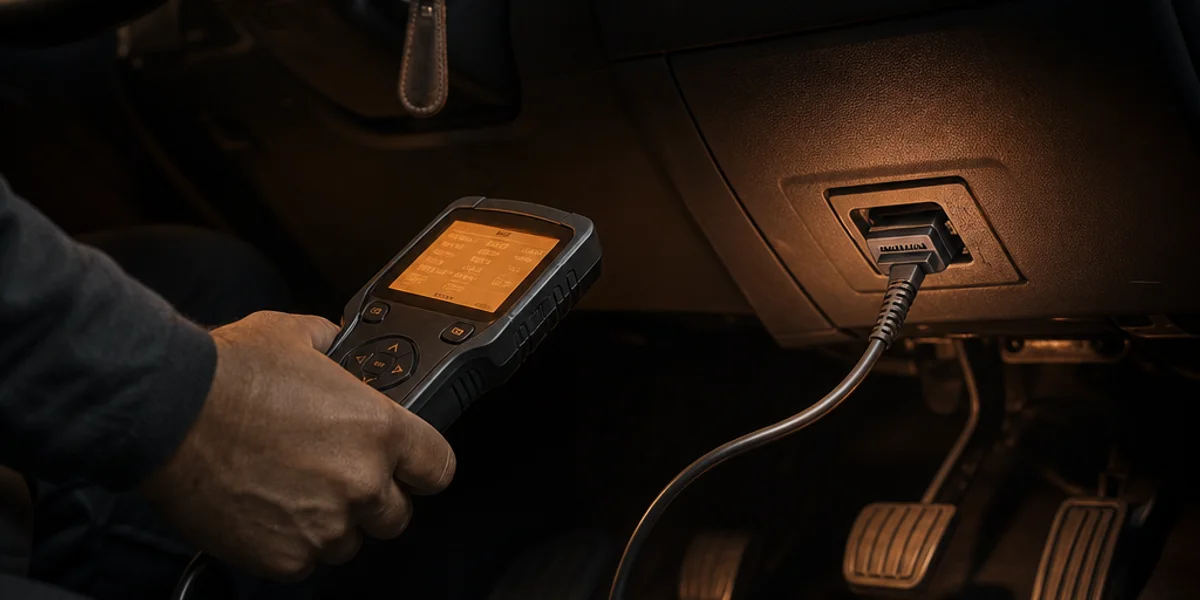
Key Takeaways
- The driver's footwell is a strong prior, not a certainty. SAE J1962 fixes the connector and requires tool-free access from the driver's seat, but does not specify a location.
- Five vehicles break the pattern badly: Vauxhall Corsa F and RHD Peugeot 208 in the glovebox, Peugeot 308 in the centre console, Vauxhall Insignia B under the headlight switch, Fiat Ducato behind two screws.
- Right-hand drive is not always a mirror image. The VW Golf MK7 changes access method entirely, and the Peugeot 208 moves to a different part of the car.
- VW Group is not one convention: roughly a third of VAG cars are behind a cover rather than open in the footwell.
- When there is no communication, check the fuse feeding the socket before anything else. On the Hyundai i30 it is the 7.5A MODULE 1 fuse in the same panel as the port.
Introduction
Every job starts the same way. You get to the vehicle, you open the driver's door, you crouch down, and you look for sixteen pins.
Most of the time you find them in ten seconds. Occasionally you spend five minutes on your knees with a torch, working through the lower dash by feel, before you discover the port is in the glovebox. On the other side of the car.
This guide covers where the OBD-II port actually sits across the makes you will meet on UK driveways, drawn from the Keysolved vehicle database rather than from a generic list. It leads with the ones that break the pattern, because those are the ones that cost you time. Every location quoted here is a database record for a specific generation, not a guess extrapolated from the model above or below it.
The rule, and what it actually guarantees
The 16-pin connector is standardised by SAE J1962, and EOBD became mandatory across Europe for new petrol cars from 2001 and diesels from 2004 under Directive 98/69/EC. The standard fixes the connector shape, the pinout and the requirement that the port be reachable from the driver's seat without tools.
What it does not fix is the location.
That is the whole problem. "Reachable from the driver's seat" is a wide specification. It permits the port to sit in the driver's footwell, behind a hinged flap, inside a storage cubby, under the centre console, or — as Stellantis has decided on more than one platform — inside the glovebox. All of those satisfy the regulation. Only one of them is where you will look first.
So treat the driver's footwell as the strong prior, not as a certainty, and know the exceptions before you go out.
The ones that are not in the footwell
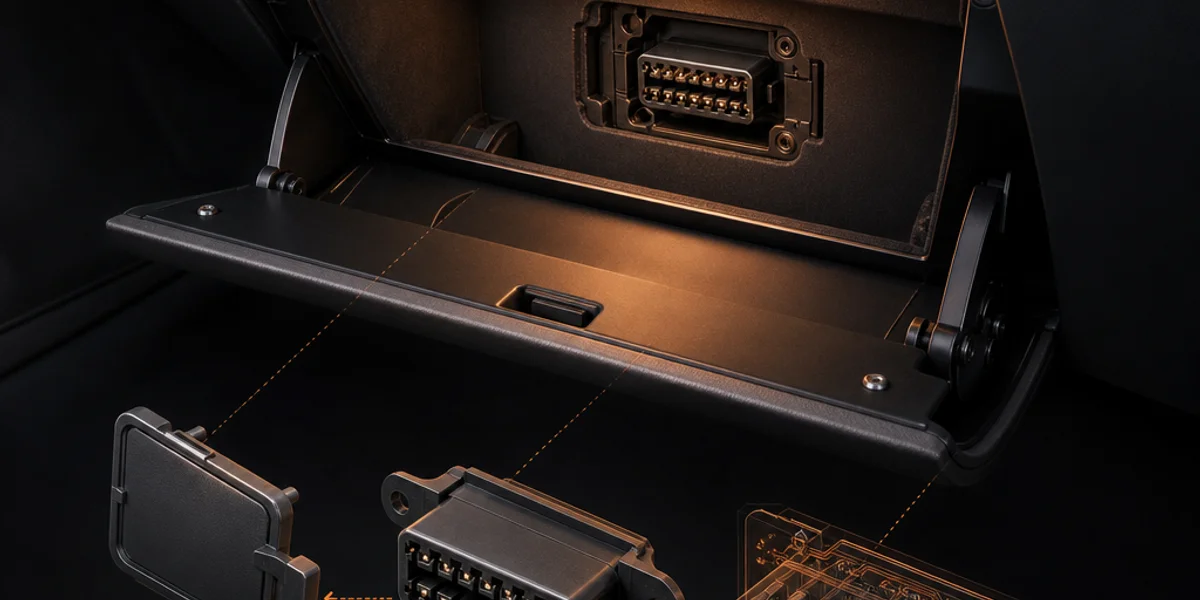
Learn these five. They account for most of the wasted minutes.
Vauxhall Corsa F (2019–2024) — glovebox
Open the glove compartment fully. There is a small protective cover on the inner face; remove it and the port is behind. This is a change from earlier Corsa generations, which put it under the driver's dash in the ordinary way. If you work on a Corsa E one week and a Corsa F the next, you will look in the wrong place.
Peugeot 208 (2019–2024) — glovebox, and only on RHD
This one is worth reading twice. On UK right-hand-drive cars, the port is behind an unclippable panel on the inner left wall of the glovebox. On left-hand-drive continental cars it is under the steering column, in the conventional place.
The database is explicit about why: the fuse box was not laterally mirrored when the car was built for right-hand drive, so the port moved rather than swapped sides. This is not a mirror image. It is a genuinely different location depending on which market the car was built for.
Both the 208 and the Corsa F sit on the Stellantis CMP platform. If you are looking at a recent Peugeot, Citroën or Vauxhall on CMP, check the glovebox before you get on the floor.
Peugeot 308 (2013–2021) — centre console
Not in the footwell at all. The port sits beneath the storage compartment that houses the 12V socket. Lift the rubber mat out of the base of the compartment, then unclip the surrounding panel frame and pull it towards you. The connector is underneath.
This is the only common car in the set where you must dismantle part of the interior to reach the port, and it is not visible at a glance under any circumstances.
Vauxhall Insignia B (2017–2022) — under the headlight switch
Below the headlight control switch there is a small storage compartment. Open the lid and the connector is inside. On RHD cars this puts it to the right of the steering column in the lower dash.
Fiat Ducato (2006–2024) — behind two screws
The only vehicle in the whole dataset that needs a tool. A small hinged cover to the left of the steering column, below the fuse box, secured with two crosshead screws. Remove both, open the panel, and the port is inside. On Type 290 vans from 2014 there may also be a rubber cap with a yellow centre over the connector itself.
Keep a short crosshead in the door pocket if you do commercial work. It is a ninety-second job if you have the driver, and an irritating one if you do not.
Right-hand drive is not always a mirror image
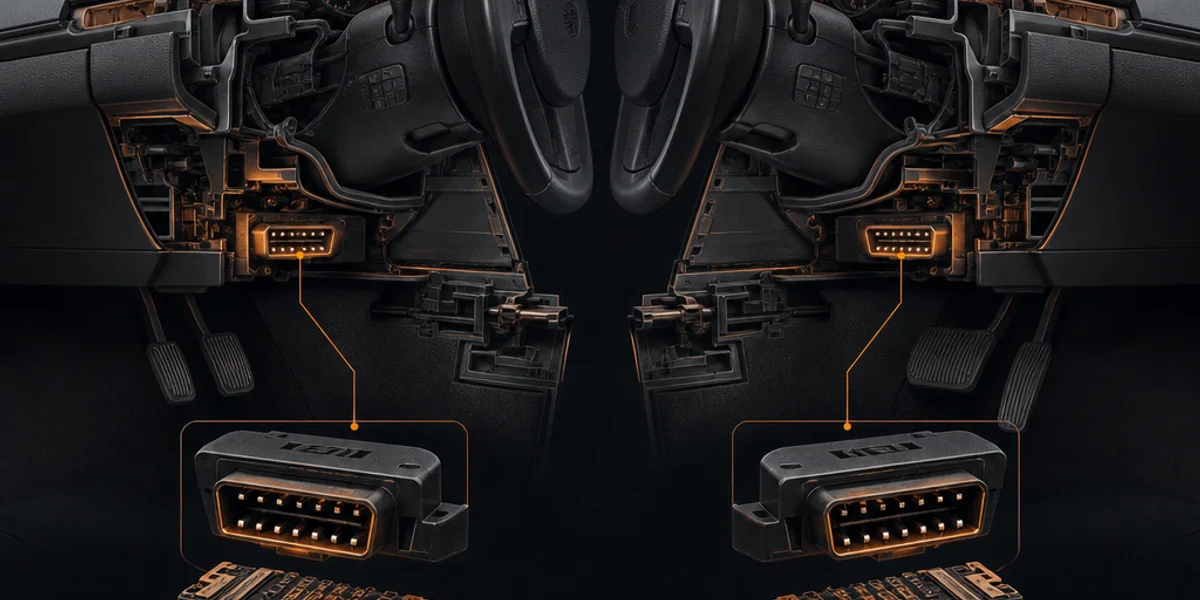
The instinct is to assume a RHD car puts the port in the mirrored position. Usually that holds. Three times in this dataset it does not, and those are the ones that catch people out.
Volkswagen Golf MK7 and MK7.5 (2012–2020). On LHD the port sits on the lower dash just left of the column behind a small clip-down cover. On RHD it sits behind the pull-down storage locker to the right of the column. Drop the locker flap and the connector is inside it. Different access method, not just a different side.
Peugeot 208. Covered above. Under the column on LHD, in the glovebox on RHD.
Fiat 500 (2007–2024). Snap out the trim panel below the steering column and the socket does not sit centrally in the opening. On LHD it sits towards the right-hand edge, towards the centre console. On RHD it moves to the left edge of the same opening, again towards the centre tunnel. Same panel, different corner. The connector is a distinctive yellow Fiat plug.
The Hyundai i30 entry makes the general point best: Hyundai prints separate left- and right-hand-drive illustrations of the panel, because it genuinely swaps sides with the driver rather than staying put.
Patterns by manufacturer
Ford splits by era and by body
Cars from roughly 2018 onward are open footwell with no cover. The Focus MK4 is left of the pedals above the footrest, visible without removing anything. The Kuga MK3 and Puma are the same.
Earlier cars and all commercials are behind something. The Fiesta MK8 has a small hinged plastic flap. The Fiesta MK7.5 has a pull-down storage cubby — swing it down and the white connector is behind it. The Transit Custom has a plastic panel about 10cm wide let into the bottom edge of the dash trim, usually moulded or labelled OBD.
One warning on the Transit V363: on 2019 facelift vans onward the connector is part of the secure CAN gateway module. Reaching the BCM through it needs a gateway-capable tool. Finding the port is the easy part on those.
Volkswagen Group is not one convention
This is the most useful finding in the dataset, and it contradicts what most locksmiths assume.
Open and uncovered: Golf MK8, Polo, Tiguan, Octavia MK3, Fabia MK3, Leon MK3, Audi A3 8V.
Covered, and you must open something: Golf MK7, Superb MK3, Ibiza MK5.
Do not assume that because it is a VAG car the port is sitting in the open footwell. Roughly a third of them are not.
Hyundai and Kia hide it, consistently
Almost every Hyundai and Kia in the set sits behind a removable plastic cover, usually shared with the cabin fuse panel. The i30 is the archetype: the lid is marked "Fuse/OBD", it grips off towards you by hand with no tools, and the connector is inside alongside the fuse rows.
That entry also carries the single most useful troubleshooting note in the database. The socket's own supply comes off the 7.5A MODULE 1 fuse in that same panel. If you get no power on pin 16 or a dead link, check that fuse before you blame the tool. It also feeds the hazard switch and the door modules, which gives you a fast way to confirm it.
The Kia Ceed works the same way — remove the lower plastic fuse box cover. The Picanto has a small cover that pulls off by hand, and the port is genuinely invisible until it is off.
Japanese makes hide it without covering it
Toyota, Honda and Nissan trend towards no cover but poor visibility. The recurring phrases in the database are "not visible at a glance", "requires crouching" and "faces downward".
The Honda Jazz is the extreme case: between the centre console and the steering column, above and left of the accelerator, and the database notes it is not mentioned in standard owner's handbooks at all. The Kia Sportage QL faces downward under the lower dash trim — crouch at the driver's door and look up and inward toward the column base.
Nothing to remove on these. You just need a torch and to know to look up rather than forward.
BMW, MINI and Land Rover are straightforward
All sit in the driver's footwell near the bonnet-release lever. The 1 Series F20 and MINI Hatch F56 have a clip-off cover. The 3 Series G20 has none. The 5 Series G30 may have a rubber dust flap.
Land Rover is the simplest make in the set. Range Rover L405, Evoque L551 and Discovery Sport are all exposed, beneath the steering column, no cover, no tools.
When the port is missing
Two entries in the database flag something worth knowing before you start doubting your equipment.
On the VW Transporter T6 and T6.1, many owners fit an aftermarket dummy OBD port cover or relocate the port entirely for security. If the standard location is empty, the port has probably been moved rather than removed.
The Ford Puma carries the same note, and the database points out why it is easy to do: the port is secured with only two bolts.
Both are commercial and near-commercial vehicles with a theft problem. If you are on a van and the footwell is bare, look for a relocated port before you conclude anything is faulty.
No communication: work through it in order
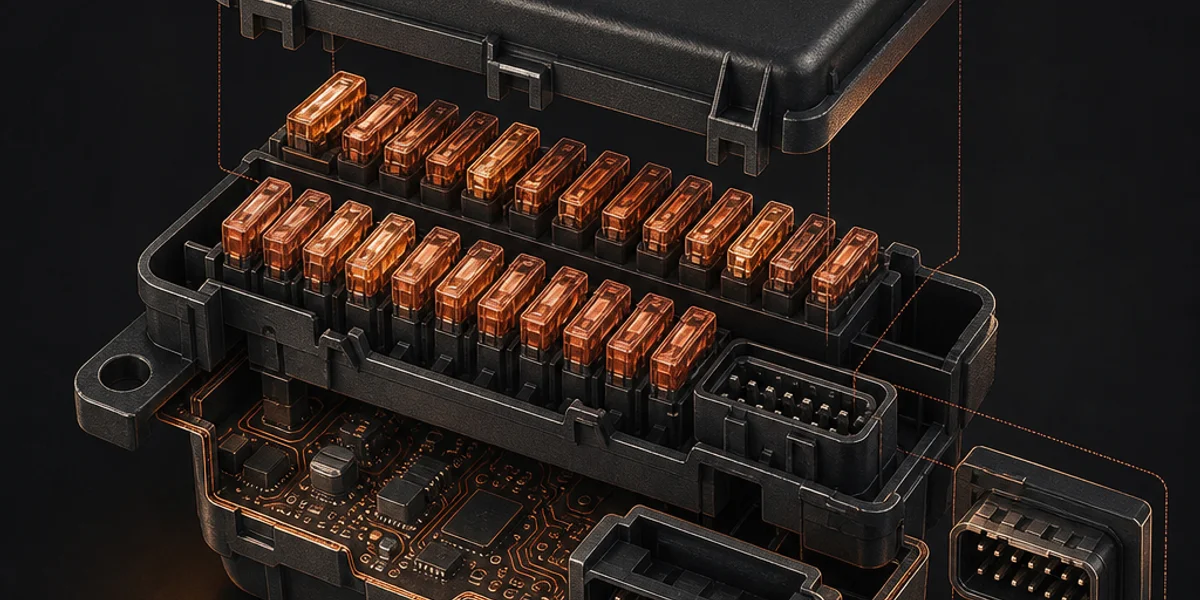
Finding the port and getting a link are different problems. When the tool connects to nothing:
- Check the fuse feeding the socket. On most vehicles pin 16 is fed from a dedicated fuse, often in the same panel as the port itself. On the Hyundai i30 it is the 7.5A MODULE 1 fuse. This is the single most common cause and takes thirty seconds.
- Confirm pin 16 has battery voltage and pins 4 and 5 are grounded. A cheap breakout is worth carrying. If there is no power at the socket the fault is upstream of anything your programmer can do.
- Check the port is the original. See the relocation note above.
- Check for a secure gateway. On 2019+ Transit V363 and most FCA and Stellantis products of a similar age, the connector is behind a gateway module. You will get power and pins but no module access without a gateway-capable tool or the correct security procedure.
- Try a different tool or cable. Bent or recessed pins in a well-used connector are common on high-mileage commercials.
- Then suspect the vehicle. A genuinely failed module is far down this list, not at the top of it.
Time: five minutes to work through steps one to four, and you will resolve most no-comms situations inside that.
Where the data is thin
Being straight about the limits is more useful than pretending to universal coverage.
Two vehicles in the database currently have an illustration but no written location: the Audi A4 B9 (2015–2024) and the Renault Trafic III (2014–2024). Do not rely on this guide for either.
Three entries carry confidence flags and should be verified on the first job rather than taken as settled: the Nissan Qashqai J12 (2021–2024) and Juke F16 (2019–2024), both flagged for review, and the Hyundai i20 BC3 (2020–2024), where the location is inferred from the preceding generation. The Kia Sportage QL record is asserted for US production; UK production is not separately confirmed.
The most significant gap for UK work is the Nissan Qashqai J11 (2014–2021) — the highest-volume Qashqai generation on British roads is not currently in the catalogue. Only the J10 and J12 are.
Generation matters more than model
The clearest lesson across all sixty-eight records is that the model name tells you very little on its own.
The Renault Clio is the cleanest example. The Clio V has the port in the driver's footwell, bottom-left of the column above the footrest, directly accessible. The Clio IV had it in the centre console under a flap. Same nameplate, completely different job.
The Corsa moved from under the driver's dash to the glovebox between E and F. Ford moved from covered to open around 2018. If you are working from memory of the last one you did, check the generation first.
Look the specific vehicle up on Keysolved before you set off. The port location, the access instructions, the LHD and RHD variants and the illustration are all there against the exact year range, alongside the key specs and tool compatibility for the same vehicle.
Frequently asked questions
Where is the OBD port on most cars?
In the driver's footwell, under the dashboard, within reach of the driver's seat. SAE J1962 requires it to be reachable without tools but does not specify a fixed position, which is why manufacturers place it anywhere from the open footwell to the glovebox.
Which cars have the OBD port in the glovebox?
In this dataset, the Vauxhall Corsa F (2019–2024) and the UK right-hand-drive Peugeot 208 (2019–2024), both on the Stellantis CMP platform. On the 208 this is RHD-specific — left-hand-drive cars have it under the steering column.
Does the OBD port move sides on right-hand-drive cars?
Usually it mirrors, but not always. The VW Golf MK7 changes access method entirely between LHD and RHD, the Peugeot 208 moves to the glovebox on RHD, and the Fiat 500 socket shifts to the opposite edge of the same opening. Hyundai publishes separate LHD and RHD illustrations because the panel genuinely swaps sides.
Why is there no communication when the tool is plugged in?
Most often a blown fuse on the socket's own supply. Check that first, then confirm battery voltage on pin 16 and grounds on pins 4 and 5. After that, consider a secure gateway module on 2019 and newer vans and Stellantis products, or a relocated aftermarket port.
Do I need tools to reach the OBD port?
Almost never. Of the sixty-eight vehicles in this dataset, only the Fiat Ducato requires a screwdriver — two crosshead screws on the cover. Everything else is either exposed or behind a cover that unclips by hand.
Why can I not find the port on a van?
Check whether it has been relocated. On the VW Transporter T6 and Ford Puma the database specifically notes owners fitting dummy covers or moving the port for anti-theft reasons. An empty standard location on a commercial vehicle usually means the port has moved, not failed.
Summary
Assume the driver's footwell, but know the exceptions: Corsa F and RHD 208 in the glovebox, 308 in the centre console, Insignia B under the headlight switch, Ducato behind two screws. Treat right-hand drive as usually-but-not-always mirrored. Expect Hyundai and Kia to be behind a cover, expect Japanese makes to be visible only with a torch, and do not assume VAG cars are uniform, because they are not.
When the link fails, work the fuse before you work the module.
Look up the specific vehicle and year range on Keysolved before the job — port location, access instructions, drive-side variants and the illustration, alongside the key specs and tool compatibility for the same record.
Full database access
Find Your Vehicle
Cancel anytime · Billed monthly
Look up the exact OBD port location, access instructions and illustration for any vehicle on Keysolved.
No card required to browse — subscribe to unlock full specs and procedures
Frequently Asked Questions
▶Where is the OBD port on most cars?
▶Which cars have the OBD port in the glovebox?
▶Does the OBD port move sides on right-hand-drive cars?
▶Why is there no communication when the tool is plugged in?
▶Do I need tools to reach the OBD port?
▶Why can I not find the port on a van?
Full database access
Check Tool Compatibility
Cancel anytime · Billed monthly
See which programming tools support the vehicle before you head to the job, including gateway-capable tools for 2019+ commercials.
No card required to browse — subscribe to unlock full specs and procedures
Sources
- SAE J1962: Diagnostic Connector(2016)— The standard defining the 16-pin OBD-II connector, its pinout and accessibility requirements
- Directive 98/69/EC - European Parliament and Council(1998)— The directive that made EOBD mandatory for new petrol vehicles from 2001 and diesels from 2004