
Transponder Key Chips: The Cross-Reference Chart for UK Locksmiths
Chip families, part numbers and cloning limits across Ford, VAG, Vauxhall, Toyota, BMW, Renault, Nissan and Mercedes
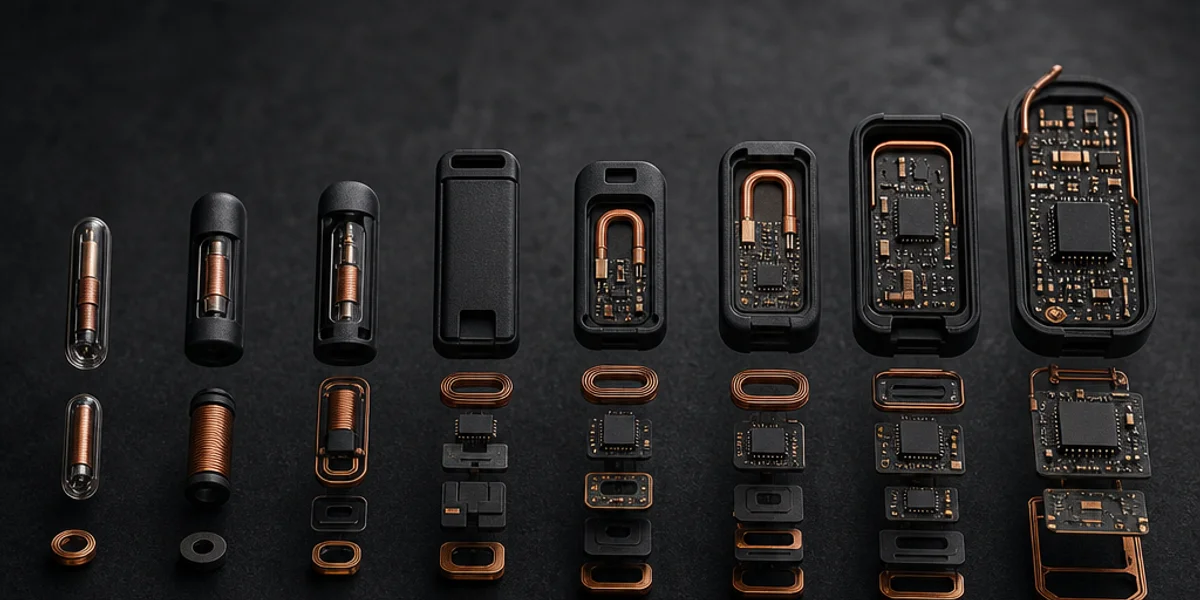
Key Takeaways
- The cryptography generation matters more than the part number — fixed-code, Megamos Crypto, Hitag 2 and early Texas DST chips can generally be cloned; Hitag AES, Hitag Pro and Texas DST AES cannot
- Part numbers are not interchangeable inside a family: a PCF7946 and a PCF7941 are both Hitag 2 and both ID46, but the Corsa D Delphi BCM only accepts the PCF7941
- Trim decides the chip more often than model year does — the RAV4 XA40 carries the G chip on lower trims and the H chip on keyless trims across the same production years
- The same chip family can mean opposite jobs: Hitag Pro is a beginner-level OBD add-key on a Ford Focus MK4 and a bench-only, dealer-for-AKL job on a Golf MK8
- Tool coverage moves against you as well as for you — Autel withdrew Renault all-keys-lost in January 2025 and blocks Toyota H-chip AKL on North America-registered devices
A customer hands you a key with a cracked head and asks for two spares. Before you cut anything, you need to know what sits inside that head, because the transponder chip decides everything that follows — whether you can clone it on the van in two minutes, whether the vehicle has to be present, whether you need a PIN, and whether this is a twenty-minute add-key or a bench job you should have quoted differently.
Most transponder key charts on the internet are scraped from key-blank catalogues. They give you a part number and stop. This one is built from the Keysolved vehicle database, which records the chip family per key variant per generation — so the Corsa D entry knows that the flip and straight remote housings share the same electronics, and the RAV4 entry knows that the G chip and the H chip live inside the same generation on different trims.
Bookmark it. You will come back to it.
What the transponder chip actually does
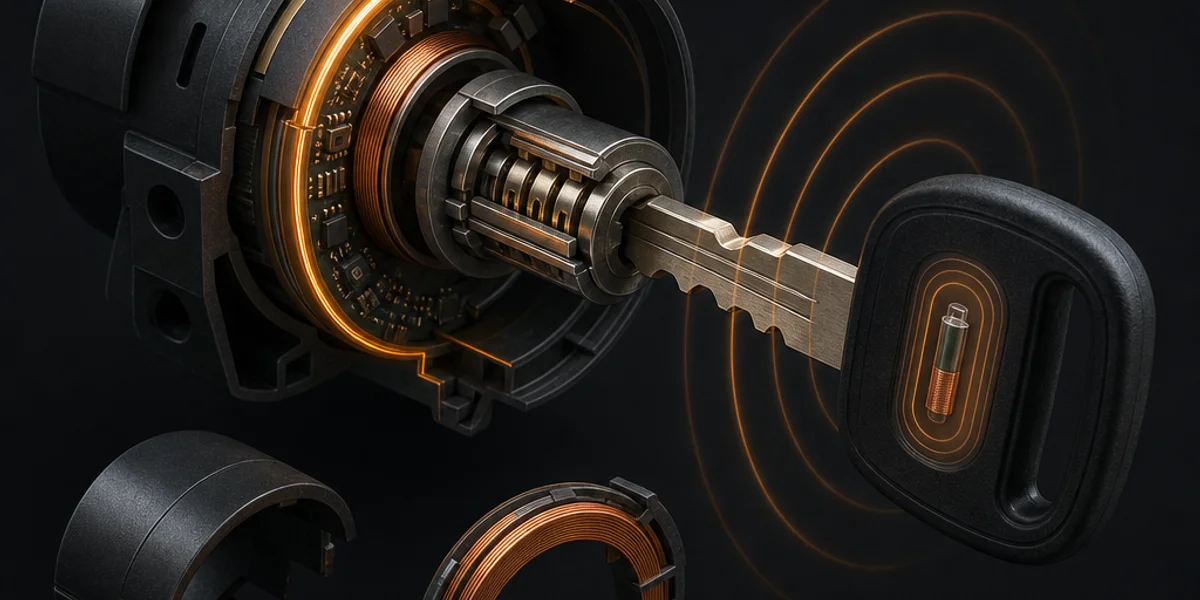
A transponder is a passive RFID tag with no battery. The coil around the ignition barrel — or the LF antenna in a keyless car — energises it, the chip answers, and the immobiliser module decides whether to release the fuel and ignition. The remote buttons are a separate radio system on a separate frequency and a separate battery. Those two systems fail independently, which is why a key that unlocks the doors but will not crank is almost always a transponder or immobiliser fault rather than a remote fault.
What matters commercially is not the part number but the cryptography generation, because that is what determines whether a chip can be copied or only enrolled:
- Fixed-code chips answer with the same value every time. They can be read and written onto a blank. Cloning works.
- Rolling-code and crypto chips run a challenge and response using a secret key that never leaves the chip. Some — Megamos Crypto, Hitag 2, the early Texas DST families — have been broken well enough that transponder-generation tools can produce a working copy. That capability came out of published academic work, not marketing: Megamos Crypto was dismantled at USENIX Security 2015 by Verdult, Garcia and Ege, who recovered the 96-bit secret key from two eavesdropped authentication traces, and Hitag 2 went the same way at USENIX Security 2012.
- AES-era chips — Hitag AES and Hitag Pro — do not clone. NXP describes the NCF29A1 as a single-chip immobiliser and passive keyless entry solution where "usage of AES effectively hampers key cloning vehicle theft". That is the marketing line, and on this occasion it is accurate. From roughly 2015 onwards, cloning stops being an option and everything becomes an enrolment job.
That single distinction is the spine of the chart below.
The five chip families you will actually meet
Fixed-code (pre-crypto)
Texas 4C and the early Philips fixed-code chips. No encryption, a static response. Found on late-1990s and early-2000s vehicles, and on a surprising number of base-trim cars into the mid-2000s. In the Keysolved record the Ford Focus MK1 (1998–2004) runs PATS 1 with a Texas 4C fixed-code, 40-bit transponder, PCM-based, with the antenna ring around the ignition barrel. Note what the record also says about that generation: there is no OBD key programming at all. Key learning needs two working keys and ignition cycling, or dealer-level access. A fixed-code chip is easy to copy and hard to enrol, which catches people out.
Megamos Crypto (ID48)
The VAG workhorse. The Golf MK5 (2003–2008) carries Megamos 48 on an HU66 blade, and the database is explicit about the part that actually costs you time: a 4-digit Security Key Code sits in the instrument cluster EEPROM, and the cluster variant decides your afternoon. VDO clusters give up the PIN over OBD quickly. Bosch RB8 clusters can take significantly longer, and if extraction fails you are removing the cluster and reading the EEPROM on a bench programmer. Cloning is available on this generation.
Hitag 2 (ID46)
The broadest family in the database by a distance, and the one most UK jobs land on. It spans manufacturers that share nothing else:
- Vauxhall Corsa D (2006–2014) — PCF7941, HU100, 433 MHz, Delphi BCM, 4-digit Car Pass code
- Vauxhall Astra G (1998–2004) — PCF7947, HU100, IMMO II, PIN read from the BCM
- Renault Clio III (2005–2012) — PCF7947 in the key, PCF7943 in the keycard, VA2 blade, UCH-managed
- Nissan Qashqai J10 (2006–2014) — PCF7946 in the remote head key, PCF7936 in the Intelligent Key, NSN14 blade, NATS
- BMW 3 Series E90 (2005–2012) — PCF7942 on CAS2, PCF7945 on CAS3 and CAS3+, PCF7953 on Comfort Access, all on HU92 at 868 MHz
- Hyundai i10 II (2013–2019) — BCM-based Hitag 2
BMW is the exception that proves the rule. The chip family is Hitag 2, but the architecture is not. Keys are written into a CAS key slot and are never cloned — the CAS module owns the list, and it is paired to the engine ECU by a shared Individual Serial Number. A key the CAS accepts still will not crank if the CAS and DME ISN do not match. That is the classic "cranks but will not start" on this platform, and no amount of chip work fixes it.
Texas DST (4D, G chip, H chip)
Toyota's lineage, and the clearest generational ladder in the dataset. The Corolla (2003–2008) record splits mid-generation: 2003–2004 cars have no immobiliser at all and take a plain cut key with no programming, while 2005–2008 cars run Toyota Type 2 with a TI 4D67 chip on a TOY44D blade and an immobox holding key data in a 93C56 EEPROM.
The RAV4 XA40 (2013–2018) is where the ladder matters most, because both rungs exist in the same model year on different trims. Lower trims take a remote head key with the G chip (TMS37157, Texas DST80) on a TOY40 blade. Keyless trims take the H chip / 8A (Texas DST AES) on a TOY2014 blade, with a 12-digit seed held in the PEPS ECU. The 80-bit DST80 cipher was published and analysed by KU Leuven and Birmingham researchers in 2020, covering Toyota, Kia, Hyundai and Tesla — which is precisely why aftermarket coverage of G-chip vehicles is mature and H-chip coverage is not.
Hitag AES and Hitag Pro (ID4A, ID49)
The current generation, and the end of cloning. The Ford Focus MK4 (2018–2024) uses Hitag Pro throughout — PCF7953 in the smart key, PCF7945 in the flip — and the database notes there is no chip family change mid-generation, no PIN and no ETIS incode required, because the BCM hands the security data to the tool over OBD. That is a genuinely easy job.
The Vauxhall Corsa F (2019–2024) is Hitag AES ID4A on the Stellantis BSI platform: NCF2960M in the flip, NCF29A1M in the smart key, a 128-bit AES rolling challenge between BSI and engine ECU on every ignition cycle, and a 4-digit BSI PIN read over OBD.
And then the two that pay differently. The Golf MK8 (2020–2024) runs MQB49 IMMO 5D with SFD active from launch; add-key requires reading synchronisation data off the original key PCB on the bench, and all-keys-lost is effectively dealer-only with standard aftermarket tooling as of early 2026. The Mercedes C-Class W205 (2014–2021) is FBS4, where the EIS is deliberately locked against being read over OBD and the security data lives on Mercedes' servers in Germany. There is no PIN to extract. Anyone telling you otherwise is selling something.
The cross-reference chart
| Chip family | Typical part numbers | Where you will meet it | Clones? | The thing that catches people |
|---|---|---|---|---|
| Fixed-code (Texas 4C) | 4C | Ford PATS 1, early 2000s base trims | Yes | Easy to copy, very hard to enrol — no OBD path on PATS 1 |
| Texas 4D (DST40) | 4D67, 4D63 | Toyota Type 2 2005–2008, Ford PATS 2 | Yes | All-keys-lost needs immobox EEPROM work, not OBD |
| Megamos Crypto | ID48 | VAG IMMO 3, Golf MK5 era | Yes | Cluster type decides the PIN read; Bosch RB8 may go to the bench |
| Hitag 2 | PCF7936, PCF7941, PCF7942, PCF7945, PCF7946, PCF7947 | Vauxhall, Renault, Nissan, Hyundai, BMW CAS | Usually | Part numbers are not interchangeable within the family |
| Texas DST80 (G chip) | TMS37157 | Toyota and Lexus 2010s non-keyless trims | Yes | Same model year as the H chip — check the trim, not the badge |
| Texas DST AES (H chip / 8A) | 8A | Toyota keyless trims 2013 onwards | No | All-keys-lost needs a PEPS bypass cable |
| Hitag AES | NCF2960M, NCF29A1M, PCF7961 | Stellantis BSI, PSA-era Vauxhall, early W205 | No | Enrolment only — plan the job around PIN access |
| Hitag Pro | PCF7945, PCF7953, NCF2951, NCF29A1 | Ford MK4 onwards, VAG MQB, late W205 | No | Some are trivial (Ford), some are dealer-only (MQB49) |
The chip family tells you what class of job you are in. It does not tell you the answer for a specific car — for that, look the vehicle up.
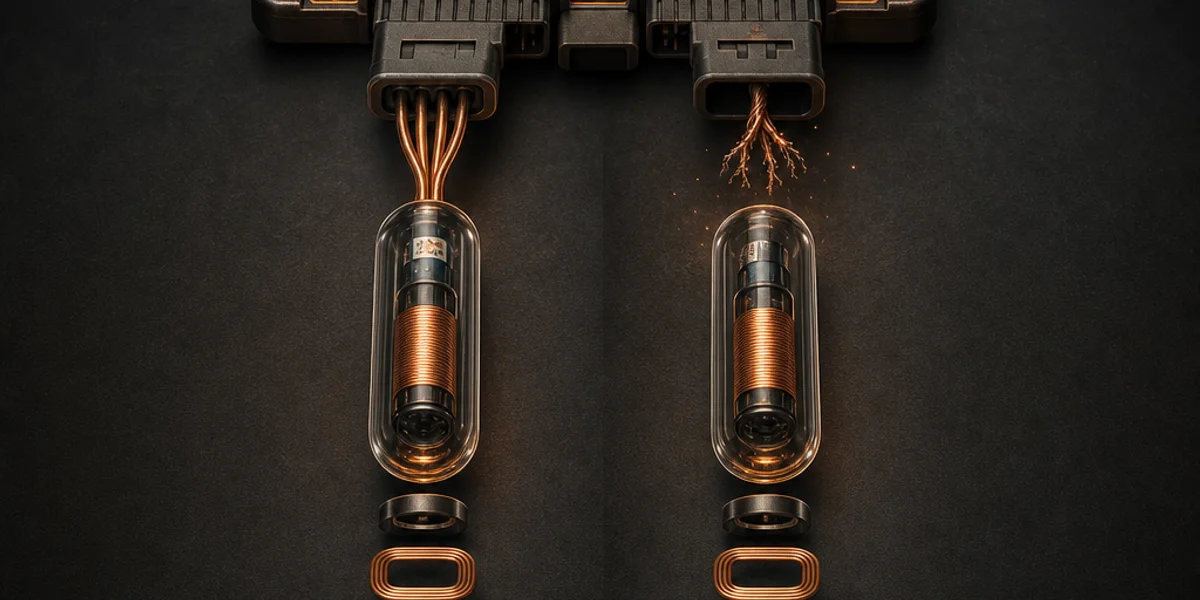
Cloning versus programming: how to decide on the doorstep
Cloning copies an existing working key onto a blank. The vehicle does not need to learn anything, so no PIN, no ignition cycling, no key-slot limit. Programming enrols a new key into the immobiliser module, which needs the vehicle, usually needs a PIN, and on some platforms consumes a finite key slot.
Cloning is faster and cheaper. It is also unavailable on most of what has been sold since about 2015, and it has a hidden cost: a cloned key is invisible to the vehicle, so if the customer later loses a key you cannot erase it from the module, because as far as the module is concerned it never existed.
- Identify the chip family from the chart above, or from the vehicle record.
- If the family is AES-era — Hitag AES, Hitag Pro, DST AES — stop. Cloning is not available. Quote an enrolment job.
- If the family is Hitag 2, Megamos or DST40, check whether the vehicle record flags cloning as available. Several do not, for architectural reasons rather than chip reasons.
- Confirm you have a working key. No working key means no clone, whatever the chip.
- Check the key-slot count if you are enrolling. The Golf MK5 record notes up to 8 slots; a Mercedes EIS holds up to 8. A car that has collected keys over twenty years can be full.
- Quote before you cut.
- Time: 3–5 minutes if you have the vehicle record open. Considerably longer if you are guessing on the driveway.
Identifying an unknown chip on the job
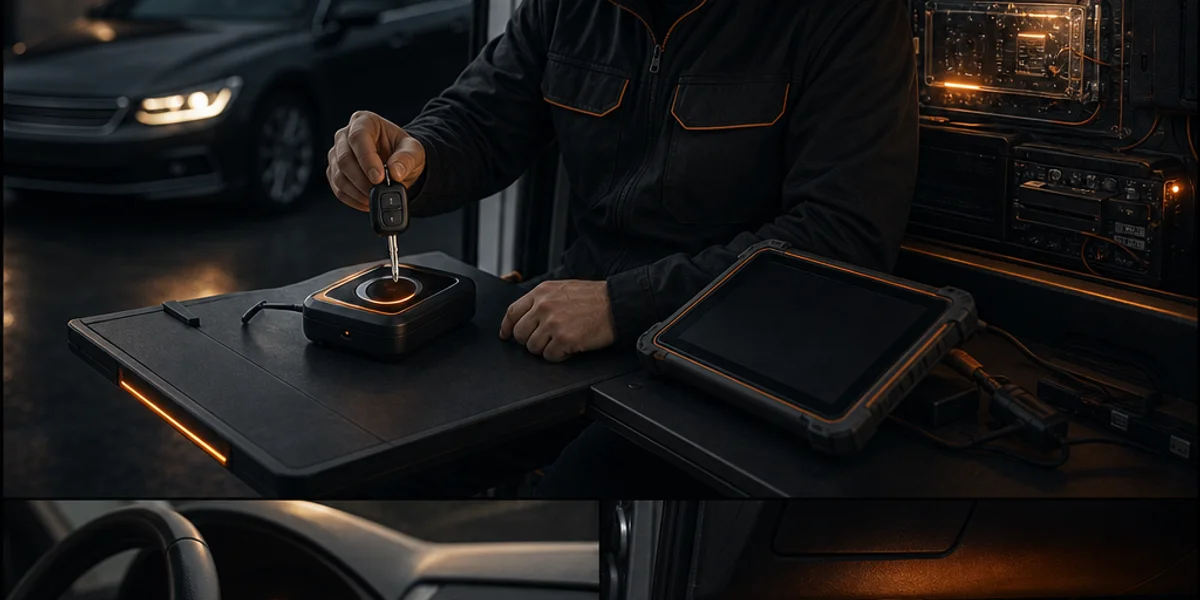
You will not always have a donor key to read. This is the order that wastes the least time.
- Confirm the vehicle properly — VIN plate, not the customer's description of the model year. Facelifts move chip families mid-generation more often than model names suggest.
- Establish the trim, not just the model. The RAV4 XA40 is the standing example: G chip on lower trims and H chip on keyless trims within the same years, on different blades.
- Check the blade profile. Blade and chip correlate strongly within a make. HU100 on a Vauxhall points at Hitag 2; HU83 points at the PSA-era platform and Hitag AES. Blade profile alone is not proof, but it is a fast sanity check.
- Read the existing key if there is one, with a transponder reader or the read function on your programmer. This is the only method that gives you certainty.
- Check the immobiliser architecture, not just the chip. Two vehicles with the same chip can need completely different jobs. Hitag 2 on a Corsa D is a beginner-level OBD add-key. Hitag 2 on an encrypted CAS3+ BMW is a bench read.
- Confirm PIN availability before you order the key. The database records the security-code source per vehicle — Car Pass on Vauxhall, cluster EEPROM on VAG IMMO 3, BCM sticker on Nissan NATS, and nothing at all on Mercedes FBS4.
- Time: 10–15 minutes on an unfamiliar vehicle, most of it in step 4 and step 6.
As with any all-keys-lost or immobiliser work, do the ownership checks first — V5C, customer identification and a record of both, before a tool goes near the OBD port. Chip identification is the second question. Authorisation is the first.
Common pitfalls
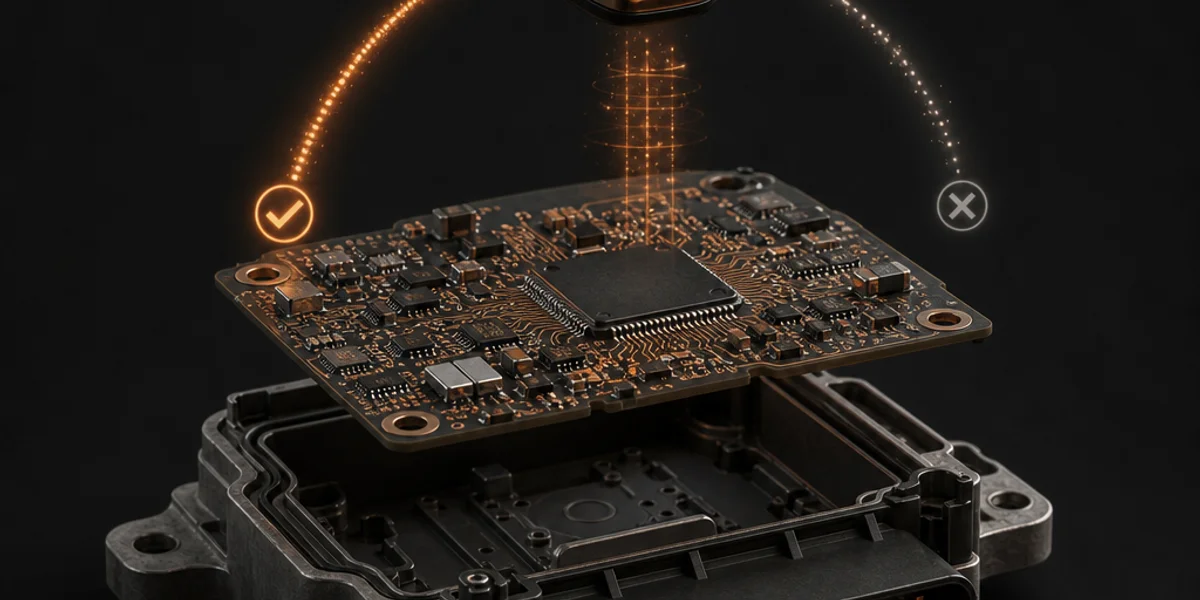
Assuming part numbers within a family are interchangeable. They are not. The Keysolved record for the Corsa D is blunt about it: Xhorse VVDI clone remotes carrying a PCF7946 chip do not work with the Delphi BCM, and the job needs an OEM or aftermarket key with a genuine PCF7941. Both chips are Hitag 2. Both are ID46. One works and one does not, and you will not find that out until the key is cut and the transponder will not enrol.
Ignoring sub-variants within a single model year. The same Corsa D record notes ISN variants by chassis number range, so a pre-coded key ordered against the wrong range is a wasted key. Check the chassis number before ordering, not after.
Treating a chip family as a coverage guarantee. Tool coverage tracks the immobiliser architecture, not the transponder. The Golf MK8 and the Ford Focus MK4 both run Hitag Pro. One is a beginner-level OBD add-key. The other requires bench access to the original key PCB and has no aftermarket all-keys-lost path at all.
Missing an all-keys-present relearn requirement. A locksmith working a Hyundai i10 II recorded in the community tips that add-key on that vehicle requires all keys present for the relearn — so if the customer has left the second key at home, the job stops. The same tip notes that a 2014 i10 needed a short blade with a rounded tip, and gives the genuine blade part number as 81996 1S001. That is the sort of detail that only comes from someone who has done it.
Assuming tool coverage is stable. It is not, and it moves against you as often as for you. The database records that Autel removed all-keys-lost for Renault in January 2025, leaving add-key only, and that Autel all-keys-lost on Toyota H-chip vehicles is blocked for North America-registered devices at Toyota's request. Coverage you had last year is not coverage you have today. Check before you drive out.
Locking out the immobiliser with repeated PIN attempts. On Nissan NATS, entering the PIN incorrectly enough times puts the system into dead-lock mode with DTC P1610, and the recorded recovery is disconnecting the battery for 30 minutes. That is half an hour of standing in someone's driveway for a mistake that a PIN read would have avoided.
FAQ
What transponder chip is in my car key?
It depends on the make, generation and often the trim rather than the model alone. The five families you will meet in the UK are fixed-code Texas 4C, Megamos Crypto ID48, Hitag 2 ID46, the Texas DST series (4D, G chip, H chip) and the AES-era Hitag AES and Hitag Pro chips. Look the specific vehicle up rather than working from the model name, because chip families change mid-generation and across trims.
Can every transponder key be cloned?
No. Fixed-code, Megamos Crypto, Hitag 2 and the earlier Texas DST chips can generally be cloned with a transponder-generation tool. Hitag AES, Hitag Pro and Texas DST AES chips — broadly, most vehicles from around 2015 onwards — cannot. Those require enrolment into the immobiliser with the vehicle present.
What is the difference between cloning and programming a car key?
Cloning copies an existing working key onto a blank, so the vehicle learns nothing and no PIN is needed. Programming enrols a new key into the immobiliser module, which needs the vehicle, usually needs a security code, and may consume a limited key slot. Cloning is faster; programming is the only option on modern vehicles and leaves a key the module can later erase.
Is ID46 the same as Hitag 2?
In everyday trade use, yes — ID46 is the common shorthand for the Hitag 2 crypto transponder family. What it does not tell you is the part number, and within Hitag 2 the part numbers are not interchangeable. A PCF7941 and a PCF7946 are both ID46 and will not necessarily substitute for one another on the same vehicle.
Why will my newly programmed key unlock the car but not start it?
The remote and the transponder are separate systems. Unlocking proves the radio side works. Failing to start means the immobiliser has not accepted the transponder — or, on BMW CAS platforms, that the CAS and engine ECU serial numbers do not match, which is a module pairing problem rather than a key problem.
Where to look it up
The chip family gets you into the right class of job. It does not get you the answer for the car on the drive, because the thing that decides your afternoon is usually the immobiliser architecture, the security-code source and the tool coverage on that specific generation — and all three move.
That is what the database is for. Every vehicle record carries the chip family per key variant, the blade profile, the frequency, the security-code source, the OBD port location and the per-tool notes with the caveats attached. If you are working somewhere new, look the vehicle up before you order the key rather than after.
Related reading: the transponder key programming beginners guide covers the fundamentals if you are new to immobiliser work, the OBD port location guide covers finding the port on any UK make, and the Ford key programming guide works the PATS generations through in full.
Full database access
Check the Chip Before You Cut
Cancel anytime · Billed monthly
Look up the exact transponder family, part number, blade profile and security-code source for any vehicle in the Keysolved database.
No card required to browse — subscribe to unlock full specs and procedures
Frequently Asked Questions
▶What transponder chip is in my car key?
▶Can every transponder key be cloned?
▶What is the difference between cloning and programming a car key?
▶Is ID46 the same as Hitag 2?
▶Why will my newly programmed key unlock the car but not start it?
Full database access
Stop Guessing on the Driveway
Cancel anytime · Billed monthly
Key specs, programming procedures, OBD port locations and honest per-tool compatibility notes across 62 makes — written for working auto locksmiths.
No card required to browse — subscribe to unlock full specs and procedures
Sources
- Dismantling Megamos Crypto: Wirelessly Lockpicking a Vehicle Immobilizer(2015)— Verdult, Garcia and Ege recover the 96-bit Megamos Crypto key from two eavesdropped authentication traces. USENIX Security Symposium.
- Gone in 360 Seconds: Hijacking with Hitag2(2012)— Verdult, Garcia and Balasch on the cryptanalysis of the Hitag 2 immobiliser transponder. USENIX Security Symposium.
- Dismantling DST80-based Immobiliser Systems(2020)— Wouters et al. publish the proprietary Texas Instruments DST80 cipher and analyse immobiliser key management on Toyota, Kia, Hyundai and Tesla. IACR TCHES.
- NCF29A1 — Tiny Single Chip Passive Keyless Entry/Go Solution(2026)— NXP product documentation for the Hitag AES/Pro generation transponder used across Stellantis, VAG MQB and late Mercedes W205 keys.