
Van Key Programming: The Cross-Make Guide for UK Locksmiths
Transit to Ducato — chips, blades, security models, OBD port traps and honest job times across the UK van parc
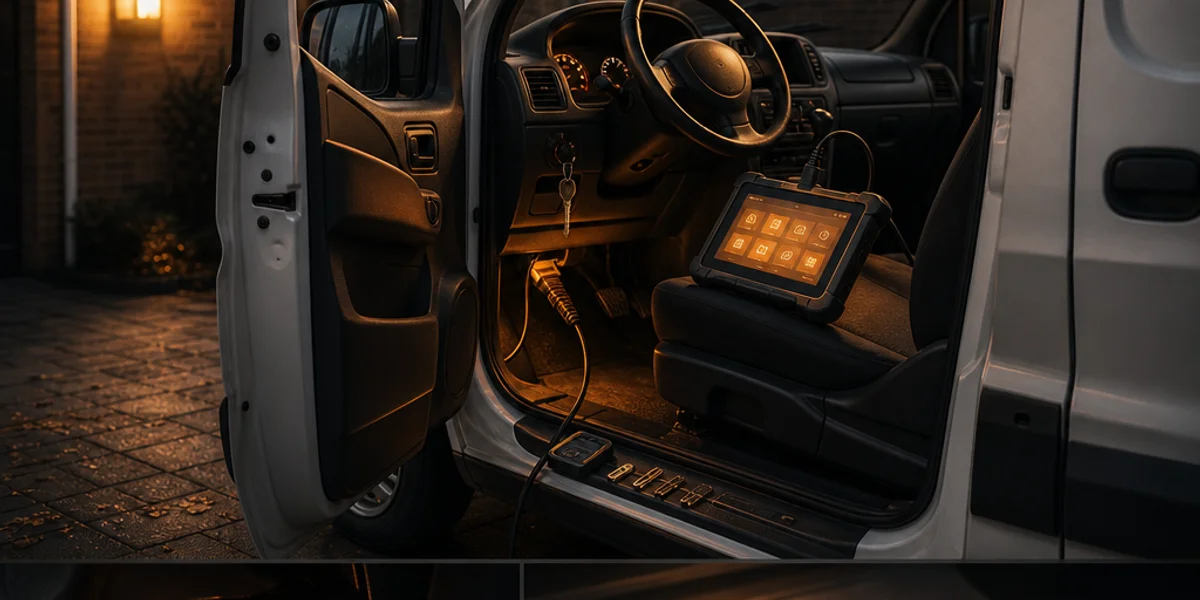
Key Takeaways
- On right-hand-drive Nissan Interstar, first-generation VW Crafter, Iveco Daily and 2021-on Fiat Ducato vans the OBD socket sits on the passenger side — the dashboard moulding does not mirror for RHD
- An armed factory alarm makes the Ford body control module refuse the diagnostic session outright, so on a lost-key van silencing the alarm is the job rather than a step before it
- Two vans wearing the same badge are routinely two different architectures: the 2014-2019 Vivaro is a Renault Trafic III, the 2019-2024 is a PSA EMP2 van, and VIN characters four to six separate the two Crafters
- Battery support is not optional on van work — several vans report low voltage as a communication fault, and losing volts mid-procedure on a Vivaro X82 can corrupt the UCH
- The key-learn rewrites the whole key table on most vans here, so every key the customer wants to keep must be in your hand before you start
Van key programming is the half of this trade nobody writes a guide for. Every make guide treats the commercial vehicle as a footnote to the car it shares a badge with, and on the driveway that assumption falls apart within about four minutes — usually while you are lying across a passenger seat looking for a diagnostic socket that is not where the forum said it would be.
The vehicles are not the problem. A Transit Custom and a Focus run the same Ford PATS architecture, the same HU101 blade and in several years the same Hitag Pro transponder. What changes is everything around the key: who actually owns the van, whether the factory alarm will let you open a diagnostic session at all, what a fleet fitter has already plugged into the OBD socket, and what every hour off the road costs the customer. Those four things decide whether a van job runs to time.
This is a cross-make reference for the UK van parc — the Transit family, the Transporter and Crafter, both generations of Vivaro, the Master and its Interstar twin, the Sprinter and the Ducato. Every chip type, blade profile, security model and tool caveat below comes from the Keysolved vehicle database. Where the database holds no figure, that is said plainly rather than filled in.
Why a van is not simply a larger car
Four differences matter commercially, and only one of them is electronic.
Ownership is rarely simple. A van is frequently on contract hire, owned by a limited company whose director is on another site, or a sub-contractor's vehicle insured through a main contractor. The V5C may well name a leasing company. Establish who is authorising the work before you travel and get it in writing, because the keeper on the V5C and the person in front of you are often two different parties.
The van is the customer's income. UK tool theft figures from Freedom of Information requests to police forces show 25,525 tool thefts reported in the twelve months to 31 December 2024, of which 12,414 were van-related, at an average cost of £1,565 in tools and a further £623 in lost income per incident. That second figure is the one to keep in mind when you quote. A van customer will pay for speed in a way a car customer will not.
The factory alarm is a live participant. On several vans below, an armed alarm causes the body control module to refuse the diagnostic session outright. You scan the module perfectly, then get no communication the instant you ask to erase or add a key. On a lost-key van, dealing with the alarm frequently is the job.
Somebody has already been in the OBD socket. The Keysolved record for the second-generation Crafter puts it bluntly: expect a tracker or tachograph piggyback lead already in the socket, and unplug it rather than doubling up, because a second device chattering on the bus will drop a key-learning session.
The OBD port is not where the car was
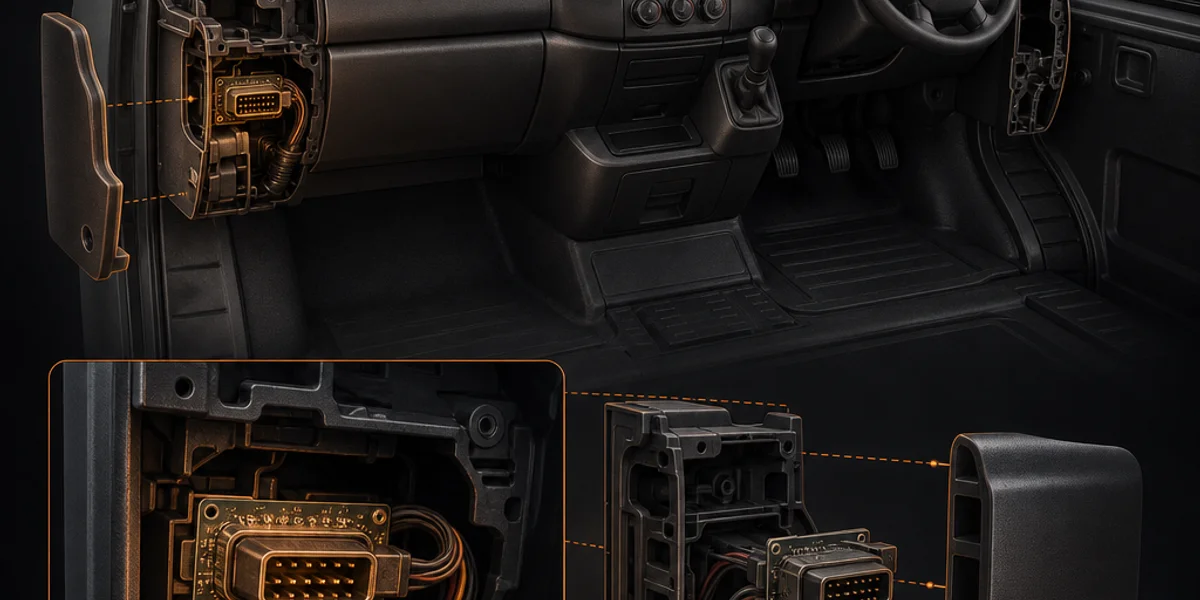 On several UK vans the diagnostic socket stays on the vehicle's left regardless of which side the steering wheel is on.
On a meaningful number of UK vans the diagnostic socket does not sit under the driver's column, and on right-hand-drive vehicles it does not always mirror across from the left-hand-drive layout. The dashboard moulding is shared across the whole body range, so the socket stays where the factory put it.
| Van | Where the socket actually is |
|---|---|
| Nissan Interstar 2022-2024 | RHD: passenger side. Low at the outboard end of the dash, behind the pull-off end panel by the passenger door aperture. Work from outside the cab |
| VW Crafter 2006-2016 | RHD: nearside footwell, bottom of the left A-pillar. It does not mirror — the electrics stay on the vehicle's left whichever side the wheel is on |
| Iveco Daily 2014-2024 | Left-hand end of the dash in both drives. On a UK Daily that is the nearside, in the passenger footwell |
| Fiat Ducato 2021-2025 | RHD: inside the dash fusebox compartment, which follows the cubby across to the passenger side |
| VW Crafter 2017-2024 | Driver's side, above the pedals — the opposite of the van it replaced. If you plug in on the driver's side and find nothing, check whether you are standing at a 2E |
| Ford Transit 2014-2024 | Driver's footwell behind the lower dash trim, own flap marked OBD. Motorhome conversions sometimes trim over it |
Two further warnings. On the VW Transporter T6, dummy and relocated sockets are common on UK vans as a theft deterrent — a socket with 12 V present but no CAN on pins 6 and 14 is a dummy, and the live one is usually spliced into the loom further up behind the lower footwell panel. And a Ducato registered around 2002 can still be the outgoing Type 230, which has no under-dash 16-pin socket at all and uses a three-pin plug under the bonnet. Check the chassis marking reads ZFA 244 before you quote an under-dash job.
The full make-by-make breakdown lives in the OBD port location guide.
Ford Transit family
Ford is the van you will see most, and the Transit family splits into three distinct jobs rather than one.
Transit Custom 2012-2023 (V362). PATS 5, with the Body Control Module owning immobiliser authentication rather than the cluster. The split is at May 2016: before it, a Texas DST80 TMS37157 on a sealed rechargeable cell that does not open for a battery change; after it, Hitag Pro on a normal CR2032. Both are HU101. The security model is a handshake, not a code — no PIN is typed in and nothing readable is stored in the van. Trade tools with current Ford Europe software take security access in seconds; software without it falls back to Ford's timed route and a ten-minute wait.
- Add key, working key present: 20–30 minutes including cut and test
- All keys lost, alarm not live: 60–90 minutes
- All keys lost, alarm live: budget half a day or decline it
Transit 2014-2024 (V363). Same PATS-in-the-BCM architecture across seven recorded key variants: TMS37157 DST80 to May 2016, PCF7945 Hitag Pro to 2021, then a later BCM on an RH850 processor from roughly 2021-22 and on every E-Transit. One detail for the key cabinet — very late vans moved to the HU198 internal-cut profile, so check the blade before you cut. A bladed-key BCM holds eight keys and will not complete an erase cycle until at least two are programmed, so turn up with one blank on a lost-key job and you have not finished.
Security access is the clock: 1–5 minutes online, the ten-minute timed route on older software, and 10–20 minutes uninterrupted for the server-authenticated all-keys-lost on the Hitag Pro vans. Do not drop the tool, the ignition or the internet while it runs.
Transit Connect 2013-2022 (V408). The easy one, and the only van here with a genuine on-board relearn. With two programmed keys present, the Phase 1 van takes a third with no tool: first key to RUN for three seconds, off, second key within ten seconds to RUN for three seconds, off, then the new key within twenty seconds held at RUN for six seconds until the security light confirms. Phase 2 vans on Hitag Pro cannot use it — those are OBD only. The database flags genuine uncertainty about when that transition happened, with the 2018-19 facelift the likeliest point, so read the customer's key on the bench rather than trusting the registration year.
- Phase 1 add key, two working keys: 10 minutes, no tool
- Phase 1 all keys lost: 45–60 minutes, two keys minimum
- Phase 2 all keys lost: 60–90 minutes, bypass cable if the alarm is active
One hard warning on Phase 2 from the record: ID49 Hitag Pro keys are bricked once programmed. Do not programme one to the wrong vehicle.
More on the wider Ford range sits in the Ford key programming guide.
Volkswagen Transporter and Crafter
These are two completely unrelated jobs that share a badge, and the Crafter is two unrelated jobs on its own.
Transporter T6 2015-2019. The instrument cluster is the immobiliser — control unit J334 exists only as a virtual unit inside the dash panel insert, which is why it answers on address 25 behind the cluster at address 17. The PIN and six component security bytes come out of the cluster over OBD with a working key, or out of the EDC17 engine ECU. The remote is a separate job in the body control module at address 09, which is why a key can start the van perfectly while the buttons do nothing.
The identification trap is the one that costs money. Volkswagen moved the Transporter from Megamos Crypto ID48 to Megamos AES during 2016 and both are on the road on 2016 plates, so a 66-plate van can be either. Read the part number in the key's blade slot: AD, Q or AJ is Megamos Crypto, BH, DH, BD or BK is the AES key. A plain Megamos 48, a glass ID48 and an Xhorse XT27A are all refused on the AES vans.
- Add key: 45–60 minutes including the separate remote adaptation at address 09
- All keys lost: bench work on the 24C64 EEPROM, half a day
Two notes that will save a job. Back up the ABS coding before an all-keys-lost, because the procedure routinely wipes it. And after the service-mode write-back the dash goes dark — do not reset the instrument yet, read and save the immo data first, because resetting before you have it is the classic way to lose the job and start again. Clusters running software 2050 or later cannot be read by any aftermarket tool at all: no service mode, no immo read, no route.
Crafter 2006-2016 (2E/2F). The Mercedes-built van, where nothing is Volkswagen apart from the badge and the protocol. Drive authorisation sits in the electronic ignition lock — the EZS — which also acts as the gateway between the drive, convenience and diagnostic buses. There is no separate VAG gateway module, which is exactly why generic VW auto-detect fails and the tool has to be pointed at Crafter or LT3 by hand. The immobiliser answers on address 93, the remote side of the same physical module on 9A.
Blade is HU64, ten cuts, five depths, code series 1-6700. Chip is Megamos Crypto ID48. The key-presentation timing is tight and worth rehearsing: the immobiliser lamp lights for about two seconds and goes out, and you have roughly a minute for the whole set, so line the keys up on the seat before you save.
- Add key: 45–60 minutes, battery on a stabiliser at 12.5 V or better throughout
- All keys lost, van still wakes: 90 minutes
- All keys lost, van dead: bench read of a secured Motorola 9S12, half a day minimum
Crafter 2017-2024 (SY/SZ). The MQB van. Characters four to six of the VIN are the decider: 2E or 2F is the old Mercedes-built van, SY or SZ is this one. The old van's key is a Mercedes-style narrow-track blade; this one is the chunky two-track MQB HU162T. The 2017-2019 vans run Megamos AES on NCF29A1 and have a documented bench route for all keys lost. The 2020-on vans move to NCF2951 Hitag Pro, take their immobiliser data out of the customer's existing key rather than out of the van, and have no confirmed aftermarket lost-key route at all. Price that accordingly and tell the customer at the quoting stage.
There is one free trick on this van: open the bonnet before you plug in, which deactivates the diagnostic filter. On 2019-on builds you can confirm it at the gateway on address 19.
The rest of the VAG range is covered in the Volkswagen key programming guide.
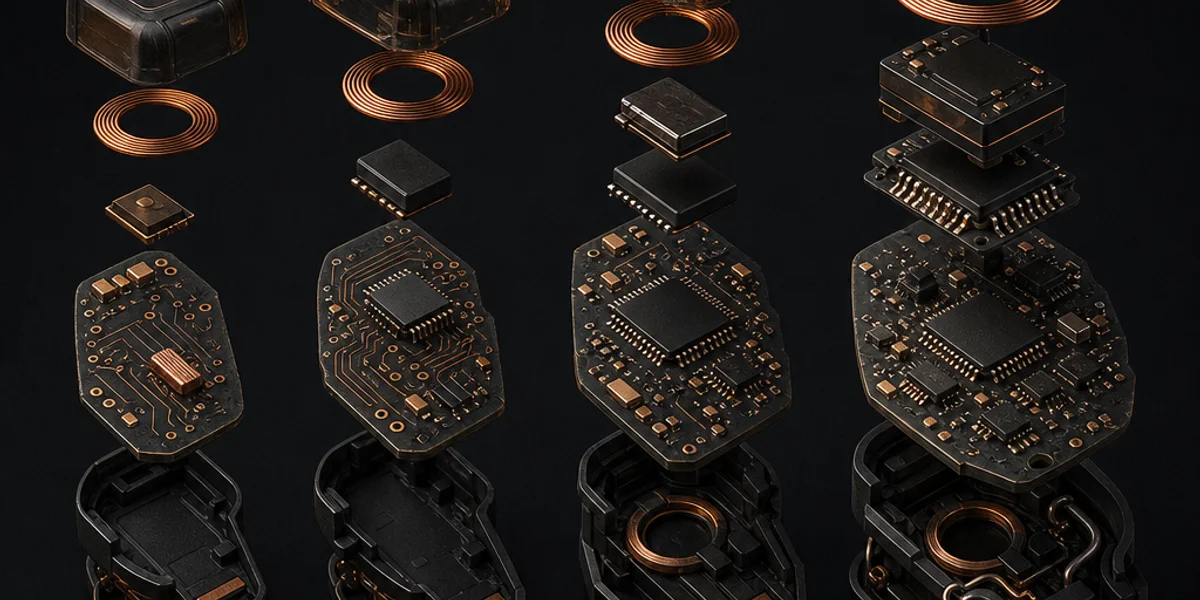 Four transponder families cover the entire UK van parc, and the wrong blank fails at the write rather than at the counter.
Vauxhall Vivaro — two vans, two architectures
The badge is continuous and the engineering is not, and getting this wrong wastes an entire visit.
Vivaro 2014-2019 (X82). This is a rebadged Renault Trafic III and uses Renault UCH architecture throughout, not GM or Delphi BCM architecture. Single chip across the whole production run — PCF7961M Hitag AES on a VA6 blade, CR2016 cell, with no chip split at the 2016 Euro 6 facelift. The PIN is extracted from the UCH over OBD by the tool; there is no card and no dealer letter.
Three warnings here carry real financial consequence. During PIN reading all existing keys are erased, so you must complete programming of at least one new key in the same session and cannot abandon it part way. Battery support at a minimum of 13.5 V is mandatory, because power loss during an all-keys-lost can corrupt the UCH. And every module must have a matching VIN before you programme — a donor or second-hand ABS or airbag unit with a different VIN will cause the UCH to brick the vehicle during key programming. The database names that last one as the single most common cause of UCH bricking on this vehicle.
Tool choice matters more here than almost anywhere on this list. The database records the Smart Pro completing an all-keys-lost in approximately three minutes with no UCH corruption reported, OBDSTAR taking approximately ninety minutes and requiring the green Renault adapter, Lonsdor supporting add-key only, and Autel not recommended following the removal of Renault functions. Abrites is noted as uniquely able to repair the UCH internal dongle error caused by failed Autel attempts on this vehicle, which tells you how often that happened.
- Add key: 30–45 minutes
- All keys lost: 20 minutes on a Smart Pro, up to 2 hours on tools taking the ninety-minute route
Vivaro 2019-2024 (III). Now a PSA EMP2 van sharing a platform with the Citroën Dispatch III, Peugeot Expert III and Toyota ProAce II. Hitag AES managed by the BSI, HU83 blade, four keys maximum. The PIN is a four-digit BSI code read over OBD — and the database is explicit that this is a different system from the Fiat Ducato despite both being Stellantis vans, because the Ducato PIN has five digits and PSA BSI uses four. Do not carry a procedure across between them.
The database gives a documented OBDSTAR all-keys-lost at approximately ninety minutes, with battery support above 13 V and 13.8 V recommended. From 2021 some Stellantis builds may additionally require online server authentication, so an expired tool subscription is a wasted journey.
Renault Master, Nissan Interstar and the UCH problem
Renault Master 2010-2024. Two recorded variants: a Hitag 2 PCF7947 remote head key on a VA2 blade with a CR2016 cell, and a Hitag Pro PCF7953 flip on an NE72 blade with a CR2032. The Hitag 2 chip can be cloned, but a clone only starts the engine — the lock and unlock buttons still have to be paired to the UCH, so a clone is half a job on this van. The database records no duration figures for the Master, which is itself worth knowing before you promise a time slot.
Nissan Interstar 2022-2024. A rebadged Renault Master III, and the database is emphatic that this is Renault architecture, not Nissan NATS — nothing from a Qashqai, Navara or Leaf carries across. The UCH holds up to four remote keys. Tool applications are written against the module rather than the registration year: earlier vans carry a BCM-N2, 2019-onward vans a BCM-N3, and from 2019 these sit behind a Renault secure gateway, which is why several aftermarket machines that still list the vehicle can no longer finish the job.
There is an on-board sequence, and it is important to understand what it does not do. Ignition off, hold the central door locking button for more than five seconds until the doors lock then unlock, and you have about ten seconds to press a button on each remote. That resynchronises remotes. It teaches the immobiliser nothing. If a key turns the ignition but the van will not start, this sequence will not touch it.
On all keys lost the PIN must come out of the UCH itself, which over OBD means reflashing the BCM — several minutes, and it must not be interrupted. Back up both the programme flash and the data flash before anything writes: some Master III BCM processors are locked for bench reading, and if the data flash ends up virgin on a locked unit there is no independent way back. A used donor UCH does not rescue it either, because it stays married to the donor VIN and security code.
A flooded UCH is a routine find on a Master, because the fusebox sits where screen-seal water ends up. If the module will not give the PIN up over OBD, check for water before you blame the tool.
The hands-free keyless device on the Tekna+ is a separate problem: the database records no aftermarket learn routine published for it on this platform by any machine that works on this van, making it a dealer initialisation with the vehicle and all keys present. Tell the customer at the quoting stage, not at the end.
- Add key, working key present: 45–60 minutes
- All keys lost, OBD route open: 90 minutes to 2 hours
- All keys lost, module out: half a day, and back everything up twice
Mercedes Sprinter and Fiat Ducato
Sprinter 2018-2024 (W907). EIS with an NCF2951 Hitag Pro transponder on later production, HU64 blade, CR2032, in remote head key or push-button smart key form depending on trim. Add key runs over OBD with a working key present. All keys lost requires the EIS module out and a bench EEPROM read to extract the ISN, and is rated expert. Cloning is not possible. This is the thinnest record of the vans covered here — no duration figures and no battery requirement are held in the database, so treat any time you quote as your own estimate rather than a documented one.
- Add key: 45–60 minutes
- All keys lost: bench EIS work, half a day
Fiat Ducato 2006-2024. Three eras. The 2006-2008 vans run Megamos Crypto ID48, the September 2008 to 2021 vans run PCF7946 Hitag 2, and all sit on a SIP22 blade with a five-digit PIN held in the Marelli BCM EEPROM that compatible tools read over OBD without removing the module. That is the good news: on the 2006-2021 generation, all keys lost does not require bench work.
The 2022-2024 vans are a different proposition — Hitag AES on a Fujitsu MB91Fxxx MCU, no OBD-only add-key route with aftermarket tools at the time of research, and bench EEPROM work for both add-key and all keys lost. The database carries an explicit warning that 2023-on units with a newer BCM variant have been reported as fully dealer-only by some locksmith sources, flagged for review rather than confirmed. Verify before you attempt bench work on one.
One procedural trap on the 2006-2008 vans: all keys must be re-programmed during each session, and keys not presented are permanently cancelled. Ask how many keys exist and have every one in your hand before you start. If you are unsure which chip family a given blank belongs to, the transponder chip cross-reference maps every family in this guide to the makes and generations that carry it.
- Add key, 2006-2021: 30–45 minutes
- All keys lost, 2006-2021: 60–75 minutes, no bench work
- Any key job, 2022-on: bench, half a day, and confirm coverage first
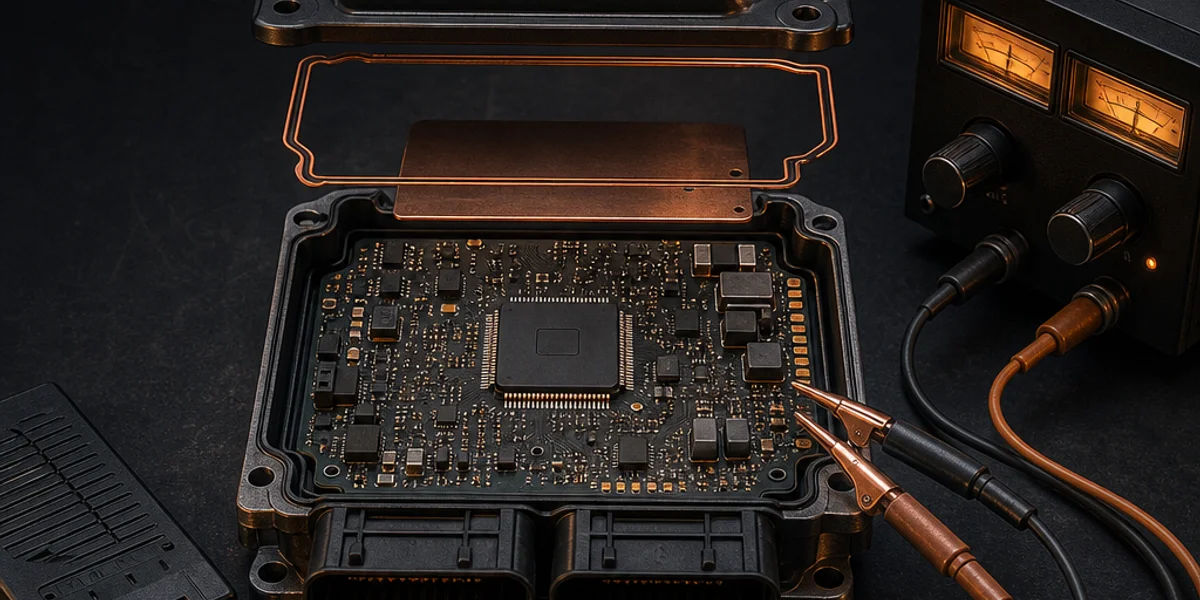 When the module will not open a diagnostic session, the bench is the last move rather than the first.
The factory alarm is the job
On the Ford vans in particular, an armed alarm does not produce a polite error. The BCM refuses the diagnostic session, and the symptom is full communication when you scan and none the moment you ask to erase or add. Locksmiths lose hours to this diagnosing a tool fault that does not exist.
The routes recorded in the database, in rough order of preference:
- Unlock with a working key first. Obvious, and it solves the add-key case entirely. Unlock, close the doors, switch the hazards off, then connect.
- Tool-switched power. The Autel G-BOX route, where the tool controls the van's power state through the procedure.
- A manufacturer emulator cable. On the Smart Pro this is the ADC2020 Ford emulator cable, and on 2022-on Transits the ADC2025 BCM bypass cable as well — the record puts that at about five minutes with no battery disconnect and no covering sensors.
- Change the alarm parameter. With Abrites, service functions, CCC, change parameter 11 Alarm from 01 Alarm to 02 No Alarm, write it, programme the keys, then set it back. Setting it back is not optional.
- The door-open and ignition-cycle wait, listening for the twin horn honk that opens a roughly sixty-second window.
- Bench. If the BCM will not open a session at all, the module comes out and the processor is read directly.
That last one deserves a note, because the database records the same finding on both the Transit and the Transit Custom: D-Flash dumps pulled by pin-probing are routinely rejected by the dump tools, while a direct read of the Renesas MCU is accepted. Order matters — try a battery disconnect to clear a lockout and the alarm-active emulator cable before you take a module out, and get the customer's agreement in writing before you open a dash.
Tool coverage, honestly
No tool covers this list. Anyone who tells you otherwise is selling one. The useful question is which gaps you can live with.
Strongest across the UK van parc. The Smart Pro with the right software modules finishes jobs others walk away from on Ford vans — the database records UK locksmiths recovering 2016 Transit Customs with the alarm live after Autel, Lonsdor, Abrites, IDS and FDRS all returned no comms — and it is the fastest and safest recorded tool on the Vivaro X82. It is token-based, and the Ford and Renault software modules are separate purchases. Abrites AVDI has the broadest coverage and is the only recorded route on several lost-key cases including the Ducato 2022-on, but it needs the right licence per family and an active annual subscription, which the database puts at roughly £1,200 a year for a full package.
Strong with caveats. Autel's IM range carries good Ford EU and PSA coverage, with two limitations recorded repeatedly. Ford forced the Ford immobiliser functions off the IM range in August 2025 and Autel restored part of that coverage in May 2026, so open the Ford EU menu and confirm the vehicle is in your unit's current software before quoting a lost-key job. Autel is also explicitly not recommended on the Vivaro X82 following the removal of Renault functions. OBDSTAR is capable and cheap per job but slow — approximately ninety minutes for a full all-keys-lost cycle on both Vivaro generations — and the green Renault adapter is mandatory on the X82, not optional.
Less than the marketing suggests. Lonsdor does not support all keys lost on the Vivaro B or Trafic III and is add-key only on the Crafter. The Xhorse Key Tool Max Pro is not an immobiliser tool on the MQB Crafter at all — it will not read the cluster and will not learn a key, though it is fine for generating a remote and cutting the HU162T. ZedFull's Crafter route is documented for adding a key only, so do not accept an all-keys-lost on the strength of it.
Things that will cost you a module. Attempting an all-keys-lost on a VAG UDS cluster without the proper cable has been known to damage the airbag module. And on the Crafter EZS a failed write is terminal — keep the module on a clean regulated supply, and back up and verify two copies before anything writes.
The full capability matrix across every make is in the car key programmer comparison.
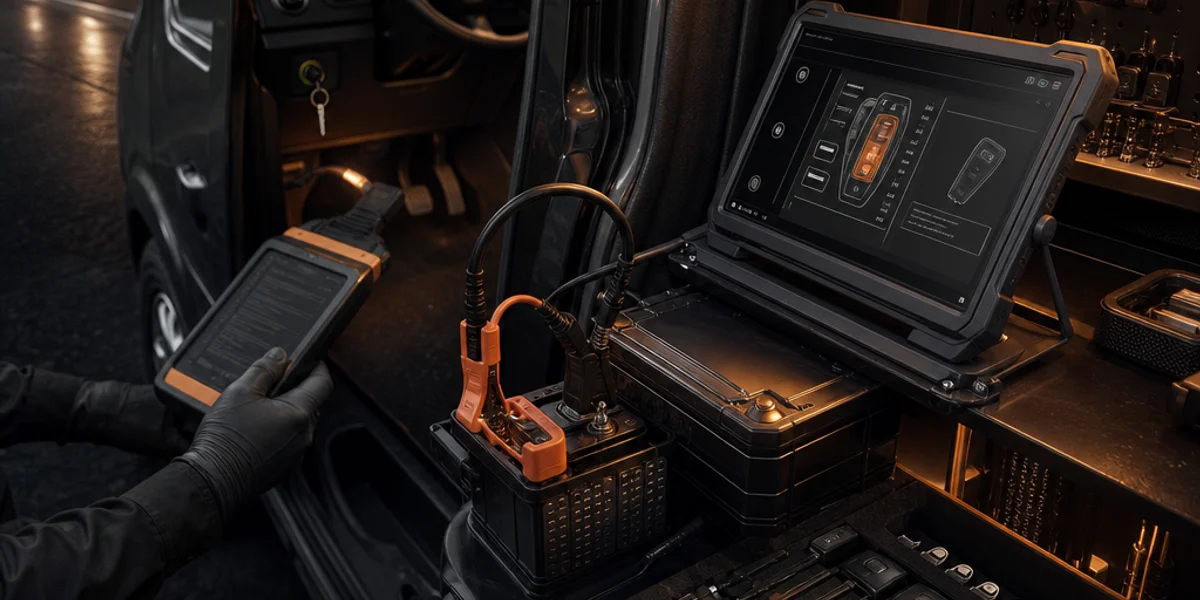 Battery support is not optional on van work — several vans report low voltage as a communication fault.
Common pitfalls
The van cranks but will not fuel, and you are sure the key learnt. On VAG vans this is usually a component security disagreement rather than the key. The engine ECU and the cluster have to agree on the component security before the ECU will give fuel, and a dealer key made from the van with no synchronisation will turn the barrel and get you precisely nowhere. Where the fault turns out not to be the key at all, work it through the immobiliser fault diagnosis guide before cutting anything.
You programmed a two-button remote to a three-button van. The engine starts, the customer drives off happy, and rings you that evening because the sliding door and rear doors no longer respond from the key. The Interstar record calls this out specifically — order three-button for Acenta and above.
The customer has more keys than they told you. On the Ducato 2006-2008, the Crafter, the Transporter and the Interstar, the key-learn rewrites the whole key table and any key not presented is dead afterwards. Ask before you start, and ask it as "how many keys exist for this van, including ones at home and ones a previous driver may still have".
You are standing at the wrong Crafter. Two completely different vans wear the same name and the same badge. Read characters four to six of the VIN before you quote, not after you arrive.
The battery sagged and the tool blamed the van. Several vans here report a low-voltage condition as a communication fault, so you chase a comms problem that is actually a flat battery. Put a support unit on every van job as a matter of course. On the Vivaro X82 this is not advice but a requirement — the database puts the minimum at 13.5 V and records UCH corruption as the consequence of losing it mid-procedure.
You assumed the 66-plate Transporter was the chip the last one was. Read the part number in the blade slot. AD, Q or AJ is Megamos Crypto, BH, DH, BD or BK is AES, and the wrong blank fails at the write.
The aftermarket immobiliser nobody mentioned. Ghost-type units are very common on UK T6s and on high-theft vans generally, and they will block programming until they are put into service mode. Ask about aftermarket security when you take the booking.
SERMI and the authorisation question
SERMI went live in the UK on 1 April 2026, with Digidentity as the UK Trust Centre, giving accredited independent operators access to manufacturer security data that was previously dealer-only. This matters more for vans than for cars, because the manufacturer route is the fallback on exactly the vehicles where the aftermarket runs out — the 2020-on Crafter, the 2022-on Ducato, the gateway-locked Transit. Twenty-two brands were committed at launch, Ford, Mercedes-Benz, Nissan and Peugeot among them, at roughly £30 a month over five years or around £1,800 upfront.
Note what is not on that list. The Keysolved record for the MQB Crafter states that Volkswagen Group is not currently signed up to the UK scheme, which makes the factory route on a 2020-on Crafter a dealer visit rather than something you can accredit your way into.
Whichever route you take the paperwork discipline is the same: proof of ownership, V5C, customer identification, records kept. A van is a high-value asset with a high-value payload, and a key cut for the wrong person is a different order of problem from a car.
Frequently asked questions
Where is the OBD port on a van?
Usually in the driver's footwell, but vans break the rule more often than cars. On a right-hand-drive Nissan Interstar it is on the passenger side behind the dash end panel. On a first-generation VW Crafter it is in the nearside footwell at the bottom of the left A-pillar, because the electrics stay on the vehicle's left regardless of which side the steering wheel is on. On an Iveco Daily and a 2021-on Fiat Ducato it also sits on the nearside in UK vans. Check the specific vehicle before you travel rather than assuming it mirrors the car.
Can you programme a van key without the original?
Yes on most of the UK van parc, but route and cost vary enormously. A Ford Transit, a Vivaro of either generation, a Renault Master and a Fiat Ducato up to 2021 all have documented all-keys-lost routes over OBD. A Mercedes Sprinter W907 and a VW Transporter T6 need bench work. A 2020-on VW Crafter has no confirmed aftermarket lost-key route at all and is a dealer job.
Why will my tool not communicate with the van?
Check four things in order. Is the factory alarm armed, because several body control modules refuse a diagnostic session outright when it is. Is there a tracker or tachograph lead already in the socket, because a second device on the bus will drop the session. Is the battery holding voltage, because several vans report low voltage as a communication fault. And are you actually in the real socket, because dummy OBD ports fitted as a theft deterrent are common on UK Transporters — 12 V present with no CAN on pins 6 and 14 means you have found a decoy.
How long does van key programming take?
An add-key with a working key present runs 20 to 60 minutes across most of this list, including cutting and testing. All keys lost over OBD runs 45 minutes to 2 hours depending on the vehicle and the tool, with the Vivaro of both generations documented at approximately 90 minutes on OBDSTAR and roughly three minutes of actual procedure on a Smart Pro for the X82. Anything requiring a module out and a bench read is a half-day job. Quote accordingly, and quote the alarm-active lost-key cases as a half day whatever the van.
Is a Vauxhall Vivaro the same job as a Vauxhall Corsa?
No, and it is not even the same job as the previous Vivaro. The 2014-2019 Vivaro is a rebadged Renault Trafic III on Renault UCH architecture; the 2019-2024 Vivaro is a PSA EMP2 van sharing a platform with the Citroën Dispatch and Peugeot Expert. Neither uses the GM or Delphi architecture the badge implies, and the PIN systems differ — four digits on the PSA van, five on a Fiat Ducato, extracted from the UCH on the Renault-era van.
Does a cloned chip work on a van?
Sometimes for the engine and almost never for the whole job. On a Renault Master the Hitag 2 chip clones and will start the engine, but the lock and unlock buttons still have to be paired to the UCH separately, so you have done half the work. Hitag AES and Hitag Pro chips — which covers most of the modern van parc, including the Vivaro of both generations, the Sprinter W907 and the 2022-on Ducato — cannot be cloned at all and must be enrolled.
Before you quote the next one
Van work pays better than car work for a reason: the customer loses money every hour the vehicle stands still, and the jobs are harder in ways that stay invisible until you arrive. Three questions decide whether a van job runs to time. Which exact variant is it, because two vans wearing the same badge are routinely two different architectures. Is the alarm going to let you in. And is the diagnostic socket where you think it is.
All three are lookups, not guesses. Put the registration or the make and model into the Keysolved vehicle database before you leave the yard and you will have the chip type, the blade profile, the security model, the port location with its right-hand-drive variant and the per-tool compatibility notes in front of you — including the ones telling you which tool to leave in the van.
Full database access
Check the Van Before You Travel
Cancel any time · Billed monthly in your local currency
Look up the exact chip type, blade profile, OBD port location and per-tool compatibility for any van in the Keysolved database.
No card required to browse — subscribe to unlock full specs and procedures
Frequently Asked Questions
▶Where is the OBD port on a van?
▶Can you programme a van key without the original?
▶Why will my tool not communicate with the van?
▶How long does van key programming take?
▶Is a Vauxhall Vivaro the same job as a Vauxhall Corsa?
▶Does a cloned chip work on a van?
Full database access
Stop Guessing on Van Jobs
Cancel any time · Billed monthly in your local currency
Keysolved holds key specs, programming procedures, OBD locations and honest tool compatibility across 60 makes — including the commercial vehicles everyone else treats as an afterthought.
No card required to browse — subscribe to unlock full specs and procedures
Sources
- SERMI launches in the UK to improve security in vehicle repairs(2026)— Digidentity, the UK SERMI Trust Centre, on the 1 April 2026 UK launch and what accredited independent operators gain access to.
- SERMI scheme goes live in UK: independent garages gain access to security data(2026)— Accreditation requirements, DBS checks, insurance thresholds, costs and the brands committed at launch.
- One tool theft every 21 minutes as UK trades workers face rising van crime(2026)— Freedom of Information data across UK police forces for the twelve months to 31 December 2024: 25,525 tool thefts, 12,414 van-related.