
Honda Key Programming: Complete Locksmith Guide (All Models)
Four Honda immobiliser eras, the procedure and job time for each, and the facelift chip change that catches people out
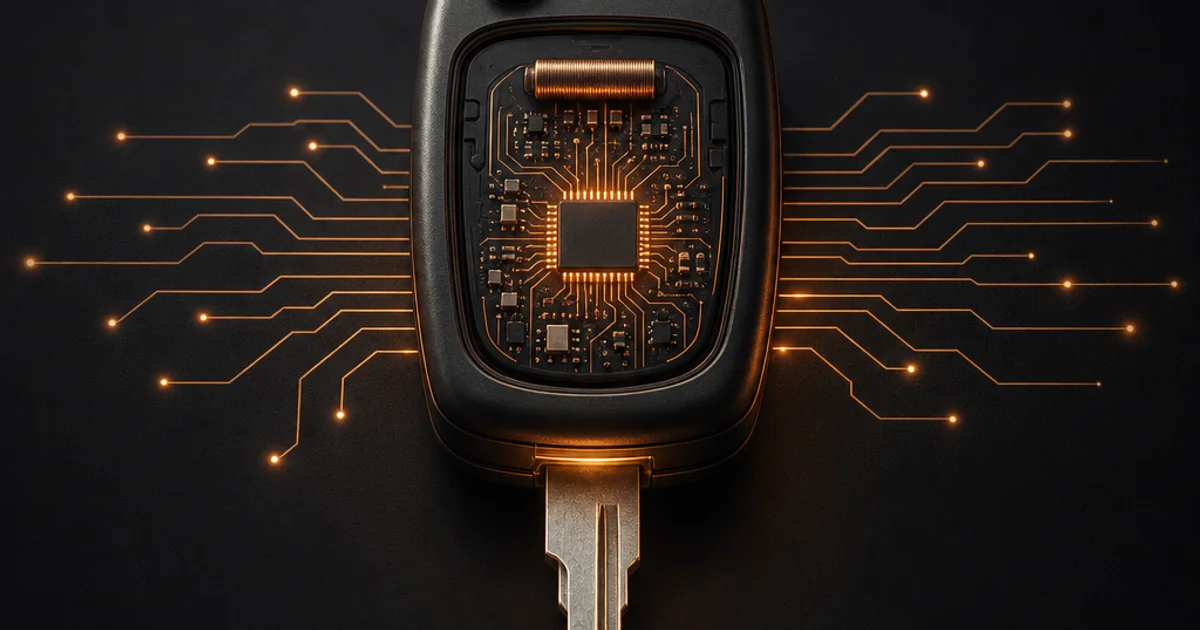
Key Takeaways
- Honda changed transponder families at facelifts rather than generation boundaries — the 2012-2018 CR-V holds ID46 keys to 2014 and ID47 from 2015, and the wrong blank cuts perfectly then refuses to programme
- Honda needs no PIN or security code on the aftermarket OBD route; the manufacturer's own route requires a VIN-specific PCM code for every key operation
- The Type 6 immobiliser marries three modules — the immobiliser-keyless control unit, the PCM and the MICU — so a no-communication message is a module pairing fault, not a key fault, and no key menu will clear it
- Honda 4A from 2020 uses Hitag AES and cannot be cloned at all: a lost-key job needs a genuine Honda fob or a 4A-capable universal smart key, and anything sold as ID47 or Hitag 3 will not pair
- Battery support is not optional on Honda — the routines are long runs of ignition cycling, and the hybrid Jazz runs a small 054-size battery with very little reserve
- Reset Key, Rewrite Key and All Keys Lost clear the whole key table rather than adding to it, so collect every key the customer wants to keep before you start
Honda is the make that turns up on a UK round without ever feeling like a specialism. A Jazz on a retirement bungalow driveway, a CR-V on the school run, a Civic that has been through three owners and two sets of keys. Nobody markets Honda work and nobody writes it up properly, which is exactly why it catches people out.
What makes Honda key programming awkward is that Honda changed transponder families twice inside a decade, and did it mid-generation at facelifts, without changing the badge on the boot. A 2014 CR-V and a 2016 CR-V look like the same estate from ten feet away. One takes an ID46 blank and one takes an ID47, and the wrong one decodes perfectly, cuts perfectly and then refuses to programme.
This guide runs through the Honda security eras you will meet in the UK, the procedure and realistic job time for each, the OBD positions on right-hand-drive cars, and an honest account of where the aftermarket stops. Every specification below is pulled from the Keysolved database, which currently holds thirty Honda vehicles.
Four Honda security eras, and how to tell them apart
The immobiliser architecture matters more than the model name, because the same name spans several systems. Identify the era first and the rest of the job follows.
Early transponder, pre-2006. Fixed and early rolling-code keys on cars such as the first-generation Jazz. Simple work, no PIN, and largely out of the trade now.
Honda Type 6, roughly 2006 to 2014. The ID46 era: PCF7936 transponders in the Hitag 2 family, HON66 blades, and a three-module security arrangement that is the single most important thing to understand about Honda. Covers the Civic 2006-2011, the Insight, the CR-V to 2014 and the Accord.
Honda G, roughly 2015 to 2021. Hitag 3 silicon, catalogued as ID47 or ID49 depending on whose list you are reading. Arrived at the 2015 facelift. Covers the Jazz Mk3, the post-facelift CR-V and the Civic 2016-2021.
Honda 4A, 2020 onward. Hitag AES. Covers the Jazz Mk4, the Civic 2022-2024 and the current CR-V. This is where cloning stops being an option at all.
One warning before any of it. Honda's database coverage includes North American models — Pilot, Odyssey, Ridgeline, Element and Passport — and those records carry US frequencies and US trim names. The UK spine is Jazz, Civic, CR-V, Accord and Insight. HR-V is not in the database yet, so if you want it, put a vehicle request in rather than working from a neighbouring record.
Honda Type 6: the three modules that have to agree
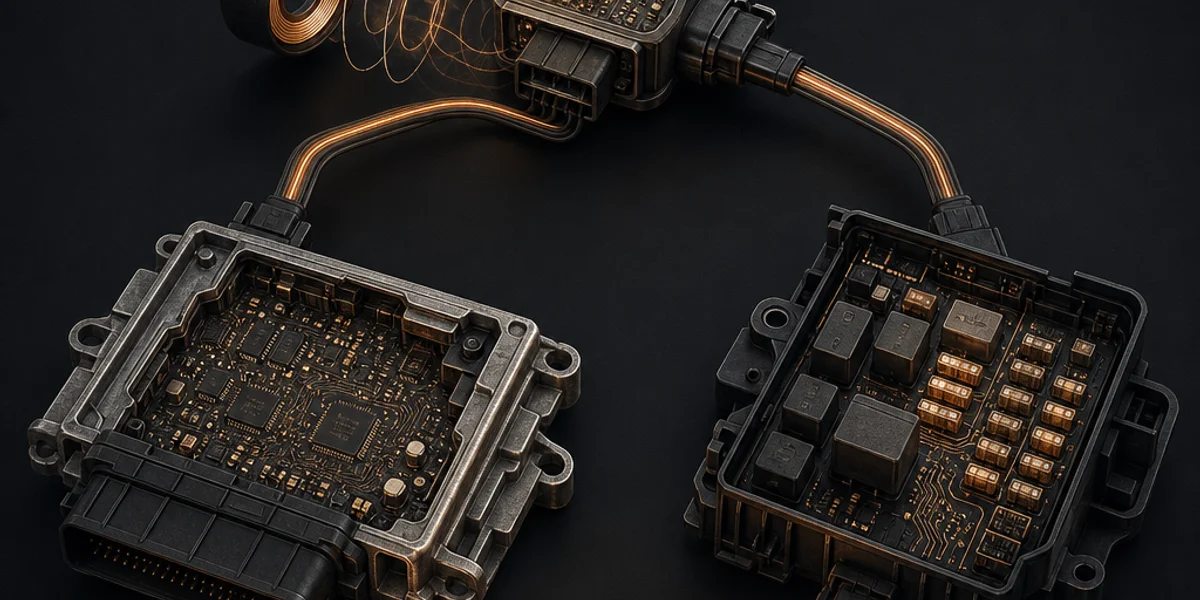
On the ID46 cars, key authentication is not owned by one module. It is owned by three, and they are married to each other.
The immobiliser-keyless control unit sits inside the plastic bezel around the steering column and carries the transponder coil around the ignition switch. It energises the chip inductively when the key turns to ON, reads the rolling code and compares it against the codes in its own memory. On a match it passes a unique serial code onward to the PCM and to the MICU — the driver's under-dash fuse and relay box, which has the IMOES unit built into it — over Honda's two-wire body network. The MICU sits in the middle and is the only communication path between the immobiliser unit and the PCM. The PCM and the immobiliser unit then handshake with each other's serial codes, and only when both recognise each other does the PCM energise the fuel supply.
Honda's own service documentation sets this out directly. The manufacturer's bulletin covering the system describes the PCM handshaking with the immobiliser-keyless control unit by returning its own unique serial code, and confirms that replacing any one of the immobiliser unit, the PCM or the MICU requires a dedicated re-registration routine or the engine will not start. That is why a used PCM or a second-hand under-dash fuse box will not start the car no matter how many keys you programme.
The practical consequence on a driveway: if your tool reports that it cannot communicate between the PCM and the immobiliser unit, you have a module pairing fault, not a key fault. No amount of retrying the key menu will clear it, and it is worth saying so before you start charging diagnostic time.
The control unit stores six transponder codes. Honda's registration table confirms the six-slot limit, and the car left the factory with three programmed, so there are three free slots before you have to start deleting keys.
Add key, Honda Type 6
- Verify the vehicle and the customer. VIN plate against the V5C, photographic identification matching the keeper, and a record kept.
- Confirm the immobiliser era before you order a blank. Read the chip out of the customer's existing key if there is one.
- Cut the blade to HON66.
- Connect at the OBD socket and run the immobiliser status scan first. It reports the registered key count and flags a PCM-to-immobiliser communication fault before you commit.
- Select the Honda immobiliser section and pick the system by type rather than by year. Honda reuses model names across several generations and the type list is the reliable one.
- Turn the ignition on with a working key and confirm the green security light drops out before you begin.
- Run Add Key and follow the timed ignition prompts. Every ON and OFF has to land inside roughly fifteen seconds of the last, or the sequence drops and you start again. Some tools run a twenty-second clock instead.
- Watch the green immobiliser indicator, not the screen. The indicator going out is the only real confirmation the key took.
- Test: engine start, remote lock and unlock, and the boot release if fitted.
- Time: 25–35 minutes including cutting and testing. Tool time alone is under a minute on a working key.
No security code is needed on the aftermarket OBD route. The manufacturer's route is different: Honda's registration table requires a VIN-specific PCM code for every key operation, retrieved through its dealer system. There is also a separate five-digit immobiliser brake code for a temporary ten-minute start on an unprogrammed key, which is a dealer recovery procedure rather than anything you will use.
All keys lost, Honda Type 6
- Verify ownership properly. This is the job where it matters most.
- Decode the driver's door lock with a HON66 two-in-one and cut a blade.
- Put battery support on. This matters more than it sounds — see the pitfalls below.
- Connect and run the status scan. Note the registered key count; it is a free audit of the customer's account of how many keys exist.
- Run the all-keys-lost or rewrite routine. This clears every transponder code from the control unit, so cut and register every key the customer is keeping in the same session. A key that is not present at the end is dead.
- Work the ignition cycling exactly as prompted.
- Test every new key for engine start and every button on each.
- Time: 60–90 minutes. Add thirty if the door lock fights you.
One quirk if you run an Abrites AVDI: on Honda the all-keys-lost routine leaves you with exactly one working key and erases the rest, so to hand over two keys you run all keys lost first, then feed that new key into the key learning function for the second.
The 2015 facelift: the trap inside one model year
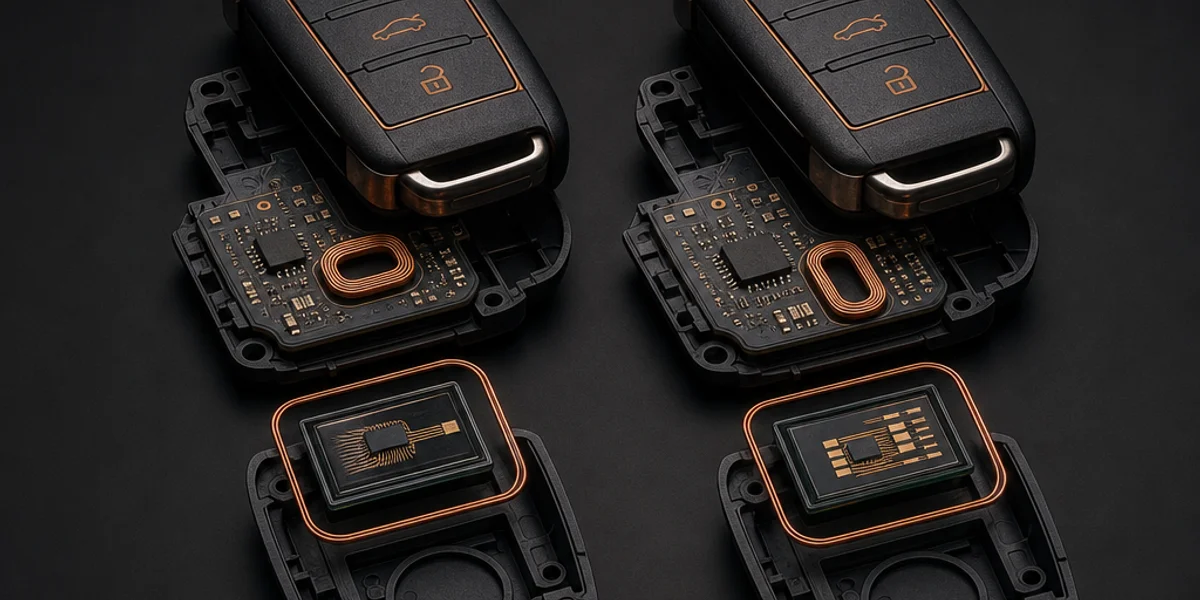
This is the Honda mistake that costs a wasted call-out, and the fourth-generation CR-V is where it bites.
The 2012-2018 CR-V is a single generation holding four key variants. The pre-facelift flip remote, 2012 to 2014, is a Hitag 2 ID46 PCF7936. The post-facelift flip remote, 2015 to 2018, is a Hitag 3 ID47 PCF7961. The database note is blunt: do not use an ID47 blank on a pre-facelift vehicle or vice versa, because the chip families are incompatible. The ID47 chip also cannot be cloned with standard ID46 cloning tools.
The smart keys split on the same boundary, with an extra wrinkle. The EU and UK pre-facelift proximity key is a PCF7945 ID46, biphase locked — which is not what North America used, because the US market moved to ID47 from 2014. The EU pre-facelift smart key stayed on ID46 until the 2015 facelift took the whole range across. If you are reading an American forum thread about a 2014 CR-V smart key, it does not describe the car on your driveway.
There is a second overlap to watch. The database holds both a 2012-2018 CR-V record and a 2012-2016 CR-V record, with different key types and different OBD positions, and it warns you when a year falls inside two generations. On a CR-V of that vintage, resolve it from the registration rather than guessing — a registration lookup settles it definitively.
Procedurally the post-facelift job is the same shape as Type 6 work: OBD, no PIN, timed ignition cycles, transponder and remote written in one session. Time: 25–35 minutes for an add key, 60–90 for all keys lost.
Honda 4A: where cloning stops
From 2020 Honda moved to its 4A system on Hitag AES silicon. This is a genuine wall rather than a difficulty.
The chip cannot be cloned, and that is not a tooling gap waiting to be filled — it is the design intent. NXP, which makes the chip family, states that use of AES on its NCF29A1 effectively hampers key cloning and vehicle theft, and describes the device as a single-chip solution combining a security transponder, passive keyless entry and a UHF transmitter. So a lost-key job on a 4A Honda means a genuine Honda fob or a 4A-capable universal smart key, and nothing else. Anything a supplier sells you as an ID47, a Hitag 3 or a 49-1C chip is the previous generation and will not pair.
The identification problem is worse than the programming problem. A Mk4 Jazz fob carries a 72147-TZA- part number and a 4A chip; the Mk3 carries 72147-T5A- and an ID47. The two look near enough identical in a photograph. Read the number moulded inside the fob under the pull-out blade, not the year on the V5C.
Expect the Jazz to be missing from tool menus entirely. Honda 4A coverage is normally listed against the Accord, Civic and CR-V, and the Fit and Jazz are rarely named even on machines whose Honda software plainly covers the platform. On most tools you get there through the Fit entry for 2020 onward, or the generic Honda proximity branch. Check your machine offers a 2020-on Fit entry before you quote a lost-key job, because finding out on the driveway is an expensive way to learn.
All keys lost, Honda 4A smart key
- Verify ownership, then get in. The only lock cylinder on a Mk4 Jazz is in the driver's door handle, HON66 keyway, so a two-in-one reads it and you can cut a blade on site.
- Expect the alarm. Mechanically unlocking a Smart Entry car is exactly what the security system is set to catch — horn and lights for thirty seconds, repeating, stopping only when the car sees a registered key or you switch it to ON. Warn the customer and carry on. You cannot pull the horn fuse first, because that fuse box is under a bonnet you can only open from inside the cabin.
- Battery support on, then plug in at the OBD socket.
- Press the START/STOP button twice without the brake to reach ON.
- Select the Honda immobiliser section, the Fit or Jazz 2020-on entry, proximity smart key, then All Keys Lost. No PIN, no code to buy and no dealer login — but several tools route the job through their own server, so confirm the tool has working internet first.
- Clear stored fault codes; most Honda key routines refuse to run with DTCs present. Shut all doors and the tailgate, and switch the audio and navigation off.
- Put one new fob on the console with nothing else in the car and every other key more than two metres away — out to the van, not into your pocket. Some tools give you roughly a hundred-second window to get the new key into the cabin.
- Run the ignition cycling as prompted. One press for OFF, two for ON, no brake, about fifteen seconds a step, until the immobiliser indicator goes out and the tool reports the key count.
- Programme every key the customer is keeping in the same session.
- Cut the emergency blade, refit it into the fob until it clicks, then test push-button start, both front door handles and the tailgate button.
- Time: 75–120 minutes. The entry and the blade work are most of it.
If the fob works but the car will not start, try the backup coil before you reach for a tool. Press the START/STOP button once, then hold the fob flat against the centre of the button with the Honda badge facing the button while the indicator flashes — about thirty seconds. When the beeper sounds and the indicator goes steady, press the brake and press the button again within ten seconds. That reads the transponder directly through the start button and rules a flat fob battery in or out in under a minute.
The Mk4 Jazz: two different jobs, one badge
The Mk4 Jazz earns its own section because the car gives you no external clue which job you have taken on.
A start button on the dash means the proximity fob. An ignition barrel means the folding key. The barrel cars are SE and SR up to 2022 and Elegance from 2023, and they are common on the UK used market. Confirm which before you quote.
On the barrel cars there is no owner-level ignition-cycle or door-lock learn sequence — Honda does not provide an onboard key-learn procedure on the Mk4 Jazz, so it is a tool job either way. On the tool, answer no when it asks whether the car is push-to-start, which routes you into the blade-key branch; picking the smart-key branch on a barrel car simply fails to communicate.
Read the chip out of the customer's key before you order anything. The vehicle-level immobiliser is 4A, so the working assumption is that the folding key is 4A too — and if it is, there is no cloneable or producible chip and no universal flip will cover the immobiliser. A genuine Honda folding key is then the only route. If the original reads as an ID47 instead, the usual Keydiy and Xhorse Honda flip profiles come back on the table. That one read decides whether this is a forty-minute job or a parts-order job, so do it first. Time for the read: 5 minutes.
One more on the blade. Hondas of this family run a secret pin in the ignition that is not represented in the door lock, so a blade cut to the door alone can turn in the door and refuse in the barrel. Decode the ignition as well, or decode the door and then progress the blade on the barrel before you hand the key over.
OBD port locations on a UK Honda
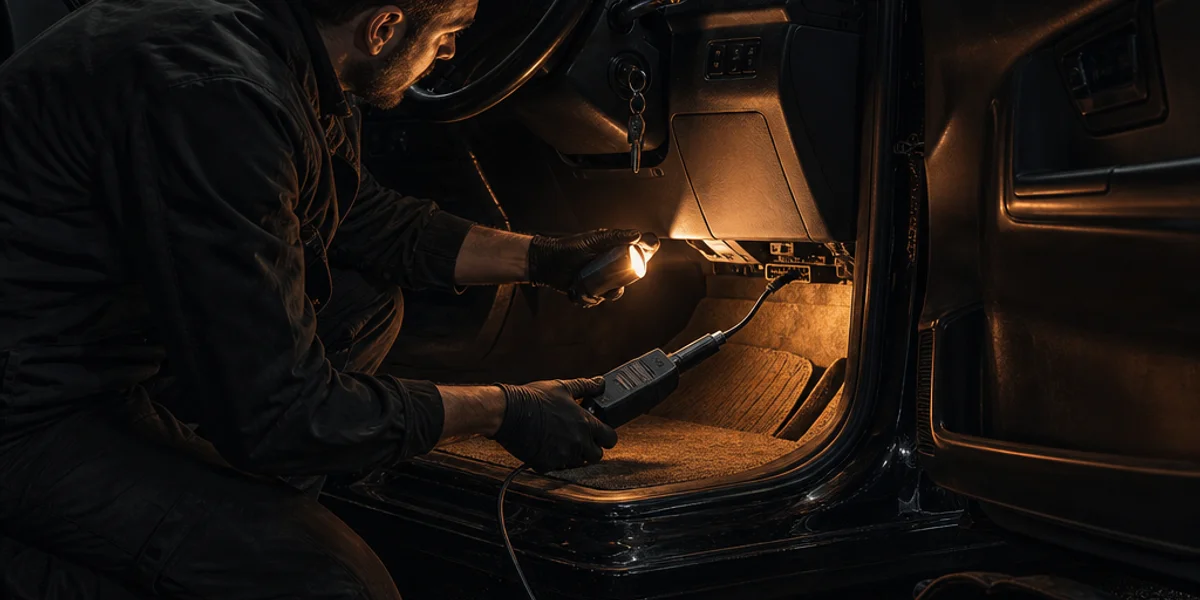
Honda does not put the socket in the same place twice, and right-hand-drive positions are not mirror images of the left-hand-drive ones. These are the ones you will meet most.
- Jazz Mk4, 2020-2024 — driver's footwell, up under the lower edge of the dash and set well outboard, towards the base of the A-pillar and the kick panel. Facing downwards and close enough to your right shin that a bulky connector fouls your leg. You cannot see it from the seat: kneel outside the open door and look up, or work by feel with a torch and a mirror.
- Jazz Mk3, 2015-2020 — driver's side under the dash, between the centre console and the steering column, above and to the left of the accelerator. Not visible at a glance and not mentioned in the owner's handbook.
- CR-V 2012-2018 — lower dashboard on the passenger side on RHD cars, tucked up under the edge of the dash near the centre console. No cover. The connector faces downward and wants a torch.
- Insight 2009-2014 — driver's footwell on the inboard side, left of the steering column, between the column shroud and the centre console. The under-dash fuse box with its clip-off cover sits on the outboard side of the same footwell, so if you are looking at the fuse lid you have gone the wrong way round the column.
- Civic 2016-2021 and 2022-2024 — driver's side under the dash, left of the steering column, recessed slightly. Angle the connector downward to seat it fully.
If you work across makes, the OBD port location guide covers the same ground for every UK manufacturer.
Tool compatibility, honestly
Honda is one of the easier makes for tool choice, because there is no PIN to buy and no security gateway to unlock on the aftermarket route. What varies is whether the tool names the vehicle, and whether it writes the remote.
Tier 1: full coverage, add key and all keys lost
Autel MaxiIM IM608 Pro II — the most complete Honda coverage in the database across all four eras. Run the immobiliser status scan before anything else, with a working key in and the ignition on: a stored immobiliser fault will stop the learn dead and is quicker to clear now than to diagnose halfway through. No PIN, no adapter and no token cost on the ID46 generation. The XP400 Pro and G-BOX only come into play if a module mismatch sends you to the bench.
Lonsdor K518Pro — select by system rather than by model and run Check Immobiliser Type first, so the tool interrogates the car and tells you which Honda generation is fitted. The year lists on this device are built around the later smart-key cars, so the type route is the dependable one. Confirm with the green indicator rather than the on-screen result.
OBDSTAR X300 DP Plus — Car IMMO, Asia, Honda/Acura, then let the tool identify the generation rather than picking a year. Rewrite Key erases the whole key table, so count the customer's keys first. OBDSTAR's own guidance is emphatic about obeying every ignition prompt to the second, and the routine will not recover a missed window.
Xhorse VVDI Key Tool Plus — generates the key and programmes it on one device, which removes a supplier step. Select the immobiliser system by type, not by year. One warning specific to Honda: the device's own super chip is not the right choice here — use a plain generated PCF7936 for ID46 work.
Tier 2: capable with caveats
Autel MaxiIM IM508S — runs the same Honda software as the IM608 family, and since Honda is a plain OBD registration with no PIN and no adapter, nothing in the job depends on the extra hardware. Genuinely good value on this make specifically. All-keys-lost has been reported working but is worth confirming on your own firmware before you commit to a doorstep job.
Advanced Diagnostics Smart Pro — needs the Honda and Acura software pack. Two things catch people out. The remote is a manual in-car procedure, so the machine will not write the buttons; you do the ignition sequence yourself. And the application asks for the PCM access code on some Honda selections even though this generation does not need one in practice, so read the prompt before you go hunting for a code you do not need. Keys are re-usable on Honda, so a second-hand key of the same era can be re-registered.
Abrites AVDI — Honda software is in the annual subscription with no extra licence, and covers Honda up to 2022. On the ID46 era you must fit the Honda K-line adapter between the interface and the OBD cable, or no session opens at all and it presents as a dead car rather than a missing adapter. That one has cost people an afternoon.
IEA ZedFull — needs the Honda OBD application pack, and the Honda scope is key programming only, so the buttons are yours to do in the car. It earns its place on the bench side: it clones ID46 Hitag 2 and will unlock a Honda ID46 chip, which is the quick way to recycle a used OEM key somebody else programmed. Expect fifteen to twenty-five tokens on the Honda pack.
Tier 3: the bench fallback
Scorpio-LK Tango — for when no OBD session will open: a damaged immobiliser unit, a corrupted MICU, or a car that has had modules swapped between vehicles. Remove the immobiliser-keyless control unit from the steering column bezel, read its 93C46 EEPROM out of circuit, load the dump, generate the key data against a new transponder and write it back. The key then starts the car without programming mode ever being entered. The same route reaches the 93C56 devices in the MICU and the PCM after a module mismatch. It means desoldering a SOIC-8 part, so this is workshop work, not roadside.
Several other tools carry Honda — Autel KM100, Xhorse Key Tool Max, XTOOL AutoProPAD and X100 PAD3, OBDSTAR X300 Pro4, Launch X431 IMMO Plus, KeyDIY KD-X2 and the CN900 for cloning. The database holds per-vehicle notes and menu paths for each. For a broader read on what each device finishes rather than merely touches, the 2026 car key programmer comparison counts confirmed coverage across the whole database.
Common pitfalls
The key table gets wiped and the customer's other keys die This is the Honda mistake, and it recurs across every tool. Routines called Reset Key, Rewrite Key or All Keys Lost clear the whole key table rather than adding to it. Add Key does not. On top of that, some tool firmware erases keys that are not present during an ordinary add-key session. Collect every key the customer wants to keep before you start, not after. On Honda, existing keys can need re-presenting to survive a new registration.
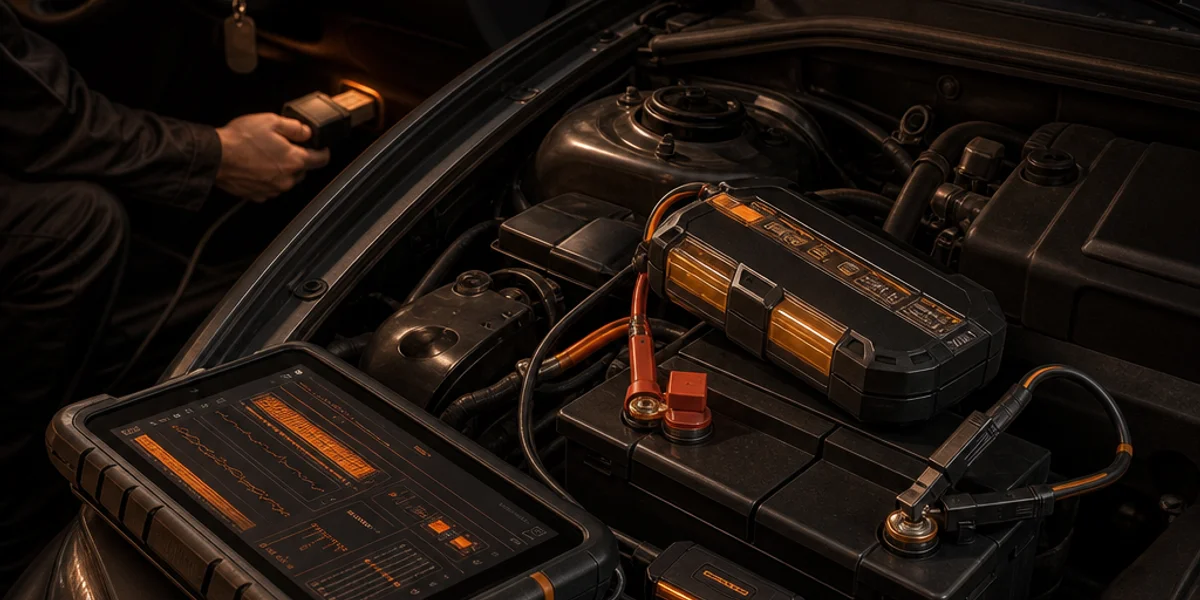
The battery sags and you blame the tool Honda key routines are long runs of ignition cycling, not single writes. A Keysolved subscriber reported it plainly on the Insight: battery support required, as the starter battery is small and easily drained by ignition cycling. On the hybrid Jazz it is worse — a small 054-size flooded unit that only wakes the electronics, because the car starts on the traction motor, so it has very little reserve and sags quickly during a key write. Put a support unit on before you start, every time.
The aftermarket remote refuses and the chip does not Field-reported rather than theoretical. On the Insight, a subscriber recorded that Xhorse Honda keys did not work, and that transponder plus blade added fine. If a universal remote refuses on a Honda, falling back to a plain transponder and a cut blade often recovers the job — the customer loses the buttons, not the car. The original Insight remote part number is HLIK-1T.
Cloning is sold as a spare and cannot be deleted Cloning an ID46 Honda chip is quick and gives a key that starts the engine with no diagnostic session. But the clone never appears in the car's key table, so the registered key count does not move and the copy can never be erased. If the customer has actually lost a key and wants it locked out, cloning is the wrong answer — programme instead. The transponder chip cross-reference covers which families still copy.
The frequency is wrong on an import Xhorse's published Civic FD entry is 433 MHz for cars sold outside North America. On a US-market car the generated remote needs to be 313.8 MHz instead, or you fit an OEM-frequency remote head key and programme only the chip. Check the output frequency before you hand it over.
Quoting a 2022-on Civic blade without checking The emergency key insert changed part number to 35118-T20-305 for 2022-onward Civics, and physical keyway compatibility with older HON66 tooling is not confirmed from primary sources. The database flags it for review rather than guessing, and so should you. Decode the lock rather than assuming your existing HON66 tooling fits.
Frequently asked questions
Does Honda key programming need a PIN or security code?
Not on the aftermarket OBD route. Honda is one of the few makes where trade tools write keys straight into the immobiliser-keyless control unit with nothing to look up or buy. The manufacturer's own route is different: Honda's registration procedure requires a VIN-specific PCM code retrieved through its dealer system for every key operation, including adds, deletions and module replacements.
How many keys can a Honda hold?
Six transponder codes on the Type 6 system. Honda's own registration documentation confirms the six-slot limit on the immobiliser-keyless control unit, and cars left the factory with three programmed, so there are normally three free slots before you need to delete keys.
Can a Honda 4A key be cloned?
No. The 4A system uses Hitag AES silicon, and AES is specifically there to prevent cloning — NXP states that use of AES on this chip family effectively hampers key cloning and vehicle theft. A lost-key job on a 2020-onward Jazz, a 2022-onward Civic or a current CR-V needs a genuine Honda fob or a 4A-capable universal smart key. Anything sold as ID47, Hitag 3 or 49-1C is the previous generation and will not pair.
What is the difference between an ID46 and an ID47 Honda key?
They are different transponder families and they are not interchangeable. ID46 is Hitag 2 — PCF7936 on blade keys, PCF7945 on EU smart keys — and ran to roughly 2014. ID47 is Hitag 3, introduced at the 2015 facelift. The CR-V is where this matters most, because both sit inside one database generation: pre-facelift 2012-2014 is ID46 and post-facelift 2015-2018 is ID47. The wrong blank cuts perfectly and refuses to programme.
Do I need SERMI accreditation to programme Honda keys?
Not for the aftermarket route, which takes security access directly from the vehicle. SERMI was introduced in the UK on 1 April 2026 and gates access to manufacturers' own security data. It is not mandated by UK law, and the scheme's own announcement names Ford, Jaguar Land Rover, Nissan and Toyota as the first brands to transition in the UK, with more expected to follow. Honda is not among that first group. If your workflow leans on manufacturer portals rather than trade tools, that is the thing to watch.
Why will the engine not start when the tool says the key programmed successfully?
On the Type 6 cars this usually means the transponder registered to the immobiliser unit but the three married modules do not agree. A tool message about no communication between the PCM and the immobiliser unit points at the MICU or the module pairing, not the key, and cannot be cleared from the key menu. If the green indicator goes out and then returns at the next ignition cycle, you have a module mismatch rather than a key problem. The immobiliser fault diagnosis guide works through the symptom-to-cause chain.
The short version
Identify the era before you order anything. Honda changed transponder families at facelifts rather than at generation boundaries, so the year on the V5C is not enough on a CR-V or a Jazz — read the part number under the blade, or read the chip out of the customer's key. That one step prevents most Honda mistakes.
After that it is straightforward work. No PIN, no gateway, no code to buy, and good coverage across every mainstream tool. Put battery support on because the routines are long, collect every key before you start because the routines wipe tables, and treat the green immobiliser indicator as the only confirmation that matters.
Every specification in this guide — key variants, transponder families, frequencies, OBD positions, procedures and the tools confirmed against each car — sits in the database. Look up the exact Honda in front of you and you will get the per-vehicle record rather than a generation-level generalisation, including the community tips other locksmiths have left on that car. If you are earlier in the trade, the transponder key programming guide covers the chip families from first principles and the UK auto locksmith training guide covers kit and accreditation.
Legitimate work only, on every job on this page: proof of ownership, identification matching the keeper, and a record kept. The trade expectation on documentation has hardened since SERMI arrived — the Independent Garage Association's guidance requires accredited operators to verify both vehicle and customer identity and retain a signed repair order for five years. Keeping to that standard whether or not you are accredited is simply good practice.
Full database access
Check the Exact Honda Before You Order a Blank
Cancel any time · Billed monthly in your local currency
Look up any Honda by model and year to see the confirmed transponder family, frequency, blade profile, OBD position and the tools named against that car.
No card required to browse — subscribe to unlock full specs and procedures
Frequently Asked Questions
▶Does Honda key programming need a PIN or security code?
▶How many keys can a Honda hold?
▶Can a Honda 4A key be cloned?
▶What is the difference between an ID46 and an ID47 Honda key?
▶Do I need SERMI accreditation to programme Honda keys?
▶Why will the engine not start when the tool says the Honda key programmed successfully?
Full database access
Settle the Generation From the Registration
Cancel any time · Billed monthly in your local currency
Honda reuses model names across immobiliser eras. A registration lookup resolves which generation and which chip you are actually working on.
No card required to browse — subscribe to unlock full specs and procedures
Sources
- Honda Service Bulletin — Immobiliser System (Type 4)(2016)— Honda's own service bulletin describing the immobiliser system components, the rolling-code transponder, the serial-code handshake between the immobiliser control unit-receiver and the ECM/PCM, and the re-registration required when the immobiliser unit, PCM or IMOES unit is replaced.
- Honda — Registration for Immobilizer System (HDS procedure table)(2026)— Honda's HDS registration table confirming the immobiliser-keyless control unit stores up to six transponders, and that a PCM code is required for every key, immobiliser unit, ECM/PCM and MICU operation.
- NXP NCF29A1 — Tiny Single Chip Passive Keyless Entry/Go Solution(2026)— Manufacturer product documentation for the Hitag AES chip family used in Honda 4A keys, stating that the use of AES effectively hampers key cloning and vehicle theft.
- SERMI — Forum for Access to Security-Related Vehicle Repair and Maintenance Information(2026)— Official SERMI site confirming the scheme's UK introduction on 1 April 2026, that UK use is voluntary rather than mandated by law, and naming Ford, Jaguar Land Rover, Nissan and Toyota as the first brands to transition in the UK.
- Independent Garage Association — SERMI: Access to vehicle security-related information(2026)— UK trade guidance on SERMI accreditation, including the requirement for approved operators to verify vehicle and customer identity and retain a signed repair order for five years.