
Jaguar Key Programming: Complete Locksmith Guide (All Models)
Five security eras, the two-key RFA wall, and where the aftermarket stops on a ranging car
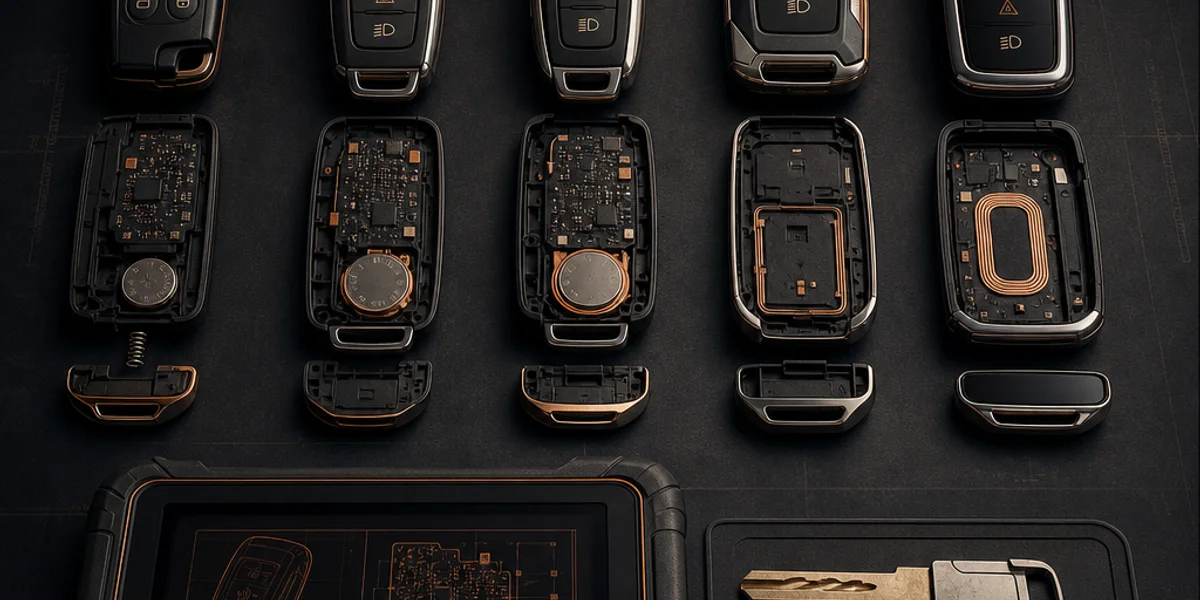
Key Takeaways
- Jaguar has five security eras, and two of them change the transponder mid-generation without changing the fob — the X250 XF switches from Hitag 2 to Hitag Pro at approximately chassis S61361, and the XJ X351 moves from KVM to BCM2 around model year 2015
- The module label decides the job, not the plate year. A 65-plate XF can be either generation: the first-generation car has a fob dock, the X260 has a marked reader area on the side of the steering column instead
- From 2018 the RFA security module accepts two learned keys and no more. On a car with two working fobs, a third key means renewing the module's secure processor or fitting a new module before anything is written
- On cars built with keyless entry, proximity ranging will let an aftermarket key take as a remote and refuse it as a transponder. The customer gets lock, unlock and emergency start, and no touch-the-handle entry — say so before cutting anything
- From the 2018 model year Jaguar is a DoIP vehicle. A CAN-only interface will not enumerate the security module or open a factory session, and no software update changes that
Jaguar key programming is not bread-and-butter work. You will programme more Ford keys in a fortnight than Jaguar keys in a year, and that is exactly the problem: the calls are rare enough that nobody builds a routine, and the cars are expensive enough that getting it wrong is costly. A Jaguar job is either twenty minutes or four hours, and almost nothing sits in between. Which one you are looking at is decided before you open the toolbox.
Rare per locksmith does not mean rare on the road. Keysolved's own coverage audit against Department for Transport licensing data puts roughly 69,000 F-Pace alone on UK roads from the 2015 to 2024 registration years. Spread across the trade that is a handful of calls each, which is precisely why so few locksmiths have the marque in their hands often enough to stay fluent in it.
The badge tells you nothing useful. Jaguar ran Ford-derived PATS for a decade, moved to its own keyless module, changed the chip inside that module mid-generation without changing the key, then under Tata moved to a security module that holds two keys and a ranging system that refuses aftermarket keys outright. Two cars on the same plate year can be two different generations with two different chips, two different module locations and two different prices. The module label decides the job, and reading it is step one, not step five.
This guide works through the five Jaguar security eras in the Keysolved database, with the procedure, the realistic job time and an honest read on where the aftermarket stops for each one. Bookmark it. The ones you meet least are the ones you look up most.
The five Jaguar security eras
| Era | Years | Models | Security module | Transponder | Blade |
|---|---|---|---|---|---|
| Ford PATS | 1999–2009 | S-Type, X-Type | Cluster + engine ECU | TMS37145 (Texas DST40) | FO21 Tibbe |
| KVM Hitag 2 | 2007–2012 | XF X250 "Prox-Slot" | KVM | PCF7945 (Hitag 2 / ID46) | HU101 |
| KVM Hitag Pro | 2012–2017 | XF X250, XJ X351, F-Type | KVM | PCF7953 (Hitag Pro / ID49) | HU101 |
| BCM2 / KVM AES | 2014–2020 | XJ, XF X260, F-Pace | KVM / BCM2 | PCF7953, NCF2951 (Hitag AES) | HU101 |
| RFA / DoIP | 2018–2024 | XF facelift, E-Pace, F-Type | RFA (SPC560B60L3) | PCF7953 / NCF2951 | HU101 |
If the module names look familiar, they should. From the X260 onwards Jaguar and Land Rover share security architecture almost completely, so most of what follows applies to the Range Rover and Discovery range of the same years — the Land Rover and Range Rover guide works the same eras from the other side of the badge, including the models where the aftermarket runs out sooner.
Two things cut across the whole table. There is no customer PIN, incode or code card on any Jaguar — authorisation comes out of the module itself, which is why every route below names a tool rather than a number you type in. And from the 2018 model year the factory moved to DoIP over Ethernet, so a CAN-only interface will not open a session with the factory application at all. Snap-on's own Ethernet and DoIP compatibility notes put Jaguar from the 2019 I-Pace and Land Rover from 2018 onward in that bracket, and confirm that reaching them needs Ethernet-capable hardware rather than a software update.
S-Type and X-Type: the easy ones
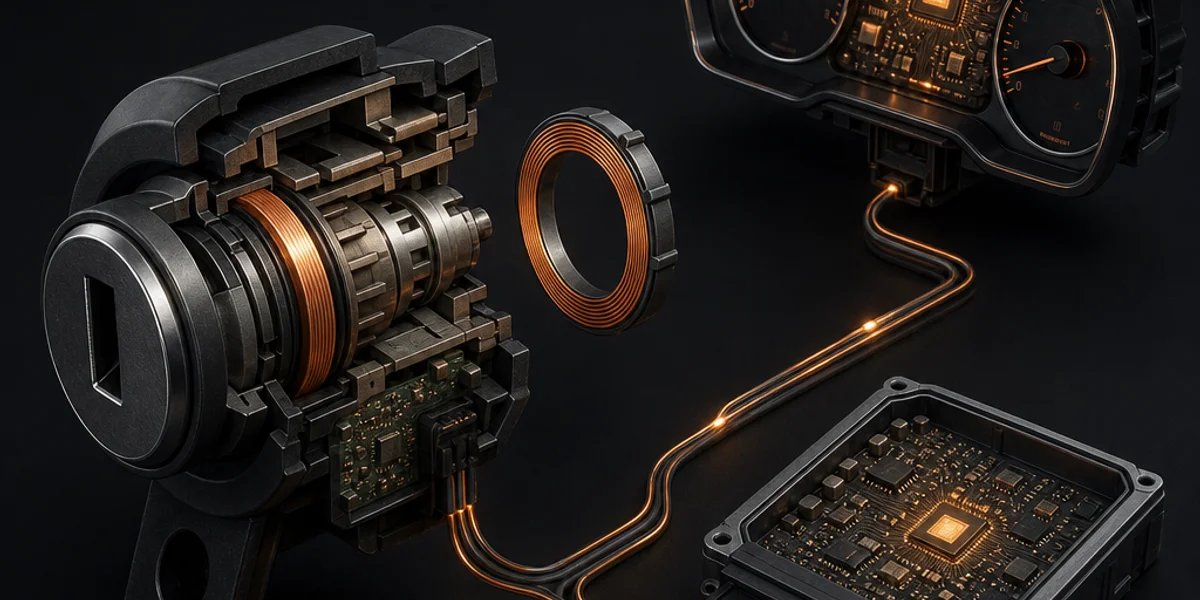
The X-Type X400 and the S-Type X200 and X204 are Jaguars with Ford underneath, and the security reflects it. Both run Ford-derived PATS, with distributed authentication between the instrument cluster and the engine ECU over a two-wire PATS network and the transponder antenna built as a ring around the ignition barrel. Eight keys maximum. No PIN anywhere.
The key is a four-button flip remote on an FO21 Tibbe blade, carrying a TMS37145 in the Texas DST40 family at 433.92 MHz on a CR2032. The four-button layout — lock, unlock, boot, headlight — is the European specification. The X-Type was built at Halewood and shares both the blade and the 4D60 transponder with the platform-sibling S-Type and the XJ8 of the same era, which means one blank covers a surprising amount of 2000s Jaguar work. These chips clone, so a straight spare does not always need the car.
Add key, with a working key present. The ignition-cycle method still works on this generation:
- Sit in the driver's seat with the door closed.
- Insert a working key, turn to position I, then cycle quickly between I and II four times.
- The alarm chimes once when the cycle is accepted.
- Remove the key. Within 10 seconds, insert each new key in turn and press any remote button — a chime confirms each fob is learned.
- Test lock, unlock, boot and headlight on every key before handover.
- Time: 10–15 minutes. The diagnostic route is faster and far more reliable on a tired cluster, so on an older car go straight to the tool rather than fighting the ignition barrel.
All keys lost. Open the Tibbe lock with a six-cut FO21 pick or decoder, read the cuts, cut a fresh FO21 blade with a 4D60 transponder, then run the tool's all-keys-lost routine over OBD. The tool authenticates against PATS and writes a new key file to both the cluster and the engine ECU. No code is entered by hand. Time: 10–20 minutes. Budget more on early 2001 and 2002 cars: where PATS has already faulted, OBD all-keys-lost occasionally refuses and the cluster has to come out for bench work.
The OBD socket on both cars is in the driver's footwell, exposed, no cover. On the S-Type, pre-facelift X200 cars from 1999 to 2002 sit the port slightly higher and further inboard than the 2003-onwards X204, but neither needs trim removed.
XF X250: one body, two key systems
The XF X250 is where Jaguar stopped being a Ford job. Security moves to the KVM — the Keyless Vehicle Module, which the parts system also calls the RFA — authenticating smart keys by challenge and response over CAN. The KVM holds eight key positions, and there is no separate engine ECU learning step.
The trap is inside the fob. The X250 split into two clear key eras at approximately chassis S61361 in early 2013:
- 2008–2012, Prox-Slot. Full proximity unlock and lock, but the driver still drops the fob into a docking slot on the dash to start the car, and that slot is the failsafe when the fob battery dies. The transponder is a PCF7945, Hitag 2 / ID46, and it clones — an Xhorse Super Chip XT27A66 in Hitag 2 mode or a JMA TPX1 will both take it.
- 2013–2015, Prox Push Button. The dock is gone and the car is pure proximity. The transponder is a PCF7953, Hitag Pro / ID49, and it does not clone at all. OBD or bench only.
Both eras share the HU101 emergency blade and 433 MHz on UK and European cars, and the fob looks identical across the change. Cars sitting near chassis S61361 can carry either chip. Confirm the transponder before ordering the key, every time — the transponder chip cross-reference covers which of these families still clone and which have to be enrolled.
Add key. Connect at the OBD port, which on a right-hand-drive X250 is in the driver's footwell to the right of the steering column, tucked up under the lower dash above your right knee and facing downward. Take a torch. Select the matching key era, let the tool read the security code out of the KVM automatically, then choose Add Key. On Prox-Slot cars present the new fob to the dock slot when prompted; on Prox Push Button cars hold it against the start button or in the centre console pocket. Test all five buttons and engine start. Time: 15–30 minutes.
All keys lost. Open the door with an HU101 pick or by decoding the lock, cut a fresh HU101 blade, and fit a fob with the matching transponder for the car's era. Run the all-keys-lost routine — the tool extracts the code from the KVM, writes the new key file and synchronises the engine ECU. Time: 30–60 minutes. Add real contingency on early Prox-Slot cars: a tired KVM, an alarm-trip lockout or a previously failed write leaves the module encrypted, and then it comes out for an EEPROM read, edit and write before any tool will touch it over OBD.
One detail worth pricing in. On initial setup this system wants a minimum of two keys, and that process wipes every key previously registered. Once two are active, further keys add individually without disturbing them.
The other thing that decides an X250 job is whether the module is locked. Abrites' own guide to modern Jaguar and Land Rover key programming states the working assumption plainly: a KVM is to be treated as locked if the car has been serviced at a dealer at any point since 2018. On a 2010 XF that has been maintained properly, that is most of them. A locked module does not stop the job, but it changes which function you use and which key you can fit, and it is the difference between a one-hour visit and a three-hour one.
The XJ and F-Type: same shell, different module
The XJ X351 carries the same lesson in a different place. Around model year 2015 it moves from the KVM-based Hitag Pro architecture to a BCM2-based Hitag AES architecture shared with the XF X260 and the Range Rover L405. The fob shape, the button count and the HU101 blade are unchanged across the cutover. The chip and the module that authenticates it are not, and XJ KVM keys and BCM2 keys are not interchangeable.
Add key runs 10–15 minutes on a KVM car and 15–25 minutes on a BCM2 car. All keys lost is where the two diverge sharply. On a KVM car, 30–45 minutes over OBD with a Jaguar-capable tool. On a BCM2 car, the standard route is to pull the BCM2 from behind the glovebox, read the EEPROM and the ISN on the bench, generate the dealer key file, refit and finish the learn over OBD: 90–180 minutes including bench time. A handful of premium tools claim BCM2 all-keys-lost without removing the module, but only behind a token-paid online calculation step.
The F-Type runs KVM from 2013 to 2017 and then crosses to the RFA and DoIP architecture in mid-2017. On the KVM cars, the new fob goes in the auxiliary slot under the cup-holder cover, and add key is 8–12 minutes per key. All keys lost is 30–60 minutes over OBD on early KVM software. From the 2015 build onwards Jaguar tightened the KVM firmware, so on-the-day OBD all-keys-lost gets noticeably harder and the bench read becomes the reliable route at one to two hours.
A useful note for ordering: genuine keys supplied after 2020 frequently arrive with NCF2951 silicon in place of PCF7953. Both are Hitag Pro and both programme identically through the dealer-level chain, so an unexpected part number on a new key is not a fault.
Why a 65-plate XF might be the wrong car
The second-generation XF X260 reached UK showrooms in September 2015, which means a 65-plate XF can be either generation. Get it wrong and every chip, module location and procedure you have planned belongs to a different car.
The tell is visible from the driver's seat and takes two seconds. The X250 has a slot in the starter control unit that the fob pushes into. The X260 has no dock at all, and instead has a marked reader area on the side of the steering column. Check that before you check anything else.
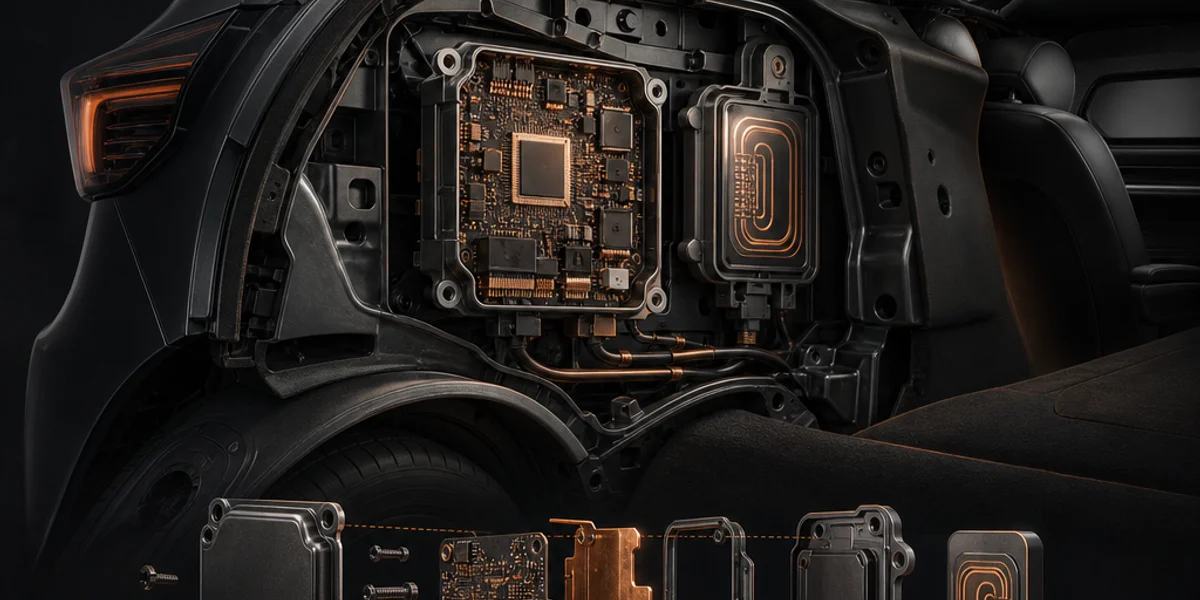
On 2015–2020 X260 cars the KVM owns the key credentials, driving the 125 kHz low-frequency aerials in the door handles and cabin and taking the 433 MHz reply. That module lives behind the right-hand rear interior trim, above the wheel arch and below the rear screen, next to the aerial module. Read its label: the prefix is AH32, BJ32, DPLA, FK72 or HPLA, and the processor is an MC9S12XET256 or MC9S12XEQ384. Both decide which menu you pick, and the toolmakers index their coverage on exactly those prefixes — Abrites, for instance, name DPLA, FK72 and HPLA on the locked-module function and JPLA, J9C3 and K8D2 on the later ones. A photograph of that label is worth more than the registration document. On a saloon with a fixed rear seat, the trim is part of the seat back, so getting a programmer onto that module means the rear seat base and back come out. Allow real time for that before you quote a bench job.
There is no onboard route on this car. No ignition cycle, no door-lock sequence, no pedal dance. Every added key goes through a tool or the factory system. There is also no cloneable transponder in the fob, so what the trade actually does is write the original key's identity onto an identity-rewritable aftermarket smart key, or write a fresh identity into the module.
Add key over OBD, module unlocked. Put a proper bench supply on the battery — not a booster pack — and read the module identification. Connect at the driver's footwell socket, which sits horizontally in the underside of the lower dash above the accelerator pedal; from the seat you are looking at its thin edge and most people conclude it is not there. Get on your knees and look up above the pedals. Present the existing working key so the tool reads its identity and position, pick a free position, put the identity-writable key in the coil and write. With eight positions, a two-key car has room. Back at the car the buttons usually work immediately but the proximity side can take a minute: hold the new key against the marked reader area on the steering column with the engine running for a minute or two, then walk the other keys away and test passive start properly. Time: 25–45 minutes.
All keys lost. Power first, then the alarm, then the key. With every key gone the car sits armed and the module normally refuses to answer, so either run an alarm-off routine that unlocks the BCM, or get onto the internal CAN pair so the tool reaches the security module past the armed state. Then connect at the footwell socket, switch the hazards on with the ignition off when prompted, and let the tool read the VIN and report a key count of zero. Choose the lost-key function and write the identity-writable key inside the few seconds the tool allows. Press its unlock button immediately to silence the siren. Programme a second key while you are there — this system expects a pair and a single-key car is a job half done. Time: 60–120 minutes, more if the module is locked. Remember that all-keys-lost clears every key the car previously knew, so any original the customer later finds is dead unless you write it back.
Emergency entry on this car catches people out. The mechanical lock is in the front left-hand door, which on a UK right-hand-drive XF is the passenger side. Release the emergency blade from the fob, find the slot on the underside of the small cap at the rear of that door handle, insert the blade, lever gently upwards and twist to pop the cap off its clips. The cylinder is behind it. Expect the alarm, and expect a painted cap to mark if you are heavy-handed. Emergency start with a flat fob battery: hold the fob flat against the side of the steering column with the buttons facing outward, using the moulded locating marks, then press the brake and press START/STOP.
The RFA era: two keys, and a ranging system that says no
This is the awkward one, and the reason a facelift Jaguar is worth quoting properly rather than off the phone.
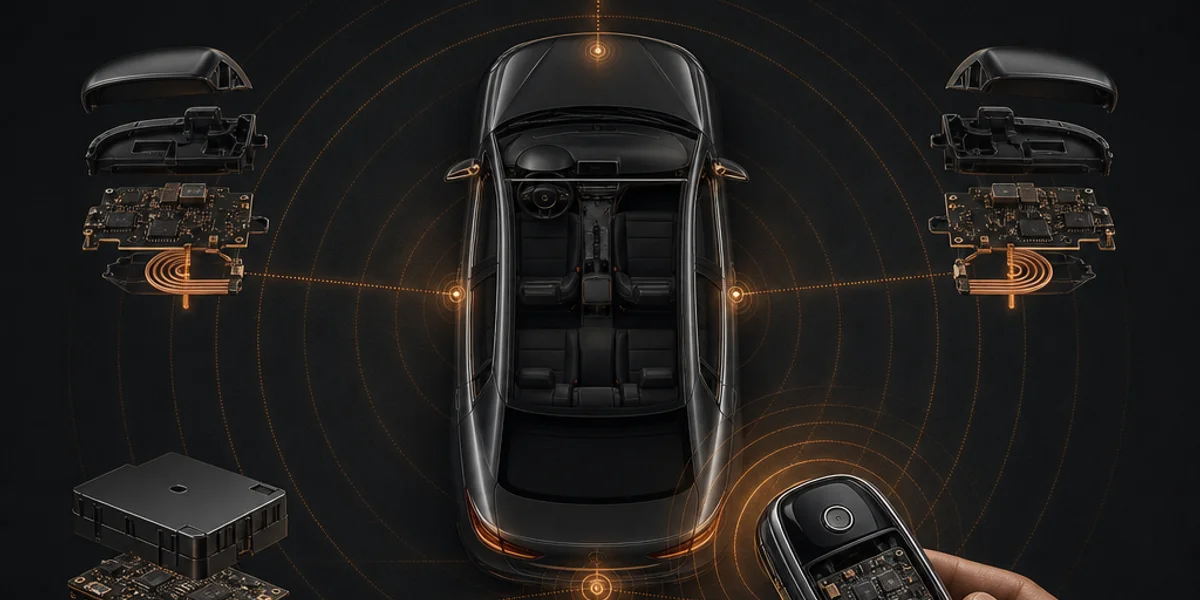
From 2018 the security module becomes an RFA — Remote Function Actuator — built around an SPC560B60L3 secure processor and carrying a JPLA, K8D2, J9C3 or M9R3 prefix. It appears on the XF facelift from 2021, on the E-Pace X540 from launch in 2017, and on the F-Type from mid-2017. Three consequences follow, and all three belong in the quote.
The RFA accepts two learned keys and no more. Not eight. Two. If both positions are filled and the customer wants a third key, you are into renewing the module's secure processor or fitting a new module before you write anything. There is no way round it, and it is better said at the kerb than at the end. Abrites describe the same constraint from the tool side — the standard Jaguar Land Rover answer to a full RFA is to replace it — which is exactly what a dealer will quote for.
Proximity ranging defeats most aftermarket key programming. Alongside the low-frequency link and the 433 MHz reply, cars built with keyless entry use separate ranging modules on their own bus to measure the time of flight of a very high-frequency signal and work out how far the key genuinely is. Jaguar Land Rover's chief electrical engineer has said publicly that ultra-wideband has "killed off" relay hacking, and the theft figures the manufacturer quotes for its newest cars support that. It also defeats you. An aftermarket key, or a genuine key without the ranging hardware, will only take if the ranging function is switched off in the vehicle configuration first — and some tools do that silently when they connect. The key you then hand over will lock, unlock, open the boot and emergency-start. It will not do touch-the-handle entry or true hands-free start. Say that to the customer before you cut anything.
This is not one vendor being cautious. Abrites state it as a known outcome of their own 2018-on key licence: on an ultra-wideband car the procedure takes the remote and does not take the transponder. When several independent toolmakers describe the same half-finished result, that is the shape of the problem rather than a firmware gap waiting to close.
There are exactly two ways to hand over a key that works passively. Fit a genuine ranging key ordered against the VIN and programme it properly, which usually means renewing the module's secure processor first because the module is already full at two keys. Or emulate the ranging side during the learn with a dedicated emulator wired into the aerial loom, so the procedure completes with the transponder half intact. Coding it out and emulating it are not the same job: the first is a configuration change you leave in the car, the second is a bench-and-loom job you undo afterwards.
The 2024 security campaign added a precondition. Following a £15m programme that the manufacturer says has updated more than 216,000 previous-generation and out-of-warranty vehicles, the fix for body control module attacks requires customer authorisation before key programming — through service mode in the vehicle app, or with a valid key detected inside the car. On cars built from 2018 onwards, expect to have to satisfy that before the vehicle will permit key programming at all. Plan the order of work around it rather than discovering it on the driveway.
Module location is worth memorising because the tools get it wrong. On an E-Pace the RFA is in the left-hand side of the loadspace under the fuse box. On an F-Pace the same module sits on the right. Several tablets show on-screen graphics pointing at the right-hand side of the boot or the passenger footwell for the whole marque; ignore the picture and trust the label you read. The E-Pace also carries two physical module builds — a fully populated passive entry and start unit with four low-frequency coil drivers, and a stripped passive-start-only unit with two. A passive entry unit can be configured down to a passive start car. A passive start unit can never be configured up.
One more E-Pace specific worth knowing before you blame the car: the diagnostic socket is fed by its own 5A fuse in the passenger-compartment fuse box, and that fuse moved position when the car went to the facelift electrical architecture for the 2021 model year. A dead socket on an otherwise live car is very often that fuse. Read the label in the car in front of you, not a diagram off the internet. The same logic applies more widely — the OBD port location guide covers the makes that hide theirs.
The F-Pace and the frequency check
The F-Pace X761 runs the JLR KVM over high-speed CAN, with the smart key authenticating by low-frequency and radio-frequency challenge to the KVM, which then validates against the body control module and the engine control module. Eight keys maximum. The security code is derived from the VIN and KVM data, and professional tools either calculate it online from the VIN or extract it from the KVM over OBD. No key card and no PIN sticker exists for this generation.
One honest caveat on the data. The F-Pace record currently in the Keysolved catalogue is the North American car, which runs 315 MHz. UK and European Jaguars of this era run 433.92 MHz, as the X260 and E-Pace records confirm. The UK-market F-Pace record is in research and the frequency is the field to check on the day rather than assume — ordering a 315 MHz fob for a British car is a wasted call-out and an avoidable one.
Tool coverage, honestly
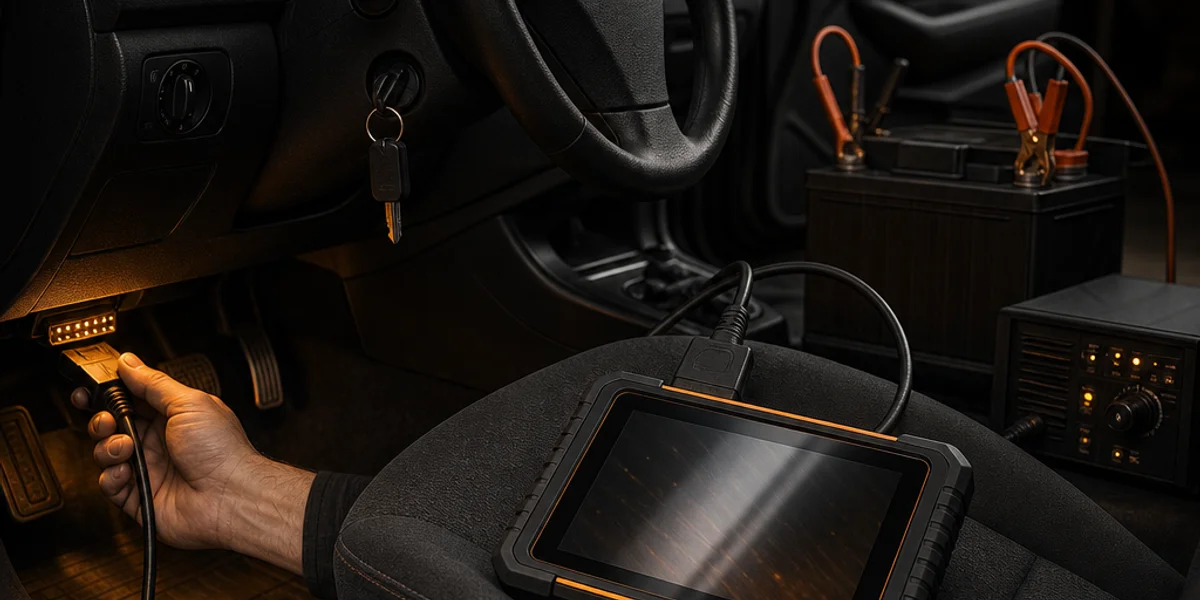
No tool covers the whole marque. The wall is 2020, and it is a hard one.
Full range, including the difficult cars. Abrites AVDI with the PROTAG programmer and the Jaguar Land Rover key licences is the strongest answer on the hard end. Its locked-module function covers the DPLA, FK72 and HPLA prefixes on the X260 entirely over OBD — no internal CAN connection, and it does not care whether the alarm is armed, which makes it the calm option on an all-keys-lost. On facelift cars its read-vehicle-information screen reports the module type, whether it is locked, how many of the two positions are used and whether ranging hardware is fitted, which is the single screen that decides the job. The EM015 UWB emulator is the only realistic way to hand a customer an aftermarket key that actually works passively on a ranging car. The cost is real, and it is not one licence. Abrites split the marque across four of them — unlocked 2008–2017 modules, locked 2008–2017 modules, the 2018–2020 RFA generation, and the later sub-platform that the E-Pace shares with the Defender and the second-generation Evoque — each with its own brand-specific key range. Add internal CAN cabling for armed cars and a live maintenance subscription with internet access throughout the procedure. Original Jaguar keys are only accepted on the unlocked-module function — on a locked module it has to be the tool's own key.
The Autel MaxiIM IM608 Pro II is the other tool that reaches the newest cars, and for one specific reason: it is the only tablet in its family with DoIP built into the interface. The IM508, IM608 and IM608 Pro do not speak DoIP and no software update changes that, so they stop at the pre-facelift cars. Autel's own published Jaguar module-learning lists for the RFA era name the XJ, XF, F-Type, XE and F-Pace and do not name the E-Pace at all, so treat a first E-Pace as a job you scope on the car rather than one you promise on the phone.
Good up to the wall. Lonsdor K518Pro with the JLR-IMMO adapter is the pragmatic choice for everything from the PATS cars through the X260, with no per-vehicle token — the licence has to be activated on the device and the blank must be a Lonsdor JLR key whose identity can be rewritten, set to 433 MHz for a UK car. A fixed-identity blank that reads all zeros will be rejected. OBDSTAR's X300 DP Plus with the P001 programmer covers the 2015–2018 window cleanly, with one catch that wastes a lot of time: the 16-pin main cable and the green gateway converter both have to be plugged in at once or the key programmer will not connect at all. Xhorse VVDI Key Tool Plus with the XDNP16 solder-free adapter is a strong bench option on the MC9S12 modules. Advanced Diagnostics Smart Pro running the ADS2207 Jaguar, Land Rover and Range Rover pack remains the default UK trade choice on the X250, with both add-key and all-keys-lost over OBD and automatic code bypass, at roughly £15 per vehicle in tokens and needing the ADC2000 cable.
Bench and specialist, with real limits. Yanhua Mini ACDP-2 with the 2018-on Jaguar Land Rover module set does processor renewal on RFA boards, and the clip side is solder-free — but it is add-key only on 2018-on cars and will not do all-keys-lost, whatever a reseller listing says, and it will not run while the module is locked in the car or the alarm is live. KeyDIY KD-X4 is fast and cheap for a copy on a facelift car, and honest about its three limits: you need a key to read, you get exactly one spare before a third key becomes a module job, and it switches ranging off on connection so the copied key will never do touch entry. Xtool's KC501 and X100 PAD3 are bench propositions on this marque rather than tools you would buy for it.
The factory route. JLR SDD, Pathfinder and the current cloud application remain the only route that leaves a car with a genuine key, full proximity and nothing coded out, and the only route for configuring a virgin module. Know which application the car needs: the older symptom-driven software covers roughly up to 2017, Pathfinder the 2017 to 2022 window, and the cloud environment everything newer. The sting is the account. A module-programming subscription on its own will not let you replace a security module, a body control module or a telematics unit — those are security functions and need accreditation with vetting behind it. In the UK that now runs through the SERMI scheme, which went live on 1 April 2026 with 22 manufacturers including Jaguar Land Rover in the launch group. Accreditation currently runs at £1,800 plus VAT as a one-off for an owner and one technician, or £30 per month plus VAT, with £125 for each additional technician. The scheme is voluntary, so it is a business case rather than an obligation — but for a shop doing occasional Jaguar work, buying the session in from a remote-programming service is usually the proportionate answer. Keysolved's programmer coverage matrix counts confirmed coverage across the catalogue if you are weighing a purchase.
Common pitfalls
"Key learnt successfully" and the car still reports no key detected. On a ranging car the learn completed the remote half and left the transponder half dead. Hold the key against the marked reader area on the steering column and press the brake and START/STOP: if it starts that way, the transponder took and the proximity side did not. The fix is the emulator during the learn, a genuine ranging key, or telling the customer what they have.
The module reports locked. This is a software state, not damage, and by now most cars that have seen a dealer since 2018 are locked. Either use a key-learning route written for locked modules — which write to the tool's own identity-changeable key and will refuse an original Jaguar key — or take the module out, read the program flash on the bench, clear the lock in the dump and write it back.
Loading the body control module dump alongside the keyless module dump. On the X260 bench route this produces "this file is not supported by current module", and it is the single most common reason that job stalls. Load the keyless module's own D-Flash and EEPROM only, and make sure both came off the car in front of you: a module pair from different vehicles will never agree.
Fitting a second-hand KVM. It is not a shortcut. A used module out of another XF has to be virginised before it will take this car's VIN. Drop one straight in and the key ends up learned to the instrument pack instead, which gives you a car that only starts with the fob held against the steering column and complains about the key every time it is driven.
Quoting an E-Pace from the tool's own picture. The module is on the left of the loadspace. The graphics point right. Trust the label.
Taking an all-keys-lost on a 2021-on car over the phone. Between the two key positions, the locked module, the armed alarm and the ranging hardware, there are four independent reasons that job becomes a module rebuild. Read the vehicle first. Where the body control module is locked outright, the standalone unblock devices can need anywhere from twenty minutes to seventy-two hours with the car powered throughout — which is a job you plan around, not one you absorb.
Arriving with a CAN-only interface on an 18MY-on car. It will not enumerate the security module and it will not open a factory session. DoIP needs Ethernet-capable hardware, not a software update — Snap-on list separate cables and scan modules for it rather than a firmware release. No amount of menu-hunting changes that.
For warning lights that look like a key fault but are not, the immobiliser fault diagnosis guide works through symptom to cause across the UK architectures, and the ghost immobiliser guide covers the aftermarket units that increasingly sit on top of these cars.
Entitlement and the law
Jaguar key work sits close enough to vehicle theft that the paperwork is not optional. Take the V5C and photo identification for any key ordered against the VIN, and expect to be asked for further proof of entitlement on an all-keys-lost, particularly where the name or address on the V5C does not match the person standing in front of you. If the answers are vague, walk away. A rare, high-value make is exactly where a bad job finds you.
This matters more than it did. The Crime and Policing Act 2026 received Royal Assent in March 2026, and Section 110 creates offences of possessing, importing, manufacturing or selling electronic devices used in vehicle theft — relay attack tools, CAN bus injection devices, signal jammers and emulators. Thatcham Research's own read on it is blunt: the Act "places the burden of proof firmly on the owner and seller of these tools to demonstrate a legitimate purpose." For a working locksmith with licensed diagnostic kit, invoiced jobs, customer identification on file and trade association membership, that burden is straightforward to discharge. For anyone who keeps no records, it is not. Keep the paperwork.
Frequently asked questions
Can a Jaguar key be cloned?
Only on the older cars. The 4D60 transponder in the S-Type and X-Type clones readily, and the PCF7945 Hitag 2 chip in a 2008–2012 XF clones with an Xhorse Super Chip XT27A66 in Hitag 2 mode or a JMA TPX1. From the PCF7953 Hitag Pro onwards — which means every XF from about 2012, every X260, every F-Type and every E-Pace — there is no cloneable transponder in the fob. The trade route is to write the original key's identity onto an identity-rewritable aftermarket smart key, or to write a fresh identity into the module. The cloning versus programming guide sets out where that wall sits across the chip families generally.
How many keys can a Jaguar hold?
It depends entirely on the module. Ford PATS cars hold eight. The KVM in the X250, X260 and F-Pace holds eight. The RFA in the facelift XF, the E-Pace and the 2018-on F-Type holds two and no more. Read the key count before quoting a spare: on an RFA car with two working fobs, a third key means renewing the module's secure processor or fitting a new module.
Do you need a PIN or security code for Jaguar key programming?
No Jaguar has a customer PIN, incode or code card. Authorisation comes out of the KVM, RFA or body control module itself. Professional tools either read it over OBD, calculate it from the VIN online, or extract it from a bench dump of the module. There is no number for a customer to produce and no paperwork that carries one.
Where is the OBD port on a Jaguar?
Driver's footwell on every model in the catalogue, but the exact position varies more than you would expect. On the X260 XF it sits horizontally in the underside of the lower dash above the accelerator pedal, edge-on to the driver, and most people decide it is not there. On the E-Pace it is low against the centre console at ankle height and invisible from the seat. On the X250 XF it is to the right of the column facing downward. Take a torch and get into the footwell properly.
Why does the new key work the buttons but not start the car?
On a 2018-on car with keyless entry, this is proximity ranging. The key learned as a remote and the ranging side refused it, so the car does not accept it as present. Test by holding the key against the marked reader on the steering column — if it starts that way, that is your answer. Fixing it properly means a genuine ranging key or a ranging emulator fitted during the learn.
Can an aftermarket tool do all-keys-lost on a 2021 Jaguar?
Sometimes, and not reliably. On the RFA generation several routes are explicitly add-key only, and the ones that do attempt all-keys-lost need the alarm dealt with first and an unlocked module. The honest answer on a late car is that the realistic route is often a bench job on the module or the body control module EEPROM, at one to three hours, or buying a factory session in from a remote-programming service. Scope it on the car.
The short version
Jaguar is a read-before-you-quote make. Five security eras, two of them splitting mid-generation without changing the key, and a 2018 boundary after which the module holds two keys and the ranging hardware refuses most aftermarket work. The module label tells you the job; the plate year does not.
The jobs worth taking confidently are the PATS cars and the X250, where the procedures are settled and the times are predictable. The X260 is straightforward with the right tool and expensive to get wrong. From 2018 onwards, read the vehicle, count the key positions, check for ranging, and price what the customer will actually receive.
Before the next one lands, look it up. The Keysolved Jaguar catalogue carries the key variants, transponder types, frequencies, blade profiles, module locations, OBD positions and per-tool compatibility notes for all eight models, including the module prefixes and processor part numbers you need before deciding whether a job is a twenty-minute add-key or a rear seat on the driveway.
Full database access
Check the Jaguar Before You Quote
Cancel any time · Billed monthly in your local currency
Look up the key variants, transponder type, frequency, blade profile, module location and OBD position for any Jaguar on Keysolved — including the module prefixes that decide the job.
No card required to browse — subscribe to unlock full specs and procedures
Frequently Asked Questions
▶Can a Jaguar key be cloned?
▶How many keys can a Jaguar hold?
▶Do you need a PIN or security code for Jaguar key programming?
▶Where is the OBD port on a Jaguar?
▶Why does the new key work the buttons but not start the car?
▶Can an aftermarket tool do all-keys-lost on a 2021 Jaguar?
Full database access
Sixty Makes, One Lookup
Cancel any time · Billed monthly in your local currency
Keysolved holds key specs, programming procedures, OBD locations and per-tool compatibility across sixty manufacturers, written for working auto locksmiths.
No card required to browse — subscribe to unlock full specs and procedures
Sources
- SERMI goes live in UK with backing of 22 manufacturers(2026)— CAT Magazine on the UK launch of the SERMI security-information accreditation scheme on 1 April 2026, with Jaguar Land Rover among the backing manufacturers, including accreditation costs.
- Crime and Policing Act 2026 strengthens UK vehicle security(2026)— Thatcham Research on Section 110 offences covering electronic devices used in vehicle theft, and the burden of proof placed on tool owners to demonstrate legitimate purpose.
- The ultimate guide to modern Jaguar/Land Rover key programming from an Abrites perspective(2024)— Tool-manufacturer documentation of the KVM and RFA module prefixes, locked-module assumptions from 2018, the two-key RFA limit, and ultra-wideband behaviour during key learning.
- JLR's letter: what Land Rover is doing to stop your older car getting nicked(2024)— Car Magazine on JLR's GBP 15m security programme covering more than 216,000 vehicles, ultra-wideband from 2018, and the body control module fix requiring customer authorisation before key programming.
- Ethernet/DoIP Communications(2025)— Snap-on diagnostics documentation listing the Jaguar and Land Rover models requiring DoIP and the Ethernet-capable hardware needed to reach them.