
Mercedes Key Programming: Complete Locksmith Guide (All Models)
FBS3, FBS4 and the Renault-built outliers — procedures, job times and honest tool limits across 26 vehicle records
Key Takeaways
- Mercedes splits into four drive authorisation systems — infra-red W168 era, FBS3, FBS4 and the Renault-built Citan. Identify the generation before you quote, not on the driveway
- FBS3 keeps the security data in the car: the password is recovered from the EIS itself, with no dealer PIN, Car Pass or incode anywhere in the process
- FBS4 from 2014 onward has no aftermarket OBD route at all. The EIS is locked and key authorisation sits on Mercedes' servers — the legitimate paths are XENTRY Online, the Abrites module-replacement route, or SERMI accreditation
- On the R171 SLK select W211, never W203. The car sits on the W203 platform but carries the W211-family HC12/ST12 ignition switch
- The Citan is a Renault Kangoo II. Every tool route goes in under Renault, none will find it by VIN, and every key not presented during the routine is erased permanently
- A dead ELV on a W204, W207 or W212 looks exactly like an immobiliser fault and is not one — dark cluster and no ignition usually means the steering lock, not the key
Mercedes is the make that separates locksmiths who own the right kit from locksmiths who own a tablet. A Ford Focus is a fifteen-minute job on almost anything. A Mercedes could be a five-minute add-key, a two-hour bench recovery, or a job you have to hand back — and the only way to know which is to identify the drive authorisation generation before you quote.
Mercedes key programming in the UK breaks into four distinct systems, and the boundaries between them are hard rather than gradual. Get the generation right and the job is predictable. Get it wrong and you have driven to a job you cannot finish, or quoted forty-five minutes for something that will take you three hours.
This guide covers all four, with the procedures, realistic times and honest tool limits for each. Every specification here comes from the Keysolved vehicle database, which holds 26 Mercedes-Benz vehicle records across 14 models and the full generation range.
The four systems, and how to tell them apart
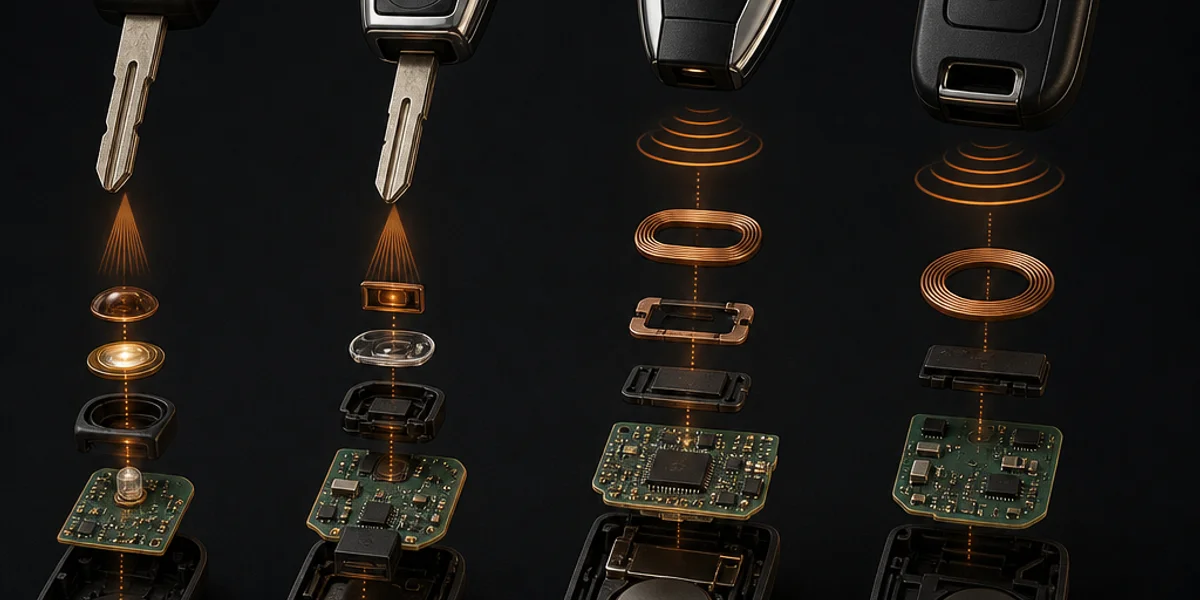
Everything Mercedes has fitted in the last thirty years falls into one of these.
Infra-red key era (roughly 1997–2004). The W168 A-Class is the clearest example. There is no conventional transponder anywhere on the car — key authentication runs over a proprietary infra-red beam from the key head to the EIS column receiver. The database records the key frequency as 0 MHz, which is not an error. There is no RF circuit involved in starting the vehicle at all. No standard transponder tool will see anything, and there is nothing to clone.
FBS3 / DAS3 (roughly 2004–2014). The bread and butter. The EIS (also called the EZS) is the controlling module, and it authenticates the key over infra-red in the ignition slot. The critical property is that the security data lives in the car. There is no dealer PIN, no Car Pass card and no incode. A password is recovered from the EIS itself — read out instantly with a working key, or calculated server-side after collecting data for an all-keys-lost. This is why FBS3 is workable for the aftermarket and FBS4 is not.
FBS4 / DAS4 (2014 onward on new platforms). The EIS is locked against being read out over OBD, and key authorisation lives on Mercedes' central servers in Germany. The W205 C-Class launched on FBS4 with no pre-facelift FBS3 window, so the entire 2014–2021 run behaves the same way. There is no aftermarket OBD add-key. More on this below, because it is the single most misunderstood thing in Mercedes work.
The Renault-built outliers. The Citan W415 has a three-pointed star on the grille and a Renault Kangoo II underneath it. There is no EIS, no DAS module and no infra-red key anywhere on the van. The immobiliser is the Renault UCH, and the security gate is the Renault 12-digit after-sales code. Selecting Mercedes on your tool will get you nowhere.
Identify which of these you are looking at before anything else. The rest of the job follows from it.
FBS3: the generation that pays the bills
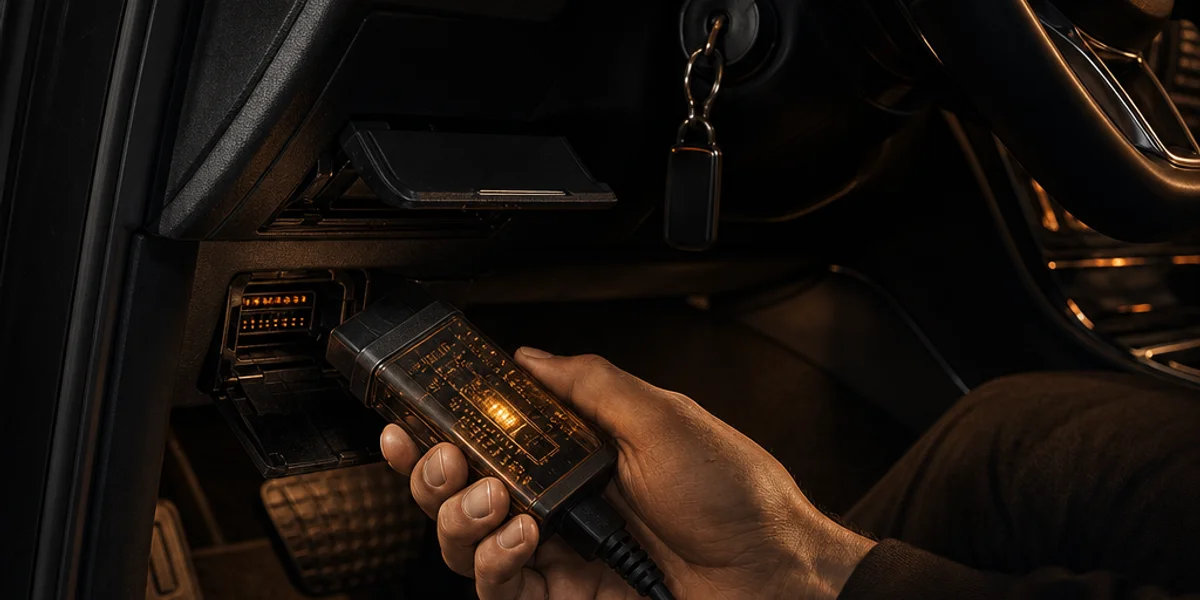
FBS3 covers the W204 C-Class, W211 and W212 E-Class, R171 SLK, W209 CLK and their relations. It is the deepest, best-documented territory in Mercedes work and the generation most likely to be sitting on your driveway.
The architecture is worth understanding because it explains the timings. On the R171 the EIS, the electric steering lock, the engine ECU and — on 7G-Tronic 722.9 cars — the transmission controller each compute and compare the authentication hash independently. Every one of them must release before the engine will crank. The EIS is also the gateway between interior CAN B and engine-bay CAN C, and it carries the diagnostic socket, so every tool operation you run passes through it.
The EIS holds 8 key tracks with 3 slots each. Data collection fails outright if every position is already occupied, which is a trap worth knowing before you start rather than after.
Add-key procedure, FBS3
- Verify the vehicle and confirm proof of ownership — V5C and customer ID before the tool comes out of the van.
- Check what the customer's working key actually is. If it is a BE key, the password reads directly out of the key over infra-red at no cost and you skip the collection run entirely. This one check saves more time than any other habit on Mercedes.
- Connect to the OBD socket. On the W212 the port is in the driver's footwell behind a small flip-down cover beside the bonnet release — the car also carries a legacy 38-pin round socket in the engine bay, but all FBS3 key work happens on the 16-pin socket. Port locations for the rest of the range are in the OBD port location guide.
- Read the EIS data and identify the switch type. On the R171 the ignition switch is the W211-family part (A211 545 xx 08) running the CAN-protocol Motorola HC12, usually written ST12. Select W211, never W203, even though the car sits on the W203 platform.
- Recover the password — instant with a working key, or a collection run followed by server calculation.
- Generate the key file and write to a renewable BE or NEC key.
- Learn the key in the ignition slot, then insert and remove it several times until the red lamp stops sitting on.
- Test: engine start, central locking, and confirm the key is set to 433.92 MHz rather than 315 MHz. A key on the wrong frequency will start the car but will not lock it.
- Time: 30–50 minutes for a straightforward add-key with a working key present.
All-keys-lost procedure, FBS3
The same shape, with the password recovery replaced by a collection run. Understanding what the tool is actually doing explains why the times are what they are: the password is brute-forced out of a space of 8,192 sixteen-digit combinations, and usually falls somewhere between five hundred and twelve hundred attempts at roughly half a second to two seconds each.
That is why the accelerator hardware matters. A G-BOX3 fitted to the ignition fuse gives around a fourfold speed-up on the W211 switch group — expect roughly fifteen minutes for the password rather than a simulator being inserted north of nine hundred times. Abrites' fuse relay achieves a similar effect by a different route.
Time: 90 minutes to 3 hours, depending on switch family, accelerator hardware and whether the EIS has to come out for a bench read.
Be honest with the customer about the range rather than quoting the best case. On the R171 in particular, reading the password out of the ignition switch over infra-red works well on the older K-line HC08 switches and very poorly on the HC12/ST12 unit this car carries — so plan on a server-side calculation or a bench read, and price accordingly.
FBS4: where the aftermarket genuinely stops
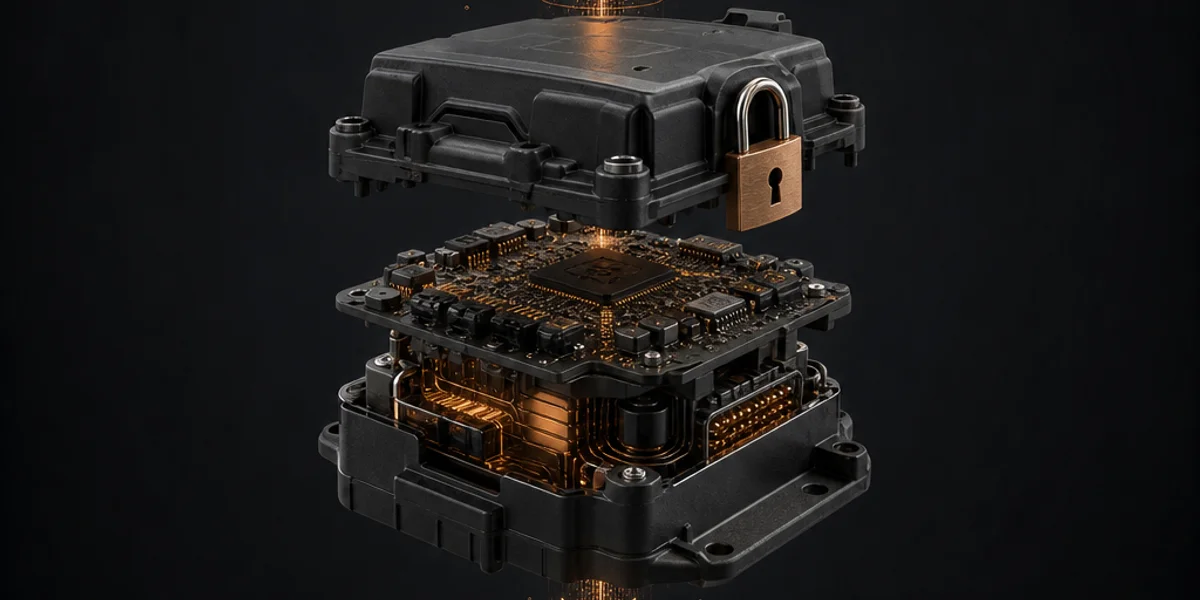
This is the section most Mercedes content gets wrong, so it is worth being blunt.
On an FBS4 car — W205 C-Class, W213 E-Class, W177 A-Class and the rest of the post-2014 platforms — there is no aftermarket OBD key programming. Not a slow one, not one with the right adapter. A generic key programmer plugged into the socket will not enrol an FBS4 key, and any supplier telling you otherwise is selling something.
The reason is architectural rather than a coverage gap waiting to be filled. The EIS is deliberately locked against read-out over OBD, and the key authorisation data sits on Mercedes' central servers, released only to an FBS4-authorised XENTRY Online account. There is no locally recoverable PIN because the secret is not in the car.
Aftermarket vendors list these fobs around the Hitag Pro or ID47 class, and the database records NCF2951 on the late W205 variants. Treat that as a labelling guide only. The FBS4 crypto layer sitting on top is Mercedes-proprietary, and the chip family tells you nothing about whether the key can be produced locally. It cannot.
That leaves two legitimate routes.
Route one — dealer or XENTRY Online. Open a case with Mercedes, prove ownership, get the VIN released, and a key is ordered pre-coded to the chassis and synced to the car. Typically one to two weeks. Most dealers want the vehicle present.
Route two — the specialist module path. Abrites AVDI with the Mercedes MN licence pack, including the FBS4 personalisation and DAS Manager licences, recovers an all-keys-lost car by fitting and personalising a used or virgin EIS — and matching the ECU, ESL and transmission controller where needed — so that a key you control starts the vehicle. Keys are then added from there. Abrites' own release notes for MN032, the DAS Manager licence for FBS4 cars, describe resetting FBS4 control units to virgin state, reading and saving personalisation data, and transferring it to replacement modules across ECU, TCU, ISM, DSM and EIS/ELV.
Note carefully what that is and is not. It does not read or calculate the original locked EIS over OBD. It works by swapping in a module you control. It requires the relevant licences active, usually a donor EIS, bench access to modules that must be undamaged and readable, and it is expert-level work. Abrites themselves described the FBS4 adaptations as pioneering new and uncharted territory and still working out the rough edges.
Time: 3–6 hours for a module-route FBS4 recovery, assuming the donor EIS is in hand and every module reads cleanly. This is not a driveway job.
The SERMI route is now open
There is a third route that did not exist a year ago. SERMI — the scheme for Security-related Vehicle Repair and Maintenance Information — became operational in the UK on 1 April 2026, after approval in January 2026. Accredited independent operators gain standardised access to manufacturer security data for key programming and immobiliser work through one central approval system rather than negotiating with each manufacturer separately.
Accreditation is not trivial. The Independent Garage Association's guidance sets out the requirements: ownership documentation, public liability insurance above £1 million, basic DBS certificates for the owner and nominated employees, and proof of automotive sector experience. The certificate runs five years with at least two audits in that period, one of them an unannounced site visit.
For any locksmith taking regular FBS4 work, that is the direction of travel. It is the only route that turns FBS4 from a job you refuse into a job you can price.
The vans
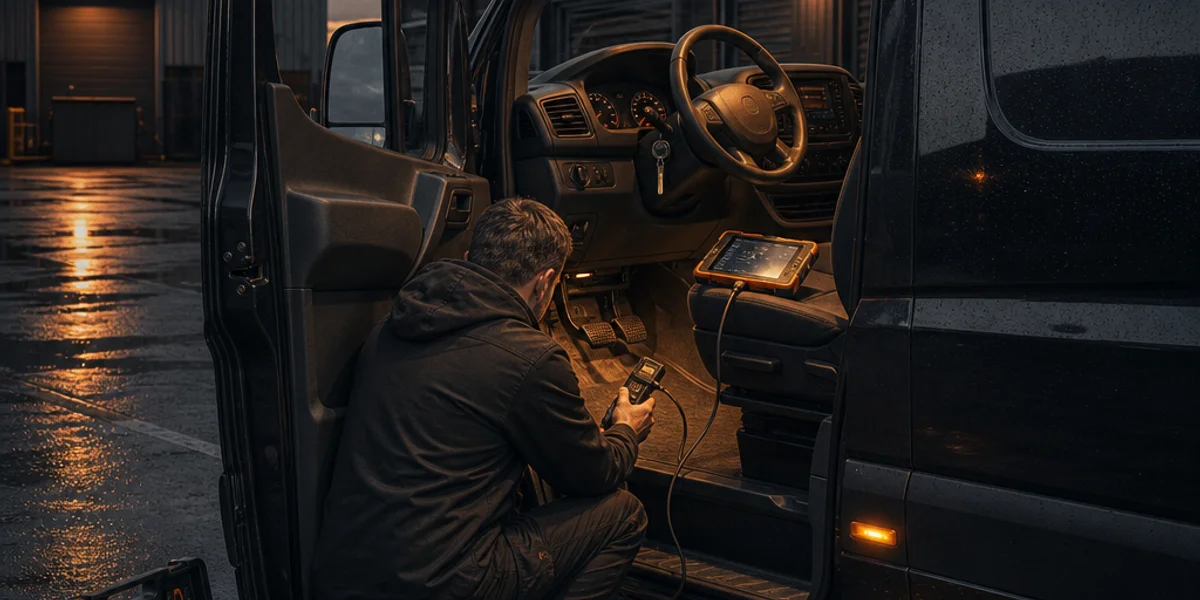
Van work is where Mercedes gets commercially interesting, and the systems do not line up with the cars.
Sprinter W906 splits mid-generation. Early builds (2006–2010) use an NEC-based transponder; later builds transition to the Hitag AES family with a PCF7961 and a YM15 blade in place of the early HU39. Add-key runs over OBD with a working key; all-keys-lost needs an EIS EEPROM bench read. Add-key time: 40–60 minutes.
Sprinter W907 moves to NCF2951 Hitag Pro with an HU64 blade, remote head key on base trim and smart key higher up. Add-key over OBD is confirmed. Some 2021-onward vehicles require online server authorisation steps, so check before quoting.
Vito W447 stays on PCF7961 Hitag AES with an HU43 blade — closer to the W204 workflow than to the W205 car of the same era. Cloning is not possible; add-key over OBD, all-keys-lost via bench EIS read.
Citan W415 is the one to read twice. Because it is a rebadged Kangoo II, every tool route goes in under Renault, not Mercedes. Autel, Lonsdor, OBDSTAR and Xhorse all list it under Kangoo II 2008- or 2012+, and none of them will find it by VIN — the van carries a Mercedes VIN starting WDF or W1V that does not appear in any Renault identification table. Select it by hand. The UCH holds a maximum of four keys, and every key not presented during the routine is erased permanently, so collect them all before you start. Keep the supply above 13 V; a voltage dip during learning can leave the van with zero allocated keys and turn a spare-key job into a full recovery. Time: 30–45 minutes with the code reading cleanly over OBD.
Tool compatibility, honestly
The database records 25 compatible tools on the W212 alone, which tells you something about how well-served FBS3 is and how thin the ground gets elsewhere. Full per-vehicle matrices are in the tool comparison guide; this is the working summary.
Tier 1 — the Mercedes specialists
CGDI Prog MB — the one handheld whose published Mercedes list names chassis outright rather than leaving you to infer from a sibling. Collection with a working key runs about a minute fifty, server calculation about forty seconds. It identifies switch type and CAN protocol itself. It ships with one free token, so the first AKL calculation is effectively free; after that expect roughly £4–5 a token or an annual service, capped at four calculations a day. It also renews W204, W207 and W212 ELV units with the steering lock simulator. Verdict: if you do Mercedes weekly, buy this first.
Xhorse VVDI MB Tool — full FBS3 coverage, 1 token for add-key and 2 for all-keys-lost. Handles NEC v51 and v57 keys without soldering. The ESL Tools menu reads the steering lock over K-line and tells you whether it is damaged, which on a W204 or W212 is not a luxury. Buy the mains adapter — it enables the fast collector on the W169/209/211 switch group.
Abrites AVDI — the only credible aftermarket route into FBS4, and the strongest option on awkward FBS3 recoveries. No per-job tokens; the cost is the licence plus an active subscription. The add-key side carries a genuinely useful extra: automatic key activation that bypasses the factory 24-hour delay before a new key goes live.
Tier 2 — capable with the right accessories
Autel MaxiIM IM608 Pro II — strong FBS3 coverage, and the ignition switch stays in the car on most W211-family jobs. The XP400 Pro is what makes it possible, not the tablet; it carries the infra-red emulator. The plain XP400 will not do it. Add a G-BOX3 and an APB112 simulator or the collection run becomes impractical.
Autel MaxiIM IM508S — reaches the same Mercedes functions, but the bundled XP200 will not do third-generation Mercedes work at all. Budget for the XP400 Pro and a G-BOX before assuming this covers you.
Xhorse VVDI Key Tool Plus — same Xhorse FBS3 engine as the MB Tool in a tablet form factor. Reading a BE key's password is free; online calculation is 1 token add-key, 2 all-keys-lost.
Lonsdor K518Pro — EZS read, data upload, password query, key calculation. Add-key with a working key is quick; AKL goes through the online query.
OBDSTAR X300 Classic G3 — password calculation is online, five to ten minutes, and carries no token charge. It needs the separate Benz FBS3 kit, and that kit runs only on the Classic G3 with the MP001 programmer — not the X300 DP Plus or Pro4. It also does the FBS4 DSM222 virgin reset under a paid licence.
Tier 3 — situational
Advanced Diagnostics Smart Pro — the Mercedes solution (ADC260 plus ADS2298) covers slot and IR keys 1996–2014. Server-side password calculation at no charge, and it shows which of the 8 key slots are free so you cannot overwrite a working key. The unit must be online for the whole job: no signal on the driveway means no key. All-keys-lost needs the separate ADC2600 cable kit.
IEA ZedFull — workable on FBS3 with the Mercedes MBC cable set. No per-key charge, but a hard ceiling of three keys programmed per day, which matters if you are working a batch.
Yanhua Mini ACDP-2 — listed against W205 in the database for completeness only. It does gearbox and DME cloning. It does not do W205 EIS key programming. Do not buy it for Mercedes keys.
Common pitfalls
"Key learnt successfully" but the engine will not start On FBS3 the EIS is not the only module that has to agree. The engine ECU, the steering lock and — on 722.9 cars — the transmission controller each compute the hash independently. If the key has learnt but the car will not crank, suspect a module that has not synchronised rather than the key itself.
The steering lock is dead and you blamed the key The ELV fitted to the W204, W207 and W212 is a known weak point. The internal motor or its NEC chip fails, the column stays locked, and terminal 15 dies — dark cluster, no ignition. The symptom looks like an immobiliser fault and is not one. CGDI Prog MB and VVDI MB Tool both renew or emulate the ELV; on the R171 the Abrites emulator is plug-and-play once set to the W203 profile.
You selected W203 on an R171 SLK The car sits on the W203 platform and the steering lock is a 203-series part, which makes this a very easy mistake. The ignition switch is not — it is the W211-family HC12/ST12 unit. Work it as a W211. Bench cabling for it is sold as a single item covering W169, W171, W209, W211 and W245 for exactly this reason.
Data collection fails immediately on an FBS3 car Check whether all 8 key positions are occupied. Collection fails outright when they are. Disable a dead position first.
The new key starts the car but will not lock it Frequency. The tool will switch between 433.92 MHz and 315 MHz, and the UK cars want 433.92. Set it before you write, not after.
You went in under Mercedes on a Citan There is no EIS on that van. Select Kangoo II on the Renault side, by hand. And gather every key first — the routine erases the whole key list and rewrites it.
A data acquisition dies after about four minutes On the Autel platform this is usually a name-resolution problem on the tablet's connection rather than a fault on the car. The password calculation happens on the server; the tablet needs a live subscription and a working connection throughout.
Frequently asked questions
Can a locksmith programme a Mercedes FBS4 key?
Not over OBD, with any aftermarket tool. FBS4 cars from 2014 onward hold key authorisation on Mercedes' central servers and the EIS is locked against read-out. The legitimate routes are a dealer or XENTRY Online order against proof of ownership, a specialist module-replacement path using Abrites AVDI with the FBS4 licences, or SERMI accreditation, which has been live in the UK since 1 April 2026.
How do I tell FBS3 from FBS4 on a car in front of me?
Platform launch date is the reliable indicator, not model year. The W205 C-Class was FBS4 from launch in 2014 with no FBS3 window, while the W212 E-Class stayed FBS3 to the end of its run in 2016. Look up the specific chassis and year range rather than assuming a cutoff year applies across the range.
How long does a Mercedes all-keys-lost take?
On FBS3, budget 90 minutes to 3 hours depending on the switch family and whether you have accelerator hardware fitted. On FBS4 via the module route, 3 to 6 hours with a donor EIS in hand. Through the dealer, one to two weeks.
Can Mercedes keys be cloned?
No, on every generation currently in service. FBS3 and FBS4 both use encrypted challenge-response authentication against data held in the EIS or on Mercedes' servers, and the W168-era infra-red keys have no transponder to clone in the first place. Keys must be enrolled. See the transponder chip cross-reference for which chip families clone and which do not.
Why does my tool not find the Citan by VIN?
Because the Citan is a Renault Kangoo II wearing a Mercedes VIN. WDF and W1V prefixes do not appear in any Renault identification table, so the tool cannot route itself. Select Renault, then Kangoo II, by hand.
Does a flat key battery stop a Mercedes starting?
Not on FBS3. The key is energised inductively by a coil around the ignition barrel, and the authentication runs over infra-red, so a key with dead cells will still start the engine — it simply will not lock or unlock the doors remotely. This is a useful diagnostic: if the car starts but the remote is dead, the immobiliser is fine.
Before you quote
Mercedes rewards preparation more than any other make. Establish the drive authorisation generation first, check what the customer's existing key actually is second, and confirm your own tool's current coverage third — several of the routes above depend on an accessory or a licence rather than the tablet in your hand.
Then price the job honestly. FBS3 is good, profitable work. FBS4 without accreditation is work to refer on, and there is no shame in that; there is considerable shame in taking the booking and finding out on the driveway.
Look up the exact chassis, key variant, transponder, OBD port location and confirmed tool list for any Mercedes in the Keysolved vehicle database — 26 vehicle records across 14 models, generation by generation, with the field notes that do not appear in any manufacturer's documentation.
Full database access
Check the generation before you quote
Cancel anytime · Billed monthly
Look up the exact chassis, immobiliser system, transponder, OBD port location and confirmed tool list for any Mercedes-Benz on Keysolved.
No card required to browse — subscribe to unlock full specs and procedures
Frequently Asked Questions
▶Can a locksmith programme a Mercedes FBS4 key?
▶How do I tell FBS3 from FBS4 on a car in front of me?
▶How long does a Mercedes all-keys-lost take?
▶Can Mercedes keys be cloned?
▶Why does my tool not find the Mercedes Citan by VIN?
▶Does a flat key battery stop a Mercedes starting?
Full database access
Every make, every generation, one lookup
Cancel anytime · Billed monthly
Keysolved holds key specs, programming procedures, OBD locations and per-tool compatibility across 60 makes — written for working auto locksmiths.
No card required to browse — subscribe to unlock full specs and procedures
Sources
- MN032 — DAS Manager for Mercedes-Benz FBS4 cars(2026)— Abrites licence documentation covering FBS4 module virginisation, personalisation data transfer and replacement-module activation across ECU, TCU, ISM, DSM and EIS/ELV.
- Pioneering new and uncharted territory: MN032 and adaptations for FBS4 cars(2026)— Abrites release notes on the FBS4 adaptation workflow and its current limitations.
- SERMI — Security-related Repair and Maintenance Information (UK)(2026)— The UK SERMI scheme, operational from 1 April 2026, granting accredited independent operators standardised access to manufacturer security data for key programming and immobiliser work.
- SERMI accreditation requirements — Independent Garage Association(2026)— IGA guidance on SERMI eligibility: insurance thresholds, DBS certification, sector experience, five-year certificate validity and audit regime.