
Mazda Key Programming: Complete Locksmith Guide (All Models)
Four Mazda security systems, the procedure and job time for each, and the three cars wearing a Mazda badge that are not Mazda jobs
Key Takeaways
- Mazda runs four separate security architectures across twenty years and the requirement runs backwards from expectation — PATS-era cars from 2002 to 2012 need a rolling outcode and incode, while the 2012 to 2019 Skyactiv cars need no security code at all
- PATS-era Mazdas and the Mazda 6 GJ will not enable the engine with a single key ID stored, so programme at least two keys on every all-keys-lost job or the car cranks and dies on the driveway
- The Mazda 2 Hybrid is a rebadged Toyota Yaris XP210 needing a Toyota 8A-BA bypass cable and a TOY48 blade, while the BT-50 UN shares a platform with the Ford Ranger but runs Mazda's own 8C immobiliser on an 8-digit PIN
- The Keysolved records for the 2019-onward Mazda 3 BP and CX-5 KF are documented against North American builds at 315 MHz, so read the FCC identifier off the customer's existing fob before ordering a UK replacement
- The Lonsdor K518Pro is the primary confirmed path on the 2019-onward DST AES cars but offers no all-smart-keys-lost function on the Mazda 6 GH smart node — check the menu before promising that job
Mazda sits in an awkward middle of a UK round. You will not see one every day the way you see a Ford or a Vauxhall, but you will see enough of them that turning the job away is money left on the table, and not enough of them that the gaps in your knowledge get filled in by sheer repetition.
That is the real problem with Mazda key programming. The make looks small and tidy from the outside, and underneath it is four separate security architectures plus three cars wearing a Mazda badge that are not Mazda jobs at all. A Mazda 6 from 2010 and a Mazda 6 from 2014 have almost nothing in common at the immobiliser. One wants a rolling outcode and a matching incode before it will let you near the key memory. The other wants nothing from you except the right tool and seven minutes of patience. Quote those two the same way in front of a customer and you have priced the wrong job.
This guide goes generation by generation through the sixteen Mazda vehicles currently held in the Keysolved database, with the chip, the security model, the procedure and a realistic job time for each. Bookmark it.
The four Mazda security systems you will meet
Everything useful about a Mazda job follows from which of these four systems is in front of you. Establish that before you order a single blank.
| System | Years | Vehicles | Security access | Chip family |
|---|---|---|---|---|
| Mazda 8C | 2006–2011 | BT-50 UN | 8-digit vehicle PIN from the immobiliser EEPROM | Temic 8C |
| PATS / D-PATS | 2002–2012 | Mazda 2 DY and DE, Mazda 6 GH, MX-5 NC, CX-7 | Rolling outcode, matching incode | Texas DST80 (4D-63 80-bit) |
| Mazda IMMO with KCM | 2012–2019 | Mazda 3 BM/BN, Mazda 6 GJ, CX-5 KE/KF, Mazda 2 DJ | None required on current tools | Hitag Pro (PCF7953P) |
| Advanced Keyless / DST AES | 2017–2024 | Mazda 3 BP, CX-5 KF late | 4-digit PIN read from the PCM over OBD | Texas DST AES (8A) |
Two things in that table are worth sitting with. The security access requirement runs backwards from what you would expect: the oldest cars are the awkward ones and the 2012-onward Skyactiv cars are the easiest Mazdas there have ever been. And the chip family changes three times in twenty years, so a catalogue entry that does not name the generation is no use to you.
Where the immobiliser authority actually sits
On most makes you learn one answer to this and apply it everywhere. Mazda does not allow that.
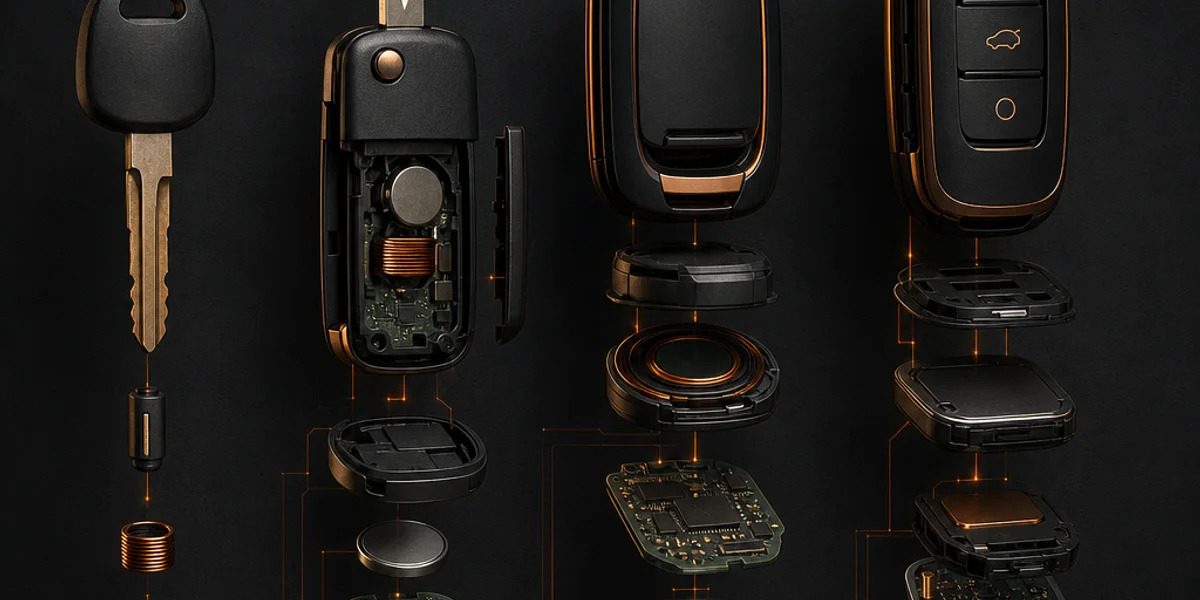
On the Mazda 6 GH the authority that enables the engine is the PCM. On the same-era Mazda 3 BK and the MX-5 NC it is the instrument cluster that holds the immobiliser identity, which is why a cluster swap on those cars breaks the car and a cluster swap on a GH does not. The Keysolved record for the MX-5 NC is explicit that the Mazda service manual treats the PCM and the cluster as a pair on 2009–2012 cars, and that both need reprogramming if either is replaced.
From 2012 the Skyactiv cars move the job again. A dedicated Keyless Control Module stores the key registrations, and a Start Stop Unit under the steering column acts as the gate: present an unrecognised key and the SSU inhibits the PCM and the TCM. Replace the KCM and the immobiliser needs re-initialising before any key will be accepted.
This matters commercially, not academically. A customer who has had a secondhand module fitted is a different job from a customer who has lost a key, and you want to know which one you have before you cut anything.
PATS-era Mazdas, 2002 to 2012
These are Ford-derived systems, and if you already do Ford work the shape of the job will be familiar. The complete Ford key programming guide covers the PATS generations properly, and the security access flow is the same here: the tool reads a rolling outcode from the PCM, and a matching incode has to go back before the key functions will run.
The chip across this era is the Texas DST80, catalogued as TMS37157, on a MAZ24 keyway. On the Mazda 6 GH the Keysolved record carries a warning that costs people blanks: the GH runs the 80-bit version of the 4D-63, and catalogues still calling it 40-bit are recycling Mazda 6 GG data. Your tool settles it, because a 40-bit chip reads back as 4D (63) and an 80-bit chip reads back as 4D (83). A 40-bit-only blank cuts cleanly, turns the barrel and does nothing.
Adding a key with two working keys, no tool
Factory default on these cars leaves Customer Spare Key Programming switched on, which means two working keys will add a third with nothing plugged in.
- Cut the new blade first. The car cannot read a chip that is not sitting in the barrel.
- Insert working key 1 and turn to ON, not START. The red security light comes on for about three seconds and goes out.
- Within about four seconds of the light going out, turn key 1 back to LOCK and pull it out.
- Within about ten seconds insert working key 2, turn to ON, wait for the security light to come on and go out, then LOCK and remove.
- Within about ten seconds insert the new key and turn to ON. The security light comes on for roughly three seconds and goes out. That is your confirmation.
- Repeat the whole cycle for each further key, up to eight IDs in total.
- Verify each key starts the car, leaving five seconds between keys.
- Time: 10–15 minutes including cutting.
Do not start the engine part-way through. That drops you out of learn mode and you begin again at key 1. A security light that flashes rapidly and keeps flashing for about a minute means the key was not accepted, and you will find DTC 15 or B1601 stored.
Adding a key with one working key
The in-car route is closed with a single key. Plug in at the 16-pin port, clear security access and run the function that adds without wiping — on most tablets this is "Program additional ignition key". Existing IDs stay where they are.
Time: 20–30 minutes.
All keys lost
- Cut a blade to the door lock. Decode the lock on the bench rather than trusting a worn key impression.
- Insert the new key and turn the ignition to ON. The security light flashing fast and DTC 15 or B1601 setting is expected with an unlearned key. Carry on.
- Connect at the 16-pin port, go to the PATS functions and let the tool read the outcode.
- Supply the incode. Current immobiliser tablets calculate it with nothing for you to type; older equipment needs a code service.
- Run the key-erase-and-programme function. Everything previously stored is wiped, which is the point, because it is what kills the missing keys.
- Programme at least two keys before you finish. One ID is not enough and the PCM will not enable the engine, so the car cranks and dies.
- Switch off, wait five seconds, then confirm each key starts and runs with five seconds between keys.
- Time: 45–75 minutes.
The two-key minimum is not a Mazda quirk you can ignore because the customer only paid for one key. Both the Keysolved GH record and the MX-5 NC record state it independently, and it is the single most common reason one of these cars is left dead on a driveway after an all-keys-lost job.
The other trap on this era is the outcode itself. Once the tool has read it, leave the ignition alone. Five LOCK-to-ON cycles regenerate the outcode and the incode you have just bought or calculated is worthless.
If the PCM refuses security access entirely, the fallback is bench work. Immobiliser data sits in the PCM, under the passenger footwell carpet on the GH, and on some builds in a serial EEPROM in the cluster — 93C56 or 93C66 on 2008-onward cars, 93C86 on earlier builds. Identify the chip on the car before you commit, because which EEPROM you are looking at is build-dependent rather than year-dependent. The Scorpio-LK Tango carries Mazda 6 key makers for the 93C66 and 93C86 and the 4D-63 80-bit image generator to go with them.
Skyactiv-era Mazdas, 2012 to 2019
This is the easy money, and it is worth knowing why.
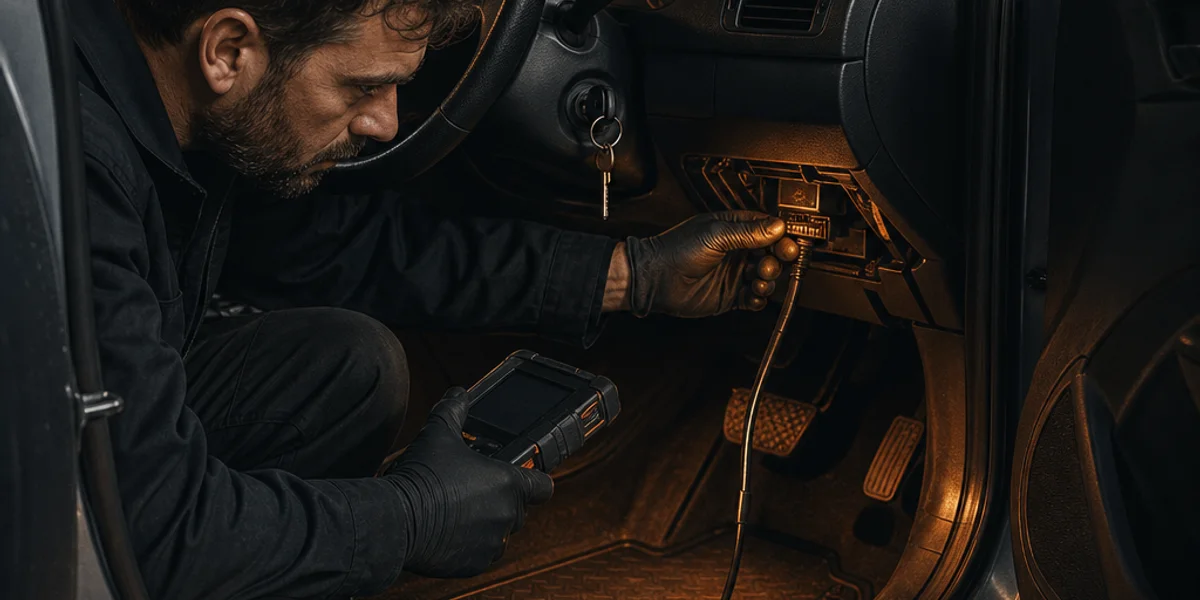
On the Mazda 6 GJ, Mazda 3 BM/BN, CX-5 KE and Mazda 2 DJ, no user-entered PIN or security code is required by current aftermarket OBD tools. The tools read the immobiliser data straight out of the KCM. Abrites performs an incode and outcode calculation underneath on its own software, but it happens without you seeing it, and Abrites states that Mazda key programming is now included in the basic Ford and Mazda software rather than sitting behind a separate licence.
The chip is a Hitag Pro, silicon labelled PCF7953P, and this is where catalogues start arguing with each other. The same part is listed as ID47, as ID49 and as NCF2951F depending on who printed the page, and Xhorse and Autel tools read it back as ID49. They are describing one chip. Order on the Mazda part number or the key's own number, not on the ID label. The transponder chip cross-reference chart maps the families properly if you want the wider picture.
Adding a smart key with one working key
- Connect at the OBD port. On the GJ it is recessed and faces downward beneath the steering column, slightly towards the centre console, with no panel to remove.
- Navigate to Mazda, then the model, then the year, then Smart Key, then Add Key.
- Switch the ignition ON with the existing working key, brake pedal depressed.
- Let the tool read the KCM immobiliser data and save the backup before going further.
- When prompted, hold the new smart key face-down close to the START/STOP button.
- Hold the brake pedal and press START/STOP for roughly ten seconds until the key indicator lamp changes.
- When the lamp turns green, hold the new key to the start button and press within five seconds to register.
- Confirm the dashboard key count has updated and the new key starts the engine.
- Time: 20–30 minutes.
All keys lost
The GJ needs a minimum of two blank smart keys. Order accordingly before you leave.
- Connect at the OBD port and select the all-keys-lost branch under Mazda, then Mazda 6 or Atenza.
- Let the tool read and erase every registered key from the KCM. This takes approximately seven minutes and it is not a hang. Leave it alone.
- When prompted, press START/STOP to bring the ignition to power mode with the brake pedal not depressed.
- Hold the first blank face-down close to START/STOP. When the indicator lamp turns green, present the key and press the start button within five seconds.
- Repeat for the second key when prompted.
- Switch off, then verify: brake depressed, key held to the start button, engine running for three seconds, switch off.
- Confirm both keys start the engine.
- Time: 60–90 minutes.
If a Keyless System Warning lamp is still lit afterwards, that is a known post-programming artefact rather than a failed job. Both the Autel MaxiIM IM608 Pro II and the Xhorse VVDI Key Tool Plus carry a dedicated Mazda ID49 smart key warning lamp clearing function for exactly this.
One ordering trap specific to this era. Advanced Keyless trims and non-Advanced-Keyless trims use the same chip family but not the same key. Programme a non-Advanced-Keyless blank into an Advanced Keyless car and you get a Keyless System Warning on the dash and no proximity function at all. On the Mazda 6 GJ the European parts split runs GHY1-67-5DY and GRV6-67-5RY on the three-button non-keyless side and GHY5-67-5DY on the Advanced Keyless side. Match the number printed on the customer's existing fob.
The 2019-on cars, and what the database does not claim
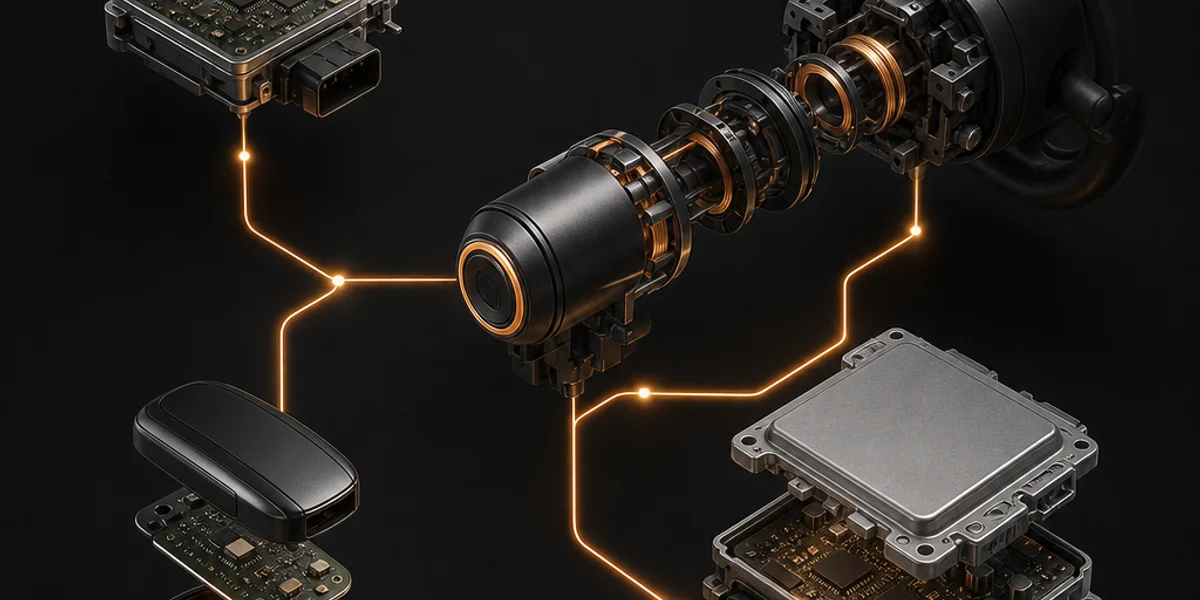
From 2019 Mazda moves to the Texas DST AES chip, the 8A family, with a Smart Key ECU talking to the BCM and PCM over CAN and the immobiliser data held in the PCM. A 4-digit security PIN is required, and on current tools it is read automatically from the PCM over OBD with no dealer lookup. The Lonsdor K518Pro is the primary confirmed path in the database for both add-key and all-keys-lost on the Mazda 3 BP and the CX-5 KF.
Here is the honest part. The Keysolved records for the BP Mazda 3 and the KF CX-5 are documented against North American builds. They carry 315 MHz, CR2032 and FCC identifiers WAZSKE13D02 for 2017–2020 and WAZSKE13D04 for 2021–2024. The database does not currently hold a confirmed UK-market frequency record for either car, and guessing one for you would be worse than useless, because a fob on the wrong frequency decodes, cuts, programmes the chip and then will not lock the doors. Read the FCC identifier off the customer's existing fob before you order anything, and if there is no existing fob, confirm the part number against a UK supplier rather than a North American listing.
Cloning is not possible on this generation. Every spare has to be enrolled.
Add-key on a BP or KF runs 25–40 minutes. All keys lost is rated expert in the database rather than intermediate, and realistically runs 90 minutes to two hours including the ordering checks above.
Three Mazdas that are not Mazda jobs
This is the section that saves a wasted call-out.
The Mazda 2 Hybrid is a Toyota. The 2022-onward car is a rebadged Toyota Yaris, built on the TNGA-B platform, and electronically it is a Yaris XP210 throughout. The immobiliser is Toyota BA with Hitag AES encryption, the blade is TOY48 rather than MAZ24, and the job needs a Toyota 8A-BA rolling-code bypass cable. If your tool has no Mazda 2 Hybrid entry, that is not a coverage gap — select the Toyota Yaris 2020-onward menu and proceed. The Toyota key programming guide covers the BA systems and the wait timings. Note the inverse case too: Mazda's own code service excludes Mazda-built Toyotas such as the Yaris iA, so the badge on the bonnet is never the thing that decides the procedure.
The BT-50 UN is not a Ford, despite the platform. This is the one that catches experienced people out. The 2006–2011 BT-50 shares its platform with the Ford Ranger PJ and PK, so the reasonable assumption is Ford PATS and a familiar outcode. It is not. The BT-50 UN runs Mazda's own standalone 8C immobiliser box, built by Lucas/TRW or Mitsubishi Electric depending on production batch, and it wants an 8-digit vehicle-specific PIN held in the module EEPROM. Without that PIN there is no add-key and no all-keys-lost. The Advanced Diagnostics Smart Pro with the Mazda 8C pack reads the PIN over OBD on this generation, which removes the EEPROM read on add-key jobs. A Keysolved subscriber has flagged the all-keys-lost side as harder than the record currently suggests, so treat an 8C all-keys-lost as a bench-capable job and quote it accordingly. Add-key 30–45 minutes; all keys lost two hours upward with module removal.
The CX-7 and CX-9 records are North American. Both sit in the database as left-hand-drive market vehicles. Useful if you are working outside the UK, and a reason to verify the port location and the key part number rather than assuming parity with a UK car.
Tool coverage, honestly
Mazda is unusual in that almost every mainstream tool covers it to some degree, which makes the limitations more important than the coverage.
Tier 1: tools that will carry Mazda across all four eras
Advanced Diagnostics Smart Pro — Mazda runs on the Ford Europe software pack with the Ford/Mazda coded add-on on the category-A dongle, and it reads the PIN as well as programming the key. It is also the only mainstream route the database records for the BT-50 8C PIN read over OBD. Where it falls short: several Mazda entries sit in the application data as North American, so confirm the European car appears in your current vehicle lookup before quoting. Remote button programming is left to the in-car sequence rather than the tool.
Autel MaxiIM IM608 Pro II — the broadest coverage in the database overall, and on Mazda it clears the outcode and incode security access itself on the PATS era with nothing to buy. Carries the ID49 warning lamp clearing special function. Where it falls short: BT-50 UN coverage is firmware-dependent and worth checking on the car.
OBDSTAR X300 DP Plus — full Mazda PATS coverage end to end on the older cars, and the same menu carries a spare-key-setting valid and invalid toggle, which is the switch that re-enables the in-car two-key add on a car where a previous fleet owner disabled it. That toggle is genuinely useful and almost nobody mentions it.
Lonsdor K518Pro — the primary confirmed path on the 2019-onward DST AES cars, reading the PIN from the PCM with no dealer involvement. Where it falls short, and this one matters: on the Mazda 6 GH the M6 smart node offers add smart key and delete smart key but no all-smart-keys-lost function. Check the menu is there before you promise an all-keys-lost on a GH Advanced Key car with this tool alone.
Abrites AVDI — Mazda key programming is included in the basic Ford and Mazda software with no separate licence, and the incode and outcode calculation runs invisibly over OBD. Where it falls short: Abrites' own coverage page states both "modern Mazda models (Mazda3/CX-30 2020+)" and "Mazda vehicles up to MY2019" without reconciling the two, so verify on the car rather than on the page. The AMS subscription and a live internet connection are both required at the roadside.
Tier 2: capable, with conditions attached
Xhorse VVDI Key Tool Plus — generates the key and programmes it on one device, and reads the Mazda password on board rather than sending you to a code service. The condition is chip selection: pick the wrong CPU type for a generated ID49 key and you get an FCC mismatch. Square is Model 19 ID49, rectangular is the three-button ID49.
IEA ZedFull — the Ford and Mazda Europe OBD pack bypasses the pincode, so there is no outcode purchase. Two conditions: the pack is a separate purchase outside an unlimited subscription, and on the MX-5 NC the IEA listing covers PIN read and key programming by OBD for add-key only, with no all-keys-lost entry at all.
Autel MaxiIM IM508S — runs the same Mazda immobiliser database as the IM608 family. On a bare IM508 the European Mazda node may be missing entirely, and the part that opens it is the XP400 Pro rather than a software licence. Worth knowing before you blame the tablet.
OBDSTAR X300 MINI Ford/Mazda — a dedicated Ford and Mazda key programmer, confirmed in the database for Mazda 3 2015 and Mazda 6 2016 all-keys-lost over OBD with no PIN, covering Mazda up to 2020. It is not currently a separate entry in the Keysolved tool catalogue, so it is named here rather than linked.
Not worth buying for Mazda
Advanced Diagnostics MVP Pro and the AD100 Pro both run the Ford Europe and Ford/Mazda coded software, but the older platforms expect an eight-digit incode worked out externally from the outcode the car gives you. That means lining up a code service account before the job rather than after. If you already own one and do a lot of older Ford work, fine. Nobody should buy one for Mazda in 2026. The full picture across every tool is in the 2026 car key programmer coverage matrix.
The manufacturer route, and why it is not the UK answer
It is worth understanding the OEM path, mostly so you can explain to a customer why you are not using it.
Mazda's own code service covers the code word method for 2003-onward Mazda 6, 2004-onward Mazda 3 and RX-8, and 2006-onward Mazda 5 and MX-5. Access runs through a paid subscription to a query form at fifty dollars for twenty-four hours or three hundred and fifty dollars for thirty days, and requires ALOA or VSP registration through NASTF. Results arrive by email roughly fifteen minutes after submission. That is a North American locksmith accreditation route, not a UK one.
The dealer route is worse for the customer. Mazda's own owner documentation states that after a key is lost an Authorised Mazda Repairer will reset the electronic codes of the remaining keys and the immobiliser system, and that starting the vehicle with a key that has not been reset is not possible. In practice that means every remaining key goes in with the car, and there is a waiting period. A trade all-keys-lost done properly achieves the same security outcome in an afternoon.
In the UK the relevant access scheme is SERMI, which went live on 1 April 2026 and gates manufacturer security data behind business-level approval and individual employee authorisation with DBS checks. Aftermarket tools taking security access directly from the vehicle are unaffected, and every procedure on this page is an aftermarket procedure.
Every job here assumes legitimate work: V5C or equivalent proof of ownership, photographic identification matching the keeper, and a record kept. Master Locksmiths Association members work to that standard as a condition of membership. An all-keys-lost that wipes the stored IDs is a security operation, and the paperwork is the part that makes it one.
Common pitfalls
Programming one key and leaving The commonest Mazda failure on the whole list. On PATS-era cars and on the Mazda 6 GJ the module will not enable the engine with a single ID stored. The car cranks and dies and you get a phone call. Programme two, every time, regardless of what the customer paid for.
Cycling the ignition after the outcode appears Five LOCK-to-ON cycles regenerate the outcode on PATS cars. If you have bought an incode from a code service, it is now worthless and you buy another. Read the outcode, then do not touch the ignition until the incode is in.
Ordering a remote and expecting a chip with it On the Mazda 6 GH the transponder lives in the flip blade, not on the remote board, and Mazda sells the two as separate parts. So do most suppliers. Order both or you will be standing at the car with half a key.
Assuming 40-bit will do on a GH The GH runs the 80-bit 4D-63. A 40-bit blank cuts, turns the barrel and does nothing. Both Xhorse and KeyDIY will flip a programmable 4D chip between modes if you have the wrong one in the van, so this is recoverable, but only if you spot it.
Fitting a non-Advanced-Keyless blank to an Advanced Keyless car Same chip family, different key. You get a Keyless System Warning on the dash and no proximity unlock. Match the part number on the existing fob.
Condemning a key on a failed keyless control module On 2009-onward Mazda 6 GH cars, DTCs B100B:11, B100C:12 or U3000:49 drop the keyless control module into fail-safe, showing the red KEY light and the red start-button light together. The fix is a revised module, not a key. Read the codes before you cut, because programming a fresh fob into a failed module is time and money gone. If the symptom is a warning light rather than a non-start, work through the immobiliser fault diagnosis guide first.
Selling a clone on a lost-key job Cloning works on the DST80 cars using an Xhorse Super Chip XT27A66 in 4D-63 80-bit mode or a JMA TPX4. A clone adds no ID to the PCM, so the car still accepts every key it accepted before, including the one the customer lost. For a spare alongside an existing key that is fine. For a customer who has lost one it is the wrong job and arguably the wrong advice.
Trusting the badge on a BT-50 or a Mazda 2 Hybrid Covered above, and worth repeating because both go the opposite way to intuition. The BT-50 shares a platform with the Ranger and does not share its immobiliser. The Mazda 2 Hybrid shares nothing visible with a Toyota and is one underneath.
Frequently asked questions
Do Mazda keys need a PIN code to programme?
It depends entirely on the generation. PATS-era cars from 2002 to 2012 need a rolling outcode and a matching incode, which current tablets calculate themselves. Skyactiv cars from 2012 to 2019 need no user-entered code at all. From 2019 the DST AES cars need a 4-digit PIN, but the tool reads it from the PCM over OBD with no dealer lookup. The BT-50 UN is the exception and needs an 8-digit PIN held in the immobiliser EEPROM.
How many keys does a Mazda need programmed to start?
At least two on PATS-era cars and on the Mazda 6 GJ. The module will not enable the engine with a single ID stored, so an all-keys-lost job finished with one key leaves a car that cranks and will not run. The PCM stores up to eight ignition key IDs on the GH, and the keyless control module holds up to six Advanced Keys.
Can Mazda keys be cloned?
On the DST80 cars, yes — an Xhorse Super Chip XT27A66 in 4D-63 80-bit mode or a JMA TPX4 will take a copy. On the Hitag Pro smart keys from 2012 and the DST AES keys from 2019, no. Those are sealed encrypted units and every spare has to be enrolled to the vehicle. Cloning is also the wrong answer on any lost-key job, because it leaves the missing key working.
Why does my tool not list the Mazda 2 Hybrid?
Because it is a rebadged Toyota Yaris XP210 and most tools catalogue it as a Toyota. Select the Toyota Yaris 2020-onward menu, fit the Toyota 8A-BA rolling-code bypass cable, and the procedure runs unchanged. The blade is TOY48, not MAZ24.
Is the Mazda BT-50 the same job as a Ford Ranger?
No. They share a platform but not an immobiliser. The Ranger PJ and PK run Ford PATS; the BT-50 UN runs Mazda's own standalone 8C box with an 8-digit vehicle-specific PIN held in the module EEPROM. Approaching a BT-50 with a Ford PATS plan wastes the call-out.
How long does a Mazda all-keys-lost take?
On a 2012–2019 Skyactiv car, 60 to 90 minutes, of which roughly seven minutes is the KCM erase cycle running unattended. On a PATS-era car, 45 to 75 minutes. On a 2019-onward DST AES car, 90 minutes to two hours. On a BT-50 8C with no PIN in hand, budget two hours and upward and expect module work.
The short version
Establish the system before anything else. Pre-2012 means outcode and incode and a two-key minimum. 2012 to 2019 means no code, a seven-minute erase and two blanks ordered in advance. 2019 onward means a PIN read off the PCM and a hard check on the frequency before you order. BT-50 means an 8-digit PIN and a different tool menu. Mazda 2 Hybrid means you are doing a Toyota.
Then look the actual car up rather than working from this page. Search the Keysolved database for the exact model and year in front of you and you get the key variants, the transponder, the OBD port location with the right-hand-drive notes attached, the full procedure and the specific tools named against that vehicle with their adapter and token requirements. The Mazda make page lists all sixteen vehicles currently held, and if the one on your driveway is not there, request it — the BT-50 all-keys-lost note on this page came from a subscriber doing exactly that.
Full database access
Look Up the Mazda on Your Driveway
Cancel any time · Billed monthly
Get the key variants, transponder, OBD port location, full procedure and the specific tools confirmed against that exact model and year.
No card required to browse — subscribe to unlock full specs and procedures
Frequently Asked Questions
▶Do Mazda keys need a PIN code to programme?
▶How many keys does a Mazda need programmed to start?
▶Can Mazda keys be cloned?
▶Why does my tool not list the Mazda 2 Hybrid?
▶Is the Mazda BT-50 the same job as a Ford Ranger?
▶How long does a Mazda all-keys-lost take?
Full database access
Every Mazda in the Database
Cancel any time · Billed monthly
Sixteen Mazda vehicles with per-generation key specs, security models and tool compatibility, plus a request form for the ones not yet covered.
No card required to browse — subscribe to unlock full specs and procedures
Sources
- Mazda Service Info — Immobilizer Codes(2026)— Mazda's own immobiliser code service. Documents the code word (in/out code) method for 2003-onward Mazda 6, 2004-onward Mazda 3 and RX-8 and 2006-onward Mazda 5 and MX-5, the subscription pricing, the ALOA or VSP registration requirement via NASTF, and the exclusion of Mazda-built Toyota models.
- Mazda Owner's Manual — Immobilizer System(2026)— Manufacturer documentation confirming that after a key is lost an Authorised Mazda Repairer resets the electronic codes of the remaining keys and the immobiliser system, and that a key which has not been reset will not start the vehicle.
- Abrites Diagnostics for Ford and Mazda(2026)— Tool manufacturer coverage page confirming Mazda key programming is included in the basic Ford and Mazda software with no separate licence, listing spare key and all-keys-lost procedures, and carrying the unreconciled coverage statements quoted in the tool section.
- New 2022 Mazda 2 launched as rebadged Toyota Yaris Hybrid(2021)— UK trade press confirmation that the 2022-onward European Mazda 2 Hybrid is a rebadged Toyota Yaris, which is why the key job runs through the Toyota menu.
- SERMI — Security-related Repair Maintenance Information (UK)(2026)— Official UK SERMI scheme site. Confirms the 1 April 2026 UK go-live and the business-level and employee-level accreditation requirements gating manufacturer security data.
- Master Locksmiths Association — About Us(2026)— MLA membership standards, referenced for the proof-of-ownership and customer identification expectations on all-keys-lost vehicle work.