
Car Key Cutting Machines: Which One Cuts What (UK Guide)
Blade profiles, clamp counts and where each class of machine stops
Key Takeaways
- Six blade profiles cover most of a UK round — HU101, HU66, HU162T, HU83, HU64 and NSN14 — and every one of them is a laser track, not an edge cut
- A machine that cuts edge-cut keys but not track cannot finish any of the six most-searched UK vehicles in the Keysolved database
- Two clamps is the realistic minimum for automotive work, one edge and one track; Tibbe needs a third and it is an optional accessory on every machine in this guide
- Blade profiles cross makes: HU101 covers Ford, Land Rover, Jaguar and Volvo, and NSN14 covers Nissan, Infiniti, Subaru, Renault, Dacia and Suzuki
- A cutting machine alone completes the job on just three vehicles in the catalogue, all North American with no transponder — on a UK round the machine is necessary and never sufficient
- Prove the cut blade in the ignition barrel before any transponder work, because a binding aftermarket blade looks exactly like a failed key learn
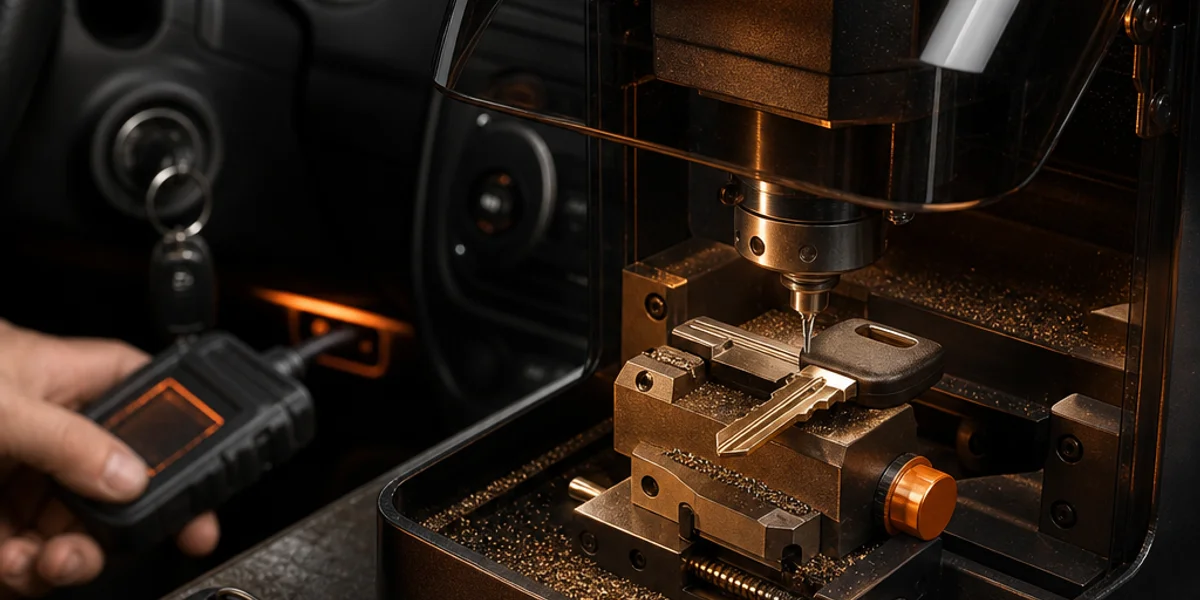
The programmer gets all the attention. It is the thing on the shelf in the photographs, the thing with the subscription, the thing locksmiths argue about on Facebook. But a transponder that has enrolled perfectly is worth nothing if the blade binds in the barrel, and a job that stalls because the blank is the wrong profile stalls on the driveway in front of the customer.
Cutting is the half of the job nobody writes about properly. It is also the half where the money goes: a key cutting machine is the single largest purchase most auto locksmiths make after the programmer, and the clamps and cutters that arrive with it decide which vehicles you can finish rather than merely diagnose.
This guide works the problem backwards. Rather than starting with machines, it starts with the blade profiles that a UK round actually throws at you — pulled from the Keysolved vehicle database — and works out from there which cuts a machine has to make, how many clamps that needs, and where each class of machine stops.
The three cuts a UK round needs
Before any of the machine comparisons make sense, there are three mechanically distinct cuts in UK automotive work, and a machine that handles one does not necessarily handle the others.
- Edge cut (standard). The traditional profile with teeth milled into the edge of the blade. Older Fords, older Vauxhalls, most pre-2000 work, and a great deal of plant and motorcycle work. Cut with a wide milling cutter against a four-sided clamp.
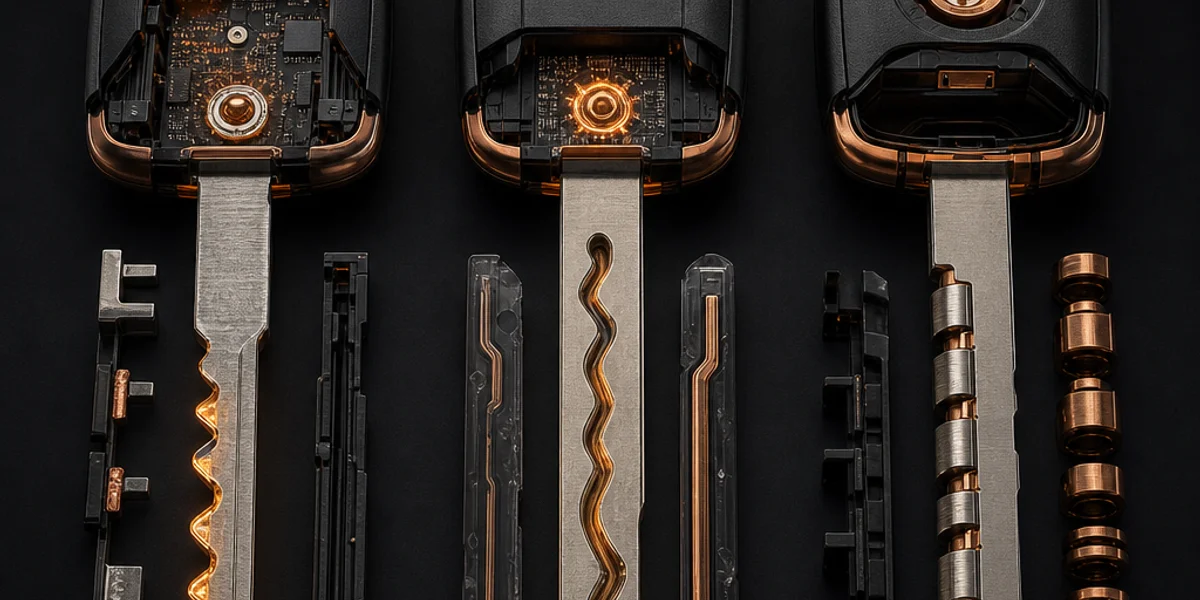
- Laser track (internal milled). A wavy channel milled into the flat face of the blade, usually on both sides, with the blade symmetrical so it enters the barrel either way up. This is the dominant modern profile: HU101, HU66, HU162T, HU83, HU64, NSN14. Cut with a small-diameter end mill, and the blade is held on its neck rather than its edge.
- Tibbe. Ford and Jaguar's rotating-disc profile, cut as a series of steps around the blade rather than along it. It is neither of the above and it needs its own fixture.
That third category is the one that catches people. Tibbe is not a variation of a laser cut — it is a different geometry requiring a dedicated clamp, and on most machines that clamp is an optional extra rather than part of the box. Ilco list the 03R clamp for Ford Tibbe FO21 keys as an optional accessory on the Futura Auto, alongside a tubular clamp for motorcycle work. Budget for it separately or decline the job.
The blade profiles behind a UK round
Six profiles cover the overwhelming majority of a British round. Here is what the Keysolved database records for the vehicles UK locksmiths search for most often.
| Vehicle | Generation | Blade profile | Cut type |
|---|---|---|---|
| Ford Transit Custom 2012–2023 | V362 | HU101 | Laser track |
| Volkswagen Golf 2012–2020 | MK7 / MK7.5 | HU162T | Laser track |
| Nissan Qashqai 2014–2021 | J11 | NSN14 | Laser track |
| Vauxhall Corsa 2014–2019 | E | HU100 | Laser track |
| Peugeot 207 2006–2014 | I | HU83 | Laser track |
| Mercedes-Benz Sprinter 2006–2018 | W906 | HU64 | Laser track |
Every one of them is a laser track. That is the single most important planning fact in this article: if you buy a machine that cuts edge-cut keys beautifully and does not cut track, you have bought a machine that cannot finish any of the six vehicles above.
One profile, several badges
The commercial argument for a track-capable machine gets stronger once you look at what each profile covers. The blade blanks the Keysolved database lists against each vehicle are not single-make parts:
- HU101 blanks are listed for Ford, Land Rover, Jaguar and Volvo.
- HU66 blanks cover Volkswagen, Audi, SEAT, Skoda and Porsche.
- HU100 blanks cover Vauxhall and Opel, Chevrolet, MG, SAAB and BMW Mini.
- NSN14 blanks cross-reference to Nissan, Infiniti, Subaru, Renault, Dacia and Suzuki.
- HU64 blanks are shared with Chrysler and, as HU116, with Volkswagen.
- HU83 blanks cover Peugeot, Citroën and Fiat.
Six profiles, something approaching twenty badges. A van stocked with those six blanks and a machine that cuts all six will finish most of what the phone brings in, which is a far more useful way to think about stock than counting makes.
Note the VAG trap in that list. Pre-MQB Volkswagen Group cars are HU66; the MQB cars from roughly 2012 are HU162T, a thinner two-track blade. They are not interchangeable, and the database records the Golf MK7 as HU162T specifically. Ordering HU66 for an MQB car is one of the commonest wasted journeys in the trade.
How many clamps does that actually need?
Manufacturers answer this differently, and the answer tells you more about a machine than the headline price does.
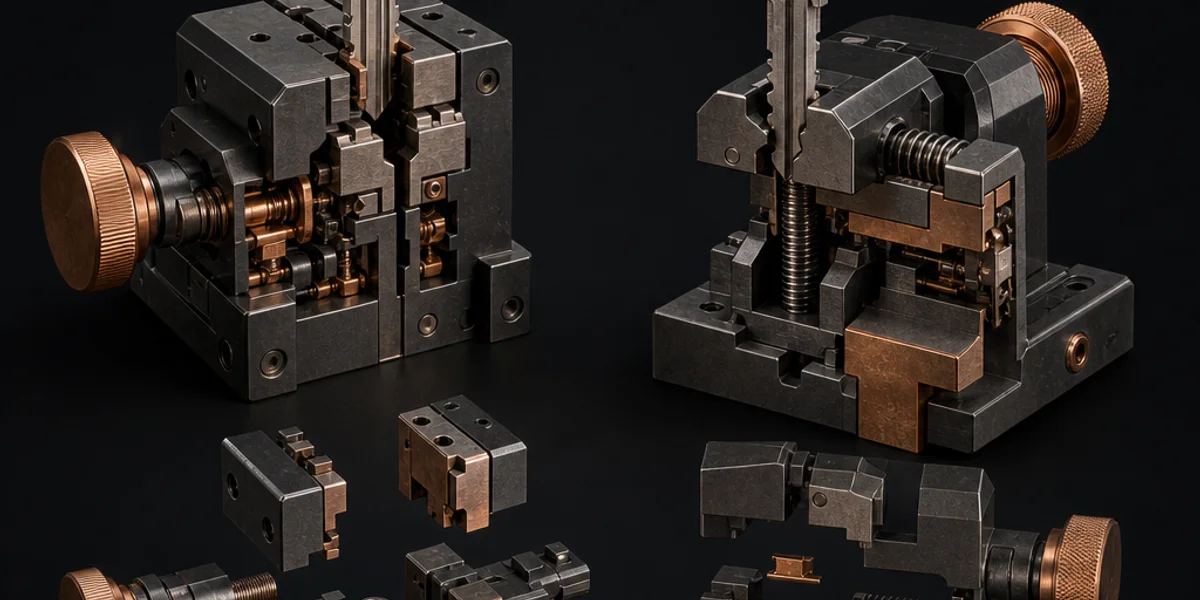
The Ilco Futura Auto ships with two interchangeable clamps on a single cutting station: the 01VA four-sided clamp for edge-cut keys and the 01RA for laser keys, which Ilco note secures the blade on the neck rather than needing special jaws per profile. That neck-gripping approach is why one laser clamp copes with HU101, HU66, HU162T and the rest without a drawer full of fixtures.
Keyline take the opposite approach on the Ninja Total, which carries two separate cutting stations — a four-sided clamp on the edge-cut side, and A02, A03 and C30 clamps on the laser and dimple side. The two stations run at different speeds, 1,500 to 3,000 rpm for edge cut against 13,000 rpm for laser and dimple work, which is the honest engineering reason the stations are separate rather than a marketing flourish. The cost is bulk: Keyline list it at 65 lbs, roughly 29 kg, against 20 kg for the Futura Auto.
The portable Xhorse machines sit at the other end, and they are the ones to read the small print on. The XC-MINI PLUS II ships with a 1.5 mm cutter, a 2.5 mm cutter and a probe, but Xhorse's own manual lists the M1 and M2 clamps as optional and notes that some special keys require the optional clamp. Vendor packing lists for the same machine disagree on which single clamp arrives in the box, so confirm the clamp set with the supplier in writing before you order rather than assuming the profiles you need are covered.
Practical reading: two clamps is the realistic minimum for automotive work — one edge, one track — and a third if you intend to take Tibbe jobs. Any machine advertised with a single clamp is telling you it does one of the three cuts.
Where each class of machine stops
Tiered by what the machine will actually finish, not by price.
Tier 1 — Edge cut and track, one machine
Ilco Futura Auto. One cutting station, two clamps, designed from the outset for automotive rather than adapted from a residential machine. Ilco specify three track cutters (01LW, 02LW and 06LW) plus a 12L steel cutter for edge cut, with the software choosing between them per key. The useful feature nobody mentions in reviews is the partial-cuts function, which lets you decode part of a broken key and build a cutting tree rather than burning blanks guessing. At 20 kg with a retractable safety shield, it is genuinely a van machine.
- Falls short: one station means swapping clamps between edge and track jobs, which costs a minute or two each way on a mixed day.
- Verdict: the sensible default for a mobile auto locksmith who wants one machine to cover the six profiles above.
Keyline Ninja Total. Two stations, no clamp swapping, and it covers edge cut, laser, dimple, cruciform and Tibbe. Keyline specify a mechanical tracer with linear sensor on the edge side and electrical contact decoding on the laser side.
- Falls short: 29 kg and a workshop footprint. The dimple and cruciform coverage is mostly wasted on a purely automotive round — you are paying for residential capability.
- Verdict: right for a shop that cuts all day and does domestic work too. Overkill and over-heavy for a van.
Tier 2 — Edge cut only
Silca Futura Edge. Silca describe it as a machine for flat residential and vehicle keys plus cruciform, with a four-sided clamp and patented laser reading of the key profile. It is a well-built machine and the laser profile reading is genuinely good.
- Falls short: it does not cut track. Read the category it sits in — flat and edge-cut.
- Verdict: do not buy this for modern automotive work. If a supplier offers you a Futura Edge for an auto locksmith round, they have either misunderstood the job or are clearing stock. The Futura Auto is the automotive machine in that family.
Tier 3 — Specialist and situational
Tibbe clamps. Treated as an accessory by every manufacturer above. If your round includes older Transits, Mondeos, the Ka, or Jaguars of the X-type and S-type era, price the clamp in before you commit to a machine. The Jaguar guide covers which Jaguar generations are Tibbe and which moved to HU101.
Cutting machine alone. Worth knowing what this is worth in the UK: effectively nothing. The Keysolved catalogue tracks key cutting machine only as a route, and it is confirmed on three vehicles — the Saturn Ion, the Saturn Vue and the Scion xB, all North American, all mechanical key with a separate remote and no transponder. On a British round there is no modern car where the cut finishes the job on its own. The machine is necessary and never sufficient.
For context on how uncommon dedicated cutting kit still is: of the 401 locksmiths with tools registered on Keysolved, 7 per cent have logged a KK12-capable cutting machine and 3 per cent a cutting machine alone. Most of the trade is still cutting by copy or sending work out.
Decode first, cut second
The order of operations matters more than the machine, and most failed cuts are failures of decoding rather than milling.
- Confirm the profile before you touch a blank. Check the vehicle record rather than the badge — the Golf MK7 example above is exactly why. Time: 1 minute.
- Decode the lock. On an all-keys-lost job, read the door lock or ignition barrel with the matching Lishi. The Lishi profile guide maps which 2-in-1 fits which vehicle. Time: 5–15 minutes depending on the lock and the weather.
- Cross-check the decode against the code source. Where the tool can read the key code from the vehicle — the Abrites NN009 licence does this on the Qashqai J11, for example — read it and compare against the decode. Two independent sources agreeing is what stops a wrong cut. Time: 3–5 minutes.
- Set the blank in the correct clamp face. Track keys on the neck, edge-cut keys on the milling groove. Time: 1 minute.
- Cut. Time: 2–4 minutes for a track blade, 1–2 minutes for an edge cut.
- Deburr. Non-negotiable on a track blade. A burr on the channel edge feels exactly like a wrong cut when it meets the wafers. Time: 1 minute.
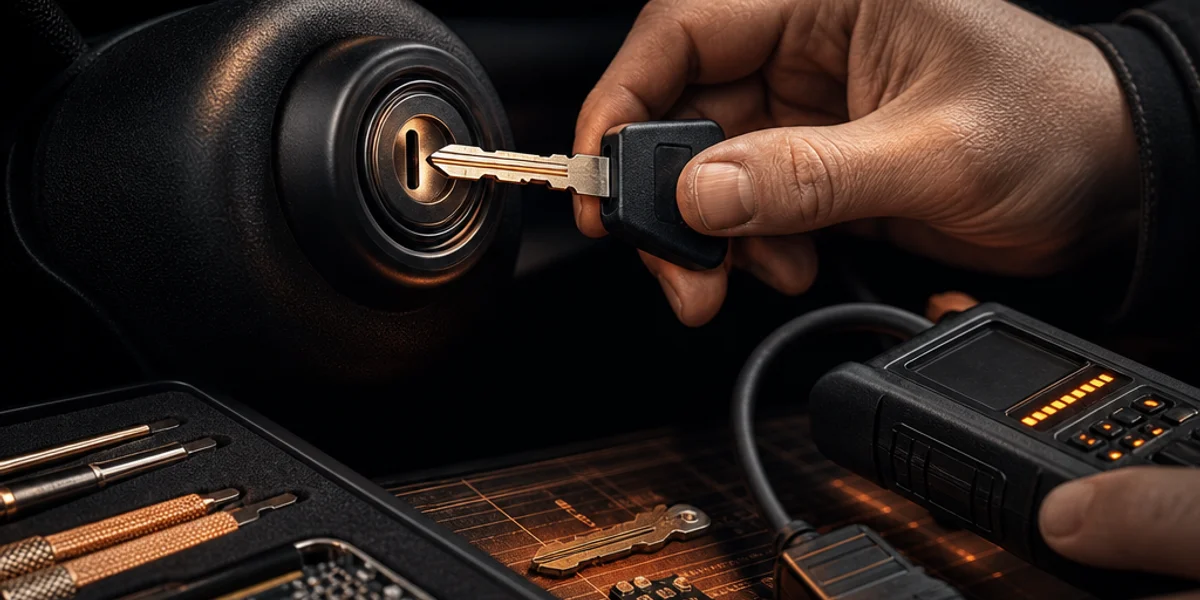
- Prove the blade in the barrel before programming. Turn the ignition with the uncut-side blade alone, before any transponder work. Time: 1 minute.
- Total: 15–30 minutes from decode to a proven blade, on a job where the lock reads cleanly.
That seventh step is the one worth hardening into a habit. The Keysolved tool notes for the Qashqai J11 bladed key put it plainly: cut and prove the NSN14 blade in the ignition barrel before you start programming, because a binding aftermarket blade looks exactly like a failed transponder learn. You can spend twenty minutes re-running a programming routine that was never the problem.
Common pitfalls
The blade turns on the bench and binds in the car. Aftermarket blanks vary in thickness batch to batch, particularly on HU101 and HU66. The blade that turns sweetly in a door lock can bind in a worn ignition barrel. Prove it in the ignition, not the door.
Cutting HU66 for an MQB car. The commonest VAG error. Pre-MQB is HU66, MQB from roughly 2012 is HU162T, and the two look similar enough at a glance in a van door. Check the vehicle record, not the shape.
Assuming Tibbe is a laser cut. It is not, your laser clamp will not hold it, and no amount of software will work round a fixture that cannot grip the blade. Buy the clamp or turn the job down.
Reusing a cutter past its life. Track cutters are small-diameter and they dull without obvious drama — the cut simply drifts shallow and the blade starts to feel tight. If blades that used to turn cleanly have started needing persuasion, change the cutter before you blame the blanks.
Cutting from a worn original. Copying an original that has done 150,000 miles reproduces the wear, not the code. Where a code source exists, cut to code. Copying is a fallback, not a default.
Skipping the deburr on a double-sided track blade. Both channels, both faces. It takes a minute and it removes the single most common cause of a blade that almost works.
Frequently asked questions
Can one key cutting machine cover every car?
No. A machine covers every car only if it cuts edge-cut, laser track and Tibbe, and Tibbe requires a dedicated clamp that is an optional accessory on every machine listed in this guide. A two-clamp machine covering edge cut and track will finish the great majority of a UK round, which is a different and more honest claim.
Do I need a cutting machine if I already have a key programmer?
Yes, for all-keys-lost work. The programmer enrols the transponder and does nothing about the blade. The Keysolved catalogue confirms only three vehicles where a cutting machine alone completes the job, and all three are North American cars with no transponder. The reverse case — a programmer with no cutting capability — leaves you unable to finish any all-keys-lost job where the customer has no blade to copy.
What is the difference between cutting by code and cutting by copy?
Cutting by code mills the blade from the lock's original code, decoded from the barrel or read from the vehicle. Cutting by copy traces an existing key and reproduces it, wear included. Code is more accurate and is the right default whenever a code source exists; copy is the fallback when the customer has a key but no code is available.
Which blade profile does a Ford Transit Custom use?
HU101, across both the pre-May-2016 and post-May-2016 key variants, according to the Keysolved record for the 2012–2023 Transit Custom. The same profile covers Land Rover, Jaguar and Volvo blanks, which makes HU101 one of the highest-return blanks to keep in quantity.
How long does cutting a laser track key take?
Two to four minutes of actual machine time on a track blade, plus deburring. The honest figure to quote a customer is 15 to 30 minutes from decode to a proven blade, because the decoding and verification either side of the cut are where the time goes.
Is a portable cutting machine good enough for professional work?
For the six profiles that dominate a UK round, yes — provided it cuts track as well as edge cut and you have verified the clamp set covers the profiles you meet. The compromise on portable machines is usually clamp range and cutter life rather than cut quality.
Where this leaves the buying decision
Work it in this order. Establish which blade profiles your round actually throws at you — for most UK locksmiths that is HU101, HU66, HU162T, HU83, HU64, HU100 and NSN14. Confirm the machine cuts laser track, because every one of those except the oldest edge-cut work is a track profile. Count the clamps, and price the Tibbe fixture separately if your area has older Fords and Jaguars in it. Only then compare prices.
And remember what the machine is for. It cuts a blade that turns a barrel. The transponder is a separate problem with separate tools — the programmer coverage matrix covers that half, and the chip cross-reference covers which transponder sits in which key. If you are still assembling a first kit, the UK training and kit guide sets out what to buy in which order.
For the profile, the blank, the chip and the tool list on a specific vehicle, look it up rather than guessing. Every blade profile quoted in this article came out of the Keysolved vehicle record for that exact generation, and the generation is usually what people get wrong.
Full database access
Check the Blade Profile First
Cancel any time · Billed monthly, or save $99 a year paying yearly, in your local currency
Look up the exact blade profile, key variant, transponder and compatible tools for any vehicle before you cut a blank.
No card required to browse — subscribe to unlock full specs and procedures
Frequently Asked Questions
▶Can one key cutting machine cover every car?
▶Do I need a cutting machine if I already have a key programmer?
▶What is the difference between cutting by code and cutting by copy?
▶Which blade profile does a Ford Transit Custom use?
▶How long does cutting a laser track key take?
▶Is a portable cutting machine good enough for professional work?
Full database access
Every Profile, Every Procedure
Cancel any time · Billed monthly, or save $99 a year paying yearly, in your local currency
Keysolved holds the blade profile, chip, security code route and per-tool procedure for every vehicle on a UK round.
No card required to browse — subscribe to unlock full specs and procedures
Sources
- Futura Auto — Technical Data and Clamps(2026)— Ilco's specification for the Futura Auto, including the 01VA edge-cut and 01RA laser clamps, the three track cutters, and the optional 03R Tibbe and 02R tubular clamps.
- Ninja Total — Specifications(2026)— Keyline's specification for the two-station Ninja Total, including the A02, A03 and C30 laser and dimple clamps, cutter speeds per station and machine weight.
- Futura Edge — Product Details(2026)— Silca's product page confirming the Futura Edge sits in the flat and edge-cut category, covering flat residential and vehicle keys plus cruciform.
- Automatic Key Cutting Machine XC-MINI PLUS II — User Manual(2022)— Xhorse's own manual for the XC-MINI PLUS II, listing the supplied cutters and probe and marking the M1 and M2 clamps as optional.