
Lishi Lock Picks: Which 2-in-1 Fits Which UK Vehicle
A blade-profile lookup for the 2-in-1 picks that earn their keep on a UK round
Key Takeaways
- Lishi tools are named after the lock profile, not the make. The Keysolved record for the Peugeot 208 and Corsa F reads "HU83 (also labelled VA2 in some aftermarket catalogues — same physical blade)" — ordering by badge is how locksmiths buy the same tool twice
- Eleven profiles cover a very large share of a normal UK round: HU101, HU66, HU162T, HU83, HU100, HU92, NSN14, TOY48, HON66, SIP22, and the HU39/YM15 pair
- HU101 reaches furthest of any single pick. The database confirms it on the Ford Focus Mk4, every Transit Custom key variant including the proximity fob, and the Land Rover Discovery 3
- The Mercedes-Benz Sprinter W906 needs two tools: HU39 on the early NEC key and YM15 on the late Hitag key. Arrive with one and it is a fifty-fifty chance
- The blade profile is more stable than the chip. The Fiat Ducato kept SIP22 from 2006 to 2024 while the transponder moved through ID48, ID46 and Hitag AES
- A decoded and cut key opens the vehicle and turns the barrel. The transponder is a separate job with its own tool, its own security access and its own clock — price the two stages separately
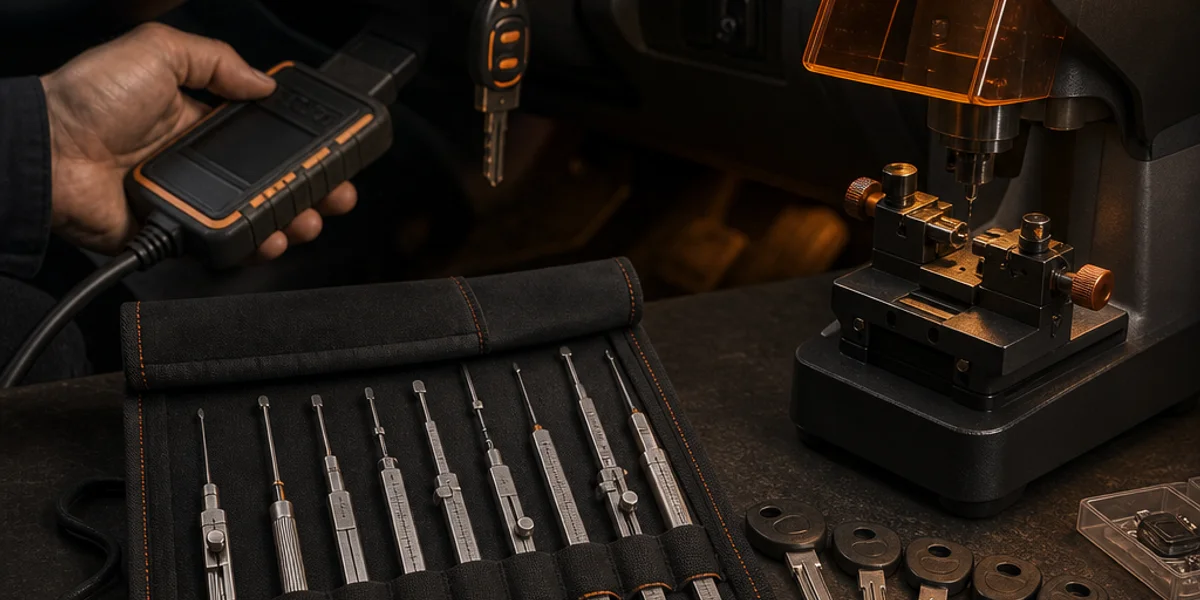
Most auto locksmiths buy a Lishi lock pick before they buy anything that plugs into an OBD port. It is the cheapest tool on the van that earns money on its first job, and on an all-keys-lost it is often the only thing standing between a decoded key and a cut-and-drill recovery that the customer will not thank you for.
The problem is not whether to own them. The problem is which ones. There are well over a hundred Original Lishi 2-in-1 tools in the automotive range, they are named after lock profiles rather than makes, and a locksmith working a mixed UK round can easily spend four hundred pounds on picks and still arrive at a Transit without the right one in the roll.
This is the lookup that fixes that. Every blade profile below is pulled from the Keysolved vehicle database, matched to the Lishi tool that fits it, and tied to the specific UK vehicles and year ranges the record confirms. It is a buying and planning reference, not a manipulation tutorial — technique comes from training and practice, and the legitimate-work checks at the end are not optional.
What a 2-in-1 actually does, and what it does not
A Lishi 2-in-1 gives you two things in one pass: entry, and the cut code. The tool sits in the keyway and lets you work each wafer or disc individually while reading its position off the gauge, so when the lock turns you also walk away with the bitting. That is the whole commercial case. Decode the door or the ignition, cut a key to code on the van, and you have a mechanical key without a single destructive step.
What it does not give you is a running car. On every vehicle in the table below the transponder is a separate problem with its own tool, its own security access and its own job time. A decoded and cut HU101 will open a 2019 Ford Focus and turn the barrel, and the Hitag Pro chip in the head still has to be enrolled in the BCM over OBD before the engine will start. Keep the two halves of the job separate in your head and in your quote.
The other thing worth being honest about: a Lishi is a skill tool. The gauge reading is only as good as your practice on that specific profile, and a profile you touch twice a year will take you three times as long as one you decode weekly.
Lishi tools are named after the lock, not the car
This is where money gets wasted. Lishi tools carry the lock profile designation — HU101, NSN14, SIP22 — and those designations come out of the key-blank catalogues, not the showroom. Order by make and you will guess wrong.
The Keysolved database records the trap directly. On both the Peugeot 208 and the Stellantis-era Vauxhall Corsa F, the blade profile field reads "HU83 (also labelled VA2 in some aftermarket catalogues — same physical blade)". One blade, two names, and a locksmith who buys a VA2 Lishi having already bought an HU83 has bought the same tool twice.
It runs the other way too. The HU101 is the clearest example of one tool covering ground you would never group together by badge. The Keysolved records confirm it on the Ford Focus Mk4, on every key variant of the Transit Custom including the proximity option, and on the Land Rover Discovery 3 — a CJB immobiliser system with nothing in common with Ford PATS beyond the shape of the blade. The trade supplier Multipick lists the same HU101 tool across Ford, Land Rover, Volvo and Jaguar applications, which is why it is the single most useful pick in a UK roll.
Blade profile to Lishi tool: the UK lookup table
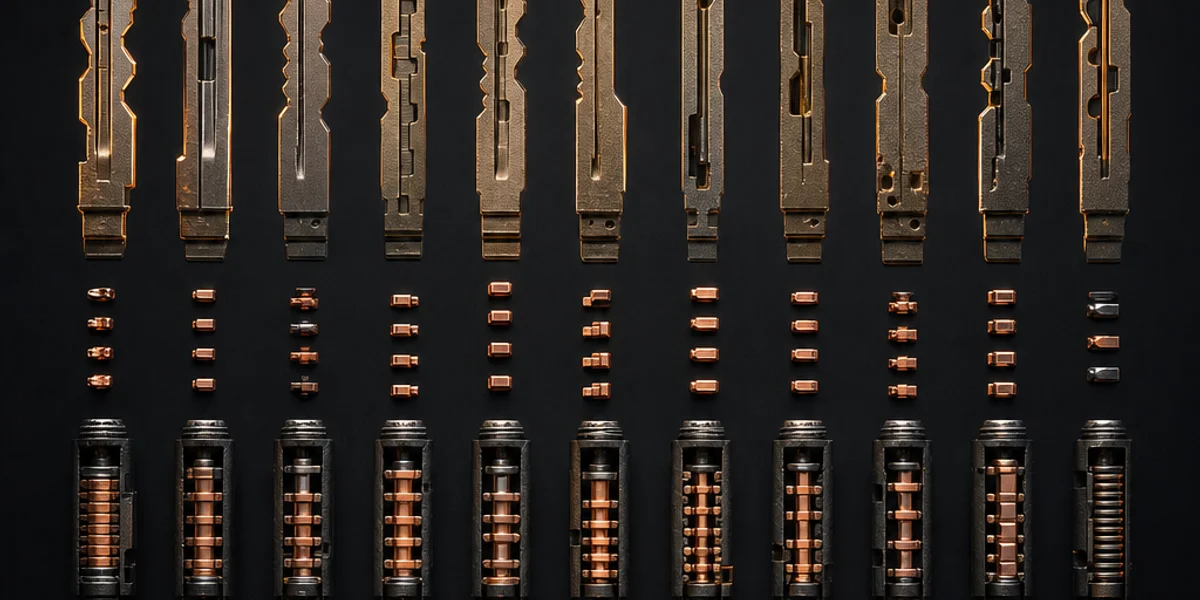
Every row below is sourced from the Keysolved vehicle records, not from a supplier catalogue. Where the database does not hold a confirmed profile, the row says so rather than guessing.
| Blade profile | Lishi tool | Confirmed UK vehicles in the database |
|---|---|---|
| HU101 | HU101 (check revision) | Ford Focus Mk4 2018–2024 · Ford Transit Custom 2012–2023, all variants including proximity · Land Rover Discovery 3 2004–2009 |
| HU66 | HU66 | Volkswagen Golf Mk5 2003–2008, IMMO 3 / ID48 |
| HU162T | HU162T | Volkswagen Golf Mk7 and Mk7.5 2012–2020, MQB — both the flip remote and the KESSY proximity fob |
| HU83 (= VA2) | HU83 | Peugeot 208 A9 2012–2019, both the Hitag 2 and Hitag AES variants · Vauxhall Corsa F 2019–2024, flip and smart key |
| HU100 | HU100 | Vauxhall Astra J 2009–2015, 2-button and 3-button |
| HU92 | HU92 | BMW 3 Series E90/E91/E92/E93 2005–2012 — all nine recorded variants, CAS2 through encrypted CAS3+ |
| NSN14 | NSN14 | Nissan Qashqai J11 2014–2021 — Intelligent Key 2-button and 3-button, and the non-keyless flip remote |
| TOY48 | TOY48 | Toyota Hilux AN120/AN130 2016–2024 — flip remote, and the emergency blade inside the smart key |
| HON66 | HON66 | Honda Civic 9th and 10th generation 2015–2022 — remote head key and smart key |
| SIP22 | SIP22 | Fiat Ducato Type 250 and Type 290 2006–2024 — all four variants across the ID48, ID46 and Hitag AES eras |
| HU39 then YM15 | HU39 and YM15 | Mercedes-Benz Sprinter W906 2006–2018 — HU39 on the early NEC key, YM15 on the late Hitag key |
| Not confirmed | — | Renault Trafic III 2014–2024: the database holds the tool coverage and the Hitag Pro chip but no confirmed blade profile. Decode from the lock, not from a catalogue. |
Two readings worth taking from that table. First, eleven tools cover a very large share of a normal UK round, which is a far smaller outlay than the hundred-plus-piece sets sold as a starting point. Second, the profile is stable across generations far more often than the chip is: the Ducato kept SIP22 from 2006 to 2024 while the transponder moved through three families, and the E90 kept HU92 across every CAS revision BMW shipped.
The vehicles that catch people out
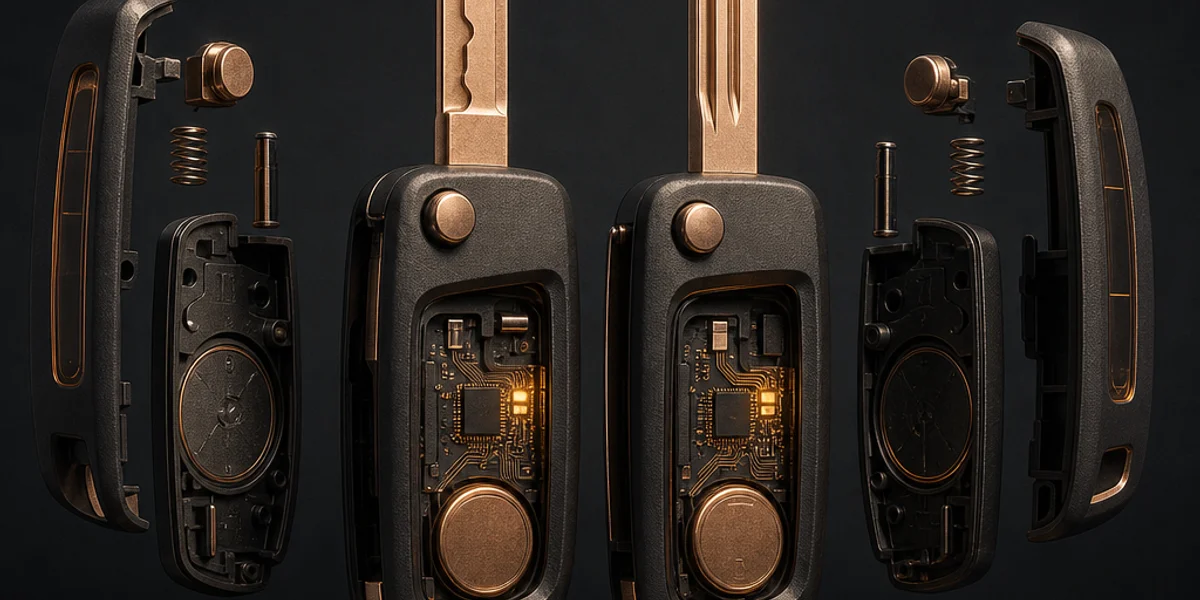
One van, two profiles. The Sprinter W906 is the row to read twice. The Keysolved record splits it: the early NEC-transponder key is HU39, and the later Hitag key is YM15. Turn up to a 2006–2018 Sprinter with one of the two and you have a fifty-fifty chance. Carry both, or identify the key before you leave.
The tool itself has revisions. HU101 is not one object. Suppliers list it as HU101, HU101 V2, HU101 V3 and cut-out versions. The locksmith supplier UHS Hardware specifies its HU101 CutOut V3 as a ten-cut tool with two lifters and five depths, listed for ignition, door and boot locks across Ford, Jaguar, Land Rover, Lincoln and Volvo from roughly 2005 to 2017. Buying "an HU101" without checking the revision against the lock you actually meet is the most common ordering mistake on the most common profile.
Anti-glare is a finish, not a capability. Original Lishi vendors ship the AG version by default, and Classic Lishi explain that the anti-glare coating reduces reflected light to make the gauge easier to read but uses the same stainless steel and does not harden it. If you are choosing between AG and standard on price alone, you are choosing on readability, not on durability.
A database gap is a reason to decode, not to assume. The Trafic III row is deliberate. The Keysolved record confirms the Hitag Pro chip and the tool coverage, and it does not confirm a blade profile. The honest answer on that van is to read the lock.
Which Lishi should you buy first?
Buy HU101 first. On a UK round it reaches further than anything else in the range — Ford's volume models and vans plus Land Rover, Volvo and Jaguar applications on one tool — and it is the profile you will meet often enough to get genuinely quick with.
After that, buy to the work in front of you rather than to a set. On the search data behind the Keysolved database, Ford, Volkswagen, Audi, Renault, BMW and Vauxhall are the six most-looked-up makes, with Transit and Transit Custom the two most-looked-up vehicles of all. That points at HU101, HU162T, HU66, HU83 and HU100 as the next five. HU92, NSN14, TOY48, HON66 and SIP22 follow on the makes behind them.
What is not worth doing is buying a hundred-piece set on day one. A large fraction of any full set is domestic cylinders, motorcycle locks and left-hand-drive-market vehicles you will never be called to, and every tool you own but never practise on is a tool you will be slow with on the one day it matters.
Genuine, Original, Classic or copy — what you are actually buying
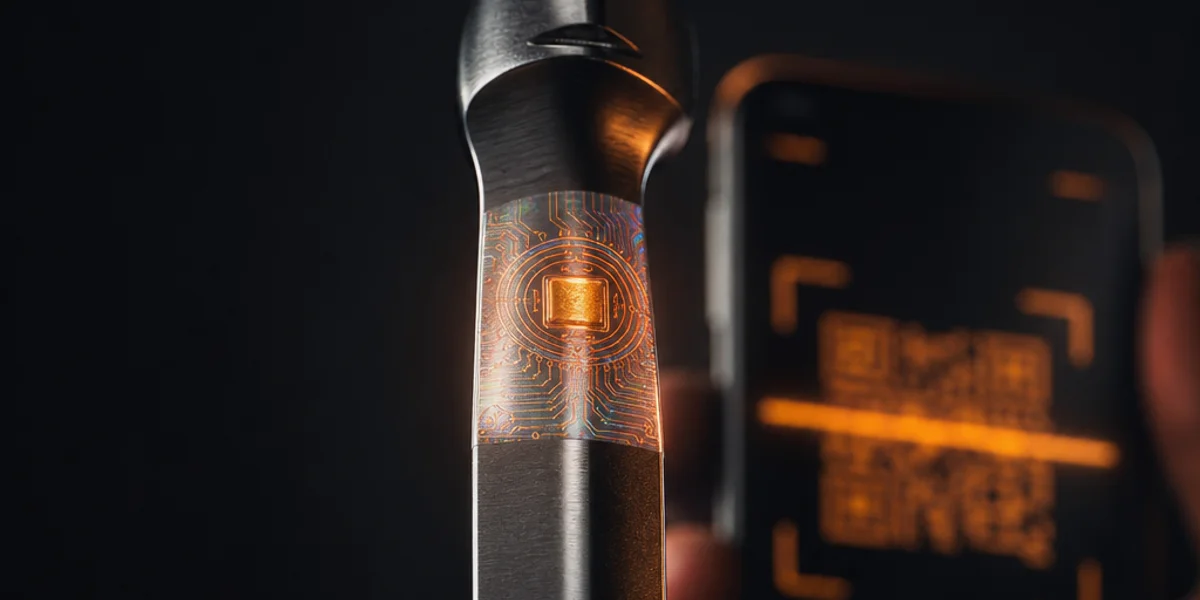
The counterfeit problem here is real and the manufacturer is explicit about it. Original Lishi state that copies are sold through the major marketplaces, that some China-based sellers falsely present themselves as official dealers, and that Original Lishi was founded for overseas markets and has no China-based dealers at all. They describe three distinct fake-label patterns, including one with an extra letter inserted into the verification URL and one whose QR code returns no verification result. Tools carrying copied labels are not warranted by Original Lishi or its dealers.
The practical position for a working locksmith is straightforward. A copy will usually decode. What it will not reliably do is hold tolerance across hundreds of jobs, and it comes with no support when it fails. Buy from the published dealer list, check the verification label before the tool goes in the roll, and treat an unusually cheap full set as exactly what it looks like.
Decoding to a cut key to a programmed key: the order of work
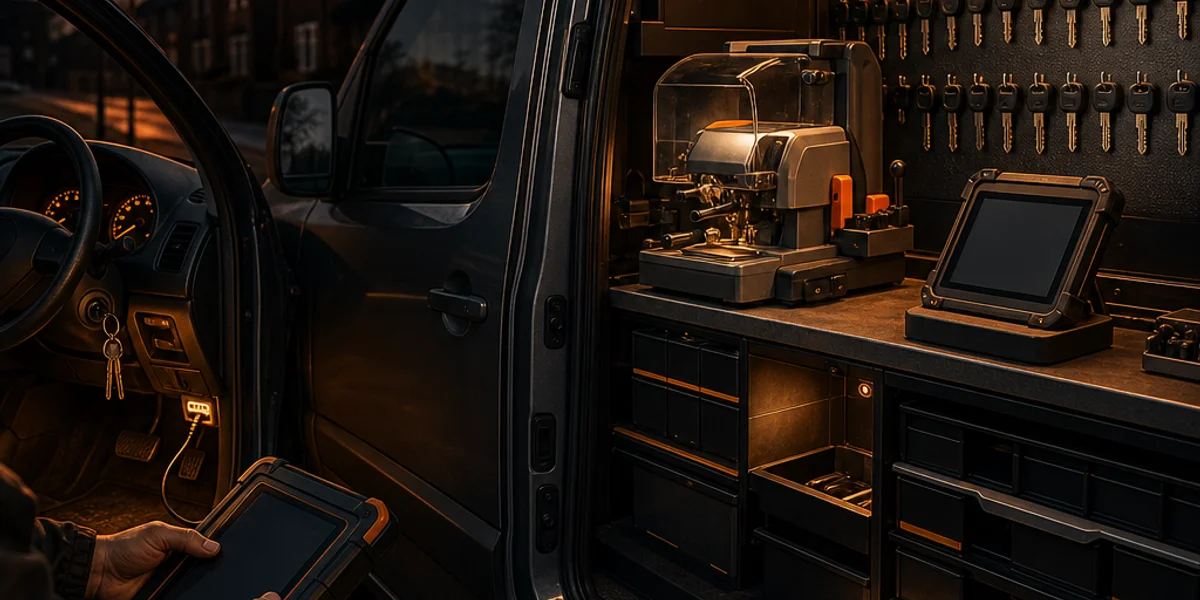
This is the sequence on a legitimate all-keys-lost job. Do the paperwork first — it is the step that protects you.
- Verify ownership before anything else. V5C, photo identification matching the keeper, and your own record of both. If the vehicle, the keeper and the address do not line up, stop.
- Identify the vehicle properly. VIN plate, not the customer's description. Confirm the generation and the key variant, because the profile can change mid-generation — the Sprinter W906 being the obvious case.
- Confirm the blade profile and pull the right tool. Check the revision, not just the designation. Time: 5 minutes, and it saves far more than that.
- Decode the lock. Door or ignition depending on the vehicle and the access. Time: plan 10–25 minutes on a profile you decode regularly, and considerably longer the first few times you meet one. This is a practice-dependent figure, not a specification.
- Cut the key to the decoded code and test it mechanically. Turn the barrel and work the door locks before you go near a programmer. Time: 10–15 minutes on the van.
- Programme the transponder. This is a separate job with its own tool and its own clock, and the database holds the real figures per vehicle. On a Ford where the tool lacks current security access, the fallback is Ford's timed route and a ten-minute wait. On an Astra J all-keys-lost via OBDSTAR the record notes a ten-minute wait during the procedure. Ford proximity security access on Autel runs three to ten minutes. A Smart Pro all-keys-lost on a Transit Custom is a ten-to-twenty-minute server-authenticated access. Time: 20–60 minutes depending on the vehicle.
- Test everything and record the job. Engine start, remote locking, proximity unlock where fitted, and a written record of the identification you checked.
Note that on a Transit Custom the erase path drops the van below its two-key minimum, so have two cut and chipped keys in your hand before you start step 6 — not in the van, and not on order.
Common pitfalls
You decoded the door and the ignition does not match. On some vehicles the door and ignition are not cut the same, and on others the door lock is worn enough that the gauge reading drifts a position. Decode the ignition where you can reach it, and where you cannot, cut and test before you commit.
The tool fits but the reading is inconsistent. Worn locks are the usual cause, and so are copies with loose tolerances. Decode twice, from scratch, and compare. Two matching independent reads is the standard before you cut.
You bought the profile and not the revision. HU101 and HU83 both ship in multiple versions. The tool will often enter the lock and still fail to give a clean read on the specific barrel in front of you.
You treated the Lishi as the whole job. A cut key that turns the barrel on a modern vehicle is a vehicle that still will not start. Price the decode and the programming as two stages, and check the programming coverage before you drive out — the database flags where the aftermarket stops, which is more often than the tool marketing suggests.
You skipped the ownership check because the job looked ordinary. SERMI launched in the UK on 1 April 2026, with access to manufacturer security systems running through certificates and security tokens issued to named, credentialed technicians. The scheme is mandated by Delegated Regulation (EU) 2021/1244, and under it a conformity assessment body approves the business and authorises named employees, with approvals valid for sixty months unless revoked for misuse. Decoding a lock is not covered by that scheme, and the standard of proof the trade is now held to has moved regardless. Document what you checked.
Frequently asked questions
Which Lishi tool fits a Ford Transit Custom?
HU101. The Keysolved record confirms HU101 on every key variant of the 2012–2023 Transit Custom, including the early sealed-battery ID63 key, both Hitag Pro flip remotes and the Keyless Entry/Start proximity fob. Check the tool revision against the barrel, as HU101 ships in more than one version.
Are Lishi picks legal to own in the UK?
Owning locksmith tools is lawful. Carrying them with intent to use them for an offence is not, and that distinction is about intent and circumstance rather than the tool. Carry them as part of an identifiable trade kit, keep your ownership-verification records, and do not treat the question as settled by the purchase receipt alone.
How many Lishi tools do I actually need?
Eleven profiles cover a very large share of a normal UK round: HU101, HU66, HU162T, HU83, HU100, HU92, NSN14, TOY48, HON66, SIP22 and the HU39/YM15 pair for the Sprinter. Buy those to the makes you actually see rather than buying a full set.
What is the difference between Original Lishi, Genuine Lishi and Classic Lishi?
They are distinct distribution brands rather than grades of the same thing. By Classic Lishi's own account, both lines come out of Mr Li's factory in Qinhuangdao, with Classic Lishi selling as an authorised distributor under a green verification label and Original Lishi operating as an export partner since 2015 under a red one — and that comparison is published by a seller describing its own business, so read it as such. The ranges and finishes differ too: Original Lishi vendors ship anti-glare by default, Classic Lishi ship standard versions with a short AG-only list. The difference that actually matters commercially is between any of these and an unlabelled copy, which carries no warranty and no support.
Does a Lishi work on a smart key vehicle with no ignition barrel?
Partly. Proximity vehicles still have a mechanical door lock and an emergency blade inside the fob, and the database records the blade profile for exactly that reason — TOY48 on the Hilux smart key, HU83 on the Corsa F smart key, HU101 on the Transit Custom proximity fob. You can decode the door and cut an emergency blade. You cannot start the vehicle that way.
Can I clone the chip once I have decoded the lock?
Sometimes, and it depends entirely on the transponder family rather than the blade. The database records cloning availability per variant: the Astra J Hitag 2 key and the Ducato ID46 key both clone, while the MQB Golf's Megamos AES key has to be enrolled. Decoding the lock tells you nothing about which applies.
Where to look it up
The profile table above covers the vehicles most UK locksmiths meet most weeks. It is not the whole fleet, and the fleet moves.
For the vehicle in front of you, look the blade profile up directly rather than working from a catalogue or from memory. The Keysolved record carries the profile alongside the transponder, the frequency, the OBD port location and the per-tool programming coverage with field notes, which is the combination you actually need before you quote. Search the vehicle, read the key variant that matches the key in your hand, and check the programming coverage in the same pass.
Three companion references finish the picture. The transponder chip cross-reference chart tells you what the chip in the head actually is and whether it clones. The OBD port location guide saves you the ten minutes of hunting that follows a successful decode. And the honest coverage matrix for key programmers tells you which machine finishes the second half of the job.
Full database access
Look Up the Blade Profile Before You Order
Cancel any time · Billed monthly in your local currency
Search any vehicle on Keysolved for the confirmed blade profile, transponder chip, frequency, OBD port location and per-tool programming coverage with field notes.
No card required to browse — subscribe to unlock full specs and procedures
Frequently Asked Questions
▶Which Lishi tool fits a Ford Transit Custom?
▶Are Lishi picks legal to own in the UK?
▶How many Lishi tools do I actually need?
▶What is the difference between Original Lishi, Genuine Lishi and Classic Lishi?
▶Does a Lishi work on a smart key vehicle with no ignition barrel?
▶Can I clone the chip once I have decoded the lock?
Full database access
Stop Guessing Which Tool Fits
Cancel any time · Billed monthly in your local currency
Keysolved holds key specs, programming procedures and honest per-tool compatibility across 64 makes — written for working auto locksmiths, not for stranded motorists.
No card required to browse — subscribe to unlock full specs and procedures
Sources
- A Word of Caution From Mr. Li(2026)— Original Lishi on counterfeit tools, the three fake-label patterns, and the absence of China-based dealers.
- Original Lishi Authorised Vendors(2026)— The manufacturer's published list of authorised dealers.
- What's the Anti-glare Version of Lishi Tools?(2026)— Explains that the AG coating reduces glare on the gauge but uses the same stainless steel and does not harden it.
- Classic Lishi vs. Original Lishi(2026)— A seller's own comparison of the two distribution brands, the shared Qinhuangdao factory and the green and red verification labels.
- Lishi U101 +V3-AG Original Tool(2026)— Trade supplier listing showing HU101 coverage across Ford, Land Rover, Volvo and Jaguar applications.
- Original Lishi HU101 CutOut V3 Pick and Decoder(2026)— Ten-cut tool, two lifters, five depths, listed for ignition, door and boot locks on Ford, Jaguar, Land Rover, Lincoln and Volvo.
- SERMI launch in the UK improves security in vehicle repairs(2026)— Confirms the 1 April 2026 UK launch and the certificate and security-token access model.
- SERMI — Scheme Owner to the European Co-operation for Accreditation(2026)— The official scheme: mandated by Delegated Regulation (EU) 2021/1244, CAB approval of businesses and named employees, approvals valid 60 months.