
Renault and Dacia Key Programming: Complete Locksmith Guide (All Models)
Four immobiliser eras, the key card, and where the aftermarket stops on the Clio V
Key Takeaways
- Renault keeps the immobiliser secret in the UCH body control module on every vehicle in this guide — if the PIN will not come out of the UCH, there is no second route
- Hitag 2 cars up to roughly 2013 clone and give up the PIN over OBD; everything from the Clio IV onward is Hitag AES and every key is an enrolment
- The Clio V, Captur II and Megane IV Phase 2 moved the HFM to a locked Renesas RH850 processor — all-keys-lost means a bench read with an RH850 programmer, not an OBD session
- Autel removed Renault all-keys-lost from the MaxiIM series in January 2025 and the gateway unlock tokens were withdrawn in December 2024 — add-key still works, all-keys-lost does not
- Handsfree and non-handsfree key cards look identical and are not interchangeable; the Clio V also moved its emergency blade from VA2 to VA6
- Dacia runs the same architecture on an easier route — the Continental UCH on the B0 cars gives up the PIN over OBD even for all-keys-lost
Renault is the make that separates locksmiths who read the vehicle from locksmiths who read the menu. A Clio III and a Clio V are both Clios, both have a card or a key in the owner's hand, and both will be described identically on the phone by the customer standing next to it. One is a twenty-minute add-key on the driveway. The other is a module out, a bench read on a locked Renesas processor, and a licence stack that costs more than the job.
Dacia sits inside the same architecture. Every Sandero, Logan and Duster on a UK driveway runs a Renault UCH, which means the Dacia work is Renault work with cheaper keys and, usually, an easier route in. That is good news, and it is the reason this guide covers both makes together rather than splitting them.
What follows is the structure Renault actually uses, era by era, with the chip, the PIN source, the all-keys-lost route and a realistic job time for each. Every specification below comes from the Keysolved vehicle database. Where the database does not hold a field, that is stated rather than guessed.
What Makes Renault Key Programming Different?
Renault put the immobiliser secret in the body control module and never moved it. There is no separate immobiliser box to pull, no ECU to pair, and no dealer code card. On every Renault and Dacia from the mid-2000s onward, the UCH — Unité de Commande d'Habitacle — authenticates the transponder and tells the engine ECU over CAN whether to allow a start.
That single decision shapes the whole trade experience of the make. Get the PIN out of the UCH and the job is routine. Fail to get it out and there is no second route, because nothing else on the vehicle holds it.
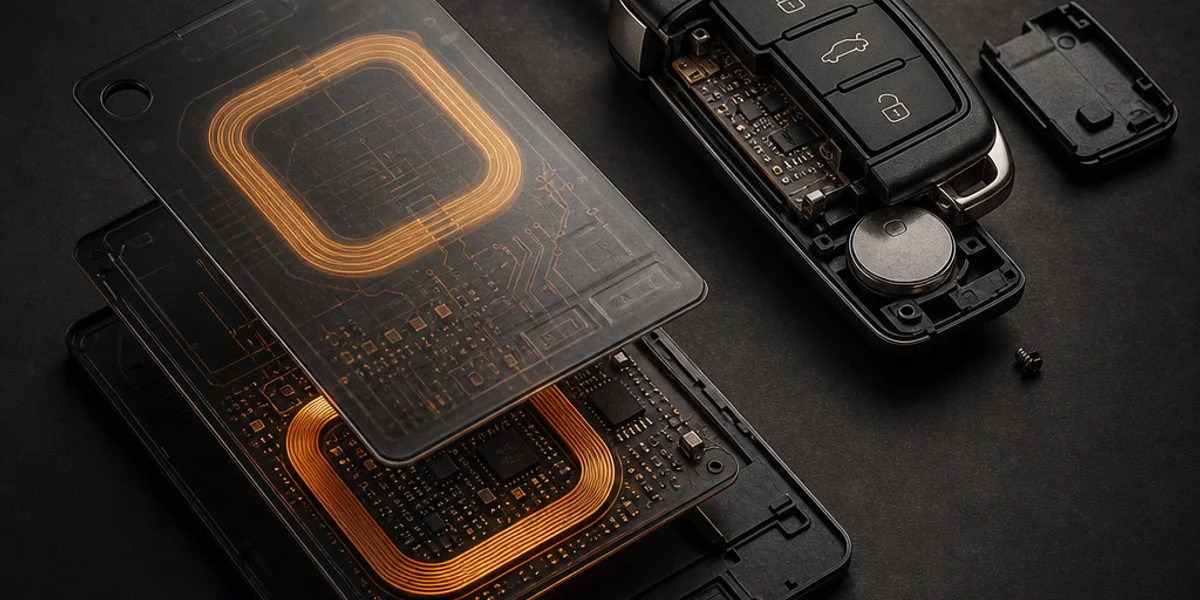
The second Renault peculiarity is the card. Renault introduced the hands-free key card on the Laguna II in 2001, and by 2021 it was fitted to nearly two-thirds of Renault vehicles sold, which is why so much of the UK parc arrives with a credit-card-shaped key rather than a blade. The card matters operationally for one reason: a handsfree card and a non-handsfree card can look identical, carry the same four buttons, the same VA2 emergency blade and the same battery, and still be the wrong part. The handsfree card carries an internal LF coil on a physically different PCB. Fit the non-handsfree version to a handsfree car and the transponder will start the engine while the proximity entry does nothing at all.
The Architecture: UCH, HFM and BCM
Three module names cover almost everything. Learn which one holds the data on the car in front of you and the rest of the job follows.
- UCH — the body control module. Holds the PIN and the ISK (Identification Secret Key). Present on every Renault and Dacia in this guide.
- HFM — the Hands Free Module, fitted only to proximity-equipped vehicles. On Clio IV and Captur I it carries a Renesas D70F3633 microcontroller whose D-flash holds the immobiliser data.
- BCM — on later non-keyless cars, the body control module alone holds everything, because no HFM is fitted.
The practical consequence: on an all-keys-lost job you must know whether the car is keyless before you decide which module is coming out. A keyless Clio V means the HFM. A Play-trim Clio V on a standard card means the BCM. Same car, same chip, different module on the bench.
Era One — UCH and Hitag 2, Roughly 2005 to 2013
This is the forgiving era. The Clio III runs a PCF7947 Hitag 2 transponder at 433.92 MHz on a VA2 blade, with a CR2016 cell. The keycard variant uses a PCF7943, also Hitag 2. The UCH stores up to four keys, and a PIN is required for all-keys-lost — but it is readable from the UCH EEPROM over OBD by every serious tool on the market, and on an add-key most tools never ask for it at all.
Hitag 2 also means these keys clone. That is worth remembering when a customer wants a spare and has a working original in their hand.
Add key — Clio III, Sandero I, Duster I pre-facelift
- Verify the vehicle. Check the V5C and the customer's identification before anything else, and confirm the chip from the existing key rather than from the model year.
- Find the port. On the Clio III it sits in the centre console below the stereo, behind a snap-off cover — not the footwell. On the Dacia B0 cars it is at the bottom of the glove box behind a grey flap.
- Connect the tool and switch the ignition on with the working key present.
- Navigate to the Renault or Dacia UCH menu and select Add Key. The tool pulls the PIN from the UCH over CAN with no manual entry.
- Present the new blank when prompted. The transponder and remote programme together — there is no separate remote pairing step.
- Test remote lock and unlock at 433.92 MHz, then start the engine.
- Confirm the original key still works. On several tools the key learn clears and rewrites the set.
- Time: 15 to 25 minutes.
All keys lost — same era
- Connect and select All Keys Lost in the UCH menu.
- The tool reads the PIN and ISK from the UCH over OBD. No module removal is needed on the Continental UCH fitted to the Dacia B0 cars.
- Programme every key the customer needs in the same session, because the procedure initialises the key count.
- Test each key for remote function and engine start before packing up.
- Time: 30 to 45 minutes.
One tool-specific note worth carrying: on several OBDSTAR and Autel procedures for this era you must enter the UCH Reset menu after the key learn and cancel immediately. Skipping that step leaves the module in learning mode and the customer calls you back.
Era Two — The Key Card Years, 2012 to 2019
This is where Renault gets expensive. The Clio IV and its B0 platform sibling the Captur I moved to Hitag AES — PCF7945M on the non-handsfree card, PCF7953M on the handsfree, both ID4A, both 433.92 MHz, both on a VA2 emergency blade. Hitag AES cannot be cloned. Every key is an enrolment.
Add-key remains straightforward, because the UCH still gives up the PIN over OBD. All-keys-lost is a different job entirely.
Add key — Clio IV and Captur I
- Verify ownership, then confirm whether the card is handsfree. Order the blank accordingly.
- Connect at the central console port, under the hinged flap forward of the gear lever. On the Captur I the port moved at the 2017 facelift to the bottom of the glove box — check before you reach into the footwell.
- Switch the ignition on with the working card in the reader, or near the reader on proximity cars.
- Select Key Card Programming, then Add Key. The tool reads the UCH PIN over CAN automatically.
- Present the new card when prompted and let the tool write.
- Test the engine start, then walk away and back to test proximity unlock if the car is handsfree.
- Time: 20 to 30 minutes.
All keys lost — the HFM bench route
- Remove the HFM. Access is typically behind the dashboard or centre console and takes 15 to 30 minutes depending on trim.
- Connect the module to a bench programmer and read the D-flash from the Renesas D70F3633. The read itself takes around 15 minutes.
- Import the dump into the key programmer and let it calculate the ISK and PIN.
- Pre-code the new cards with the extracted data.
- Connect at the OBD port, select All Keys Lost, and learn the cards.
- Refit the HFM and test every card.
- Time: 90 minutes to 2.5 hours.
Two warnings on that procedure, both of which cost real money. Use a stabilised external supply throughout. And be aware that some server-based routes virginise the HFM partway through: if the internet connection or the power drops at that point the module is bricked, and a replacement HFM from Renault runs to around a thousand euros. That is not a risk worth carrying on a domestic broadband tether in a customer's driveway.
The exception is worth knowing even if you do not own the tool. Abrites covers the Clio IV from 2015 onward for all-keys-lost over OBD with no HFM removal at all, which turns a two-hour bench job into roughly 30 to 45 minutes. Pre-2015 Clio IV gets add-key only on the base package.
The Megane III sits slightly apart. Early cars (2008 to 2012) use PCF7947 Hitag 2 on an NE72 blade; the 2012 facelift moved to NCF2951 Hitag Pro. Both remain OBD jobs, and the database rates all-keys-lost on the Hitag Pro variant as expert-level. Confirm which chip you have before ordering, because the two are not interchangeable.
Era Three — CMF-B and the RH850 Wall, 2019 Onwards
The Clio V, Captur II, Zoe ZE50 and Dacia Sandero III all sit on the CMF-B platform, and this is the generation where the aftermarket genuinely stops for some jobs.
The chip is NCF29A1M — Hitag AES, ID4A. NXP describes it as a single-chip immobilisation and keyless entry solution combining the transponder, a three-axis LF front end and a UHF transmitter, and notes plainly that the use of AES hampers cloning. It does. There is no clone path here.
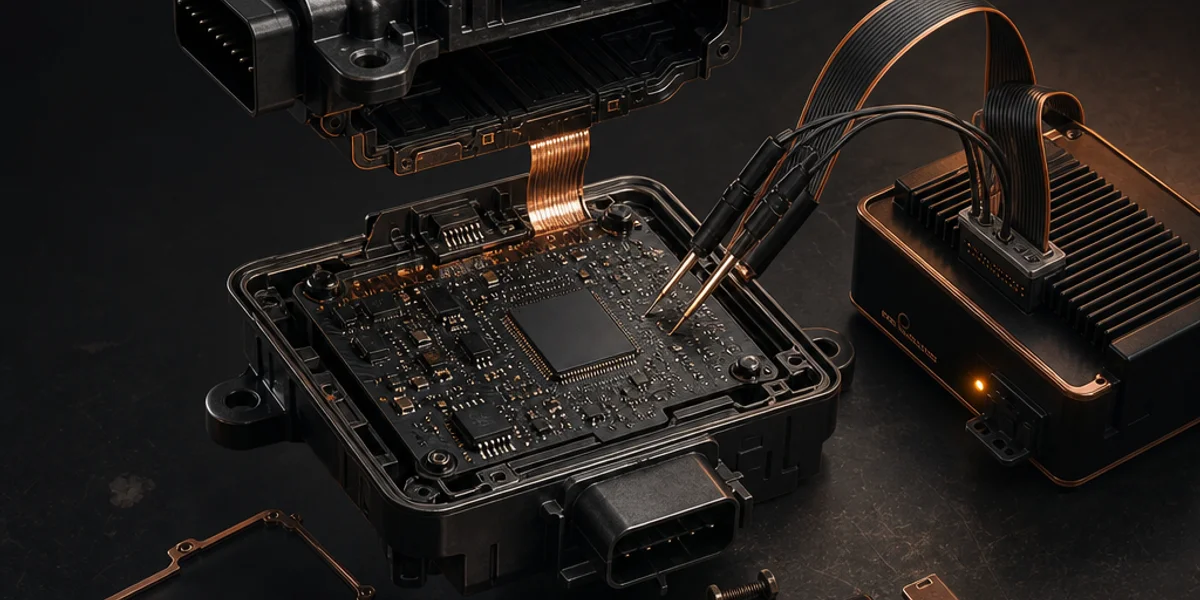
Two things changed at once on this platform. First, the emergency blade on the Clio V card moved from VA2 to VA6 — a change that catches people who order from a Clio IV part list. Second, and more seriously, the HFM now runs a Renesas RH850 microcontroller instead of the D70F3633. The RH850 is locked. It cannot be read with the Orange5, UPA or VVDI Prog that handled the Clio IV, and that single fact reshapes the economics of every Renault all-keys-lost job from 2019 onward.
Add key — Clio V, Captur II, Sandero III, Zoe ZE50
- Verify ownership and confirm the trim. Iconic and above is handsfree; Play and base trims take the non-handsfree card.
- Connect the gateway bypass. On the Clio V this is a Renault/Nissan 16+32 gateway adapter, or the ADC2017 bypass cable which connects to the BCM through two 40-pin connectors and routes around the security gateway entirely.
- Connect the tool at the driver's-footwell port — note that the Clio V moved the port back to the footwell from the Clio IV's console location, while the Megane IV puts it on the passenger side under the glovebox.
- Confirm battery voltage above 12 V and fit an external supply.
- Read the IMMO data, then select Add Key.
- Present the new card at the reader or start-button area.
- Test proximity unlock and push-button start, then clear fault codes.
- Time: 30 to 45 minutes.
The step most often skipped: this procedure clears every previously programmed key. Programme all the cards the customer owns in one session, up to the four-key maximum, or they will leave with one working card and a spare that is now scrap.
All keys lost — Clio V and Captur II
There is no OBD-only route. The module comes out.
- Identify the module. Keyless cars mean the HFM, behind the centre console ventilation; non-keyless means the BCM in the interior fuse box region.
- Remove it. On the Clio V the HFM itself is a one- to two-minute job once the kick panels are off, which is considerably better than the Clio IV.
- Read the locked RH850 with an RH850/V850 programmer. Abrites and OBDSTAR both sell one; nothing else in a normal van will read it.
- Process the dump to extract the PIN and IMMO data. On the OBDSTAR route this surfaces as a 28-digit PIN.
- Prepare the new card blank.
- Refit the module, connect with a direct CAN cable, and programme the card with the extracted data.
- Test proximity entry and start.
- Time: 2 to 3 hours, plus the licence cost below.
On the licensing, be clear-eyed. The Abrites route requires the RR026 licence for all-keys-lost from an RH850 dump, which itself requires both RR018 and RR022 as prerequisites, the RH850/V850 Programmer hardware and an active annual subscription. Abrites lists coverage as Clio V, Captur II, New Zoe, Arkana, Megane IV Ph2, Talisman Ph2, Austral, Megane E-Tech, Rafale and Symbioz, and describes the function as PIN extraction after reading the HFM on keyless models and the BCM on non-keyless. For 2025 model year and newer, the RH850 programmer is required even to add a spare.
And the honest counterweight: Autel removed Renault all-keys-lost from the MaxiIM series in January 2025, and the Renault security gateway unlock tokens were withdrawn the month before. If your van runs an IM608 as its main unit, you can still add keys to these cars with a gateway bypass adapter, but all-keys-lost is gone. That is not a firmware you are waiting on. Plan the job around a different tool or subcontract it.
Twingo III, and the Car That Hides in the Smart Menu
The Twingo III deserves its own section because the obvious approach fails and the working approach is counter-intuitive.
It runs a PCF7961M Hitag AES transponder on a VA2 blade, turn-key ignition, no push-button start and no card. The UCH is shared with the Smart ForTwo and ForFour 453 and the Trafic III, and it ships in two flash sizes. The remote learns automatically with the transponder, so there is no separate pairing step.
Here is the useful part. Autel has removed add-key from its Renault Twingo menu — but because the UCH is the Smart 453 unit, the working route is IMMO > Smart > ForFour 453 > Key learning. Back up the UCH flash, calculate the PIN from the backup, then add the key. Separately, on the 1024 KB UCH the Lonsdor Twingo III menu can stall at around 73 per cent of the flash read and time out; the route that completes is Renault > Trafic III, which reads the same module.
Both of those are the kind of thing that turns a cancelled job into a completed one, and neither appears in any tool manual.
Twingo III add key: 25 to 40 minutes. All keys lost: 45 to 70 minutes. On all-keys-lost, reading the PIN deletes every stored key, so at least one new key must be learnt before you disconnect.
Dacia and the Vans
Dacia is the easy money on this platform. The Duster I runs a Continental UCH that gives up the PIN over OBD even for all-keys-lost — no module removal, no EEPROM work, and the database rates both add-key and all-keys-lost as beginner-level. Add key runs 15 to 20 minutes, all keys lost 25 to 40 minutes.
The catch is the chip split at the 2013 facelift: pre-facelift cars are PCF7946 or PCF7947 Hitag 2 on a VAC102 blade and clone happily, post-facelift cars are PCF7961M Hitag AES and do not. Present a Hitag 2 blank to a Hitag AES car and the programming fails outright. The Sandero I before it is PCF7947 Hitag 2 throughout; note that some lower trims in certain markets shipped with no immobiliser at all, so confirm a transponder is present before you quote.
The vans are the other half of the Renault trade. The Master IV — shared with the Nissan NV400 and the Vauxhall Movano B — takes a PCF7947 Hitag 2 remote head key on a VA2 blade, the same board as the Clio III and Kangoo II, with a later Hitag Pro PCF7953 flip remote on an NE72 blade. The Hitag 2 variant clones. Add key is a 20 to 30 minute OBD job with the UCH PIN read automatically; the Hitag Pro flip is rated expert for all-keys-lost.
The Trafic III is the Vivaro B and NV300 twin. The database lists it as a Hitag Pro flip remote with OBD add-key and all-keys-lost across Lonsdor, Autel, OBDSTAR, Abrites and Smart Pro, but does not currently hold a confirmed OBD port location or chip part number for it. Verify both on the vehicle rather than assuming the Vivaro position.
Renault and Dacia Key Reference Table
| Vehicle | Years | Chip / family | Freq | Blade | AKL route |
|---|---|---|---|---|---|
| Clio III remote | 2005–2012 | PCF7947 / Hitag 2 | 433.92 | VA2 | OBD, UCH PIN |
| Clio III keycard | 2005–2012 | PCF7943 / Hitag 2 | 433.92 | VA2 | OBD, UCH PIN |
| Clio IV card, non-handsfree | 2012–2019 | PCF7945M / Hitag AES | 433.92 | VA2 | HFM D-flash bench (Abrites OBD, 2015+) |
| Clio IV card, handsfree | 2012–2019 | PCF7953M / Hitag AES | 433.92 | VA2 | HFM D-flash bench (Abrites OBD, 2015+) |
| Clio V card | 2019–2024 | NCF29A1M / Hitag AES | 433.92 | VA6 | RH850 bench read, HFM or BCM |
| Captur I card | 2013–2019 | PCF7939MA / PCF7953M / Hitag AES | 433.92 | VA2 | HFM bench, or Abrites OBD |
| Captur II proximity | 2019–2024 | PCF7953 / Hitag AES | 433.92 | VA2 | HFM bench — Autel AKL withdrawn |
| Captur II standard card | 2019–2024 | PCF7961 / Hitag AES | 433.92 | VA2 | BCM bench |
| Megane III early | 2008–2012 | PCF7947 / Hitag 2 | 433 | NE72 | OBD |
| Megane III facelift | 2012–2016 | NCF2951 / Hitag Pro | 433 | NE72 | OBD, expert |
| Megane IV Ph1 | 2016–~2021 | PCF7953M / NCF29A1M / Hitag AES | 433.92 | VA2 | OBD, server-mediated |
| Megane IV Ph2 | 2022–2023 | NCF29A1M / Hitag AES | 433.92 | VA2 | RH850 bench read |
| Twingo III | 2014–2024 | PCF7961M / Hitag AES | 433.92 | VA2 | OBD, UCH flash read |
| Zoe ZE50 card | 2019–2024 | PCF7939 / Hitag AES | 433.92 | none | OBD, UCH PIN |
| Master IV remote head | 2010–2024 | PCF7947 / Hitag 2 | 433.92 | VA2 | OBD |
| Master IV flip | 2010–2024 | PCF7953 / Hitag Pro | 433 | NE72 | OBD, expert |
| Dacia Sandero I | 2008–2013 | PCF7947 / Hitag 2 | 433.92 | VA2 | OBD, UCH PIN |
| Dacia Duster I pre-facelift | 2012–2013 | PCF7946 / PCF7947 / Hitag 2 | 433.92 | VAC102 | OBD, Continental UCH |
| Dacia Duster I post-facelift | 2013–2017 | PCF7961M / Hitag AES | 433.92 | VAC102 | OBD, Continental UCH |
| Dacia Sandero III | 2020–2024 | Hitag Pro | not confirmed | not confirmed | OBD, UCH PIN |
Frequency and blade for the Sandero III, and the OBD position for the Trafic III, are not currently confirmed in the database. Verify on the vehicle.
Tool Coverage, Honestly
Tier one — full coverage including modern all-keys-lost
Abrites AVDI. The only route that does Clio IV all-keys-lost over OBD with no bench work, and the most complete answer on the CMF-B cars. The cost is real: RR018 as the base, RR022 for Clio V and Captur II, RR026 for RH850 all-keys-lost, the RH850/V850 programmer, a PROTAG programmer and an active annual subscription. Worth it if Renault is a meaningful share of your work. Hard to justify for occasional jobs.
OBDSTAR X300 Classic G3 and X300 DP Plus. Broad Renault coverage with the green Renault converter, which is the specific adapter for the Megane IV, Talisman, Scenic IV, Espace V, Koleos and Kadjar from 2016. Confirmed for Clio V all-keys-lost with the RH850 adapter. The limitation is architectural: the procedures are server-mediated, so a dropped connection mid-process can virginise a module. Treat a stable connection and a battery support unit as mandatory kit, not optional.
Tier two — strong on add-key, limited beyond it
Advanced Diagnostics Smart Pro. The ADC2017 Renault bypass cable connects straight to the UCH or BCM and bypasses the secure gateway, which makes it one of the cleanest add-key routes on Clio V, Captur II and Zoe from 2019. All-keys-lost on those cars is not supported without the bench read. Well established in the UK trade and stable on the older UCH cars.
Lonsdor K518 Pro. Good Renault and Dacia coverage, with 2020-onward proximity support added in the August 2024 update via the SGW 12+8 bypass. Honest limitation: all-keys-lost reliability on Clio V and Megane IV Phase 2 is not confirmed from a tier-one source. Treat it as an add-key tool on those platforms.
Tier three — know the limitation before you rely on it
Autel MaxiIM IM608 and IM508. Add-key only on Renault since January 2025, when Renault all-keys-lost was removed from the MaxiIM series, and the gateway unlock tokens were withdrawn in December 2024. A gateway bypass adapter is now required. If the IM608 is your only unit, Renault all-keys-lost is outside your capability and should be priced and scheduled accordingly.
Xhorse VVDI Key Tool Plus. Renault and Dacia coverage exists and the November 2024 IMMO database update added Duster 2014–2018 flip keys, but it is thinner than the specialist Renault tools. A sensible backup, not a primary.
For coverage counts across makes rather than within one, the car key programmer comparison sets these tools against the whole database.
Common Pitfalls on Renault and Dacia
The card looks right and the proximity does not work. The handsfree and non-handsfree cards share the shape, the buttons, the blade and the battery, and differ in the LF coil on the PCB. The engine will start and the door handles will do nothing. Order against the trim, not the photograph.
You ordered a VA2 blade for a Clio V. The Clio V moved to VA6 while keeping the same card format as the Clio IV. Nothing else about the key announces the change.
The spare key stopped working after you programmed a new one. On most Clio V, Captur II and Megane IV procedures the key learn clears the whole set and rewrites it. Collect every key the customer owns before you start and programme them all in one session.
A Hitag 2 blank fails on a 2015 Duster. The 2013 Duster facelift moved to Hitag AES. The parts look identical and the pre-facelift blank will simply refuse to write.
The OBD port is not where you expect. Renault moves it more than any other make. Clio IV: centre console under a flap. Clio V: driver's footwell. Megane IV: passenger side under the glovebox. Captur I: console before the 2017 facelift, glovebox after it. Dacia B0 cars: bottom of the glovebox. The OBD port location guide has the full set.
The module bricked mid-process. Almost always power or connection. Fit a stabilised supply before the first read, not after the first failure, and do not run a server-mediated all-keys-lost on a weak mobile tether.
The warning light was never the key. Before quoting an all-keys-lost on a non-starting Renault, rule out the ordinary faults. The immobiliser fault diagnosis guide covers the symptom-to-cause path on the UCH architecture.
Frequently Asked Questions
Can a Renault key card be cloned?
No, on anything from the Clio IV onward. Those cards use Hitag AES, which cannot be cloned — every card is an enrolment to the UCH. The older Hitag 2 keys and cards on the Clio III, Sandero I, Master IV remote head key and pre-facelift Duster can be cloned with a standard ID46 clone chip when a working original is available for reading.
Where is the PIN code on a Renault?
In the UCH on almost every vehicle, and readable over OBD by any professional tool on the Hitag 2 and early Hitag AES cars. From 2019 on the CMF-B platform the PIN sits in the HFM on keyless cars and the BCM on non-keyless cars, and for all-keys-lost it must be extracted from a bench read of the locked RH850 processor. A Renault dealer can also supply the PIN through CLIP diagnostics against the VIN and proof of ownership.
Why can my Autel not do Renault all keys lost any more?
Autel removed the Renault all-keys-lost function from the MaxiIM series in January 2025, and the Renault security gateway unlock tokens were discontinued in December 2024. Add-key with a working key present still works through OBD with a gateway bypass adapter. All-keys-lost on Renault now requires a different tool.
Do I need to remove the module for a Clio IV all keys lost?
On most tools, yes — the HFM comes out for a D-flash read of the Renesas D70F3633, which is a 90-minute to two-and-a-half-hour job. The exception is Abrites with the RR018 licence, which performs all-keys-lost over OBD on Clio IV from 2015 onward with no module removal, in roughly 30 to 45 minutes.
Is Dacia key programming the same as Renault?
Architecturally yes, operationally easier. Dacia runs the same Renault UCH, and on the B0 platform cars the Continental UCH gives up the PIN over OBD even for all-keys-lost, with no module removal. The Duster and Sandero are among the most straightforward all-keys-lost jobs in the UK parc.
What does SERMI mean for Renault key work?
The Security-related Repair and Maintenance Information scheme went live in the UK on 1 April 2026, with Digidentity acting as the trust centre issuing certificates and security tokens. Accreditation gives independent operators the same access to manufacturer security data — including key programming — as franchised dealers. It does not replace your aftermarket tooling, but it is the formal route to manufacturer data where the aftermarket has no answer.
Where to Look Up a Specific Vehicle
Every chip, frequency, blade profile, PIN source, OBD location and tool note in this guide came out of the Keysolved database, and the database holds considerably more than fits in one article — 17 Renault entries and 7 Dacia entries at the time of writing, each with per-variant tool compatibility and field notes.
Before a Renault job, look up the exact year range rather than the model. The Clio IV and Clio V are a two-hour difference in work and a four-figure difference in tooling, and the only thing separating them on the driveway is a registration plate.
Browse the full Renault vehicle list or the Dacia vehicle list, or go straight to the generation you are standing next to. For chip identification across makes, the transponder chip cross-reference maps every family you will meet in the UK. And because the CMF-B platform is shared, the Nissan guide covers the Juke II and Micra K14 that sit on the same architecture as the Clio V.
As always: proof of ownership, V5C and customer identification before the tool comes out of the van. On a make where all-keys-lost means a module on a bench, that discipline protects the job as much as it protects you.
Full database access
Check the Exact Generation Before You Quote
Cancel any time · Billed monthly in your local currency
Look up the chip, PIN source, OBD port location and per-tool compatibility for any Renault or Dacia on Keysolved — Clio IV and Clio V are a two-hour difference in work.
No card required to browse — subscribe to unlock full specs and procedures
Frequently Asked Questions
▶Can a Renault key card be cloned?
▶Where is the PIN code on a Renault?
▶Why can my Autel not do Renault all keys lost any more?
▶Do I need to remove the module for a Clio IV all keys lost?
▶Is Dacia key programming the same as Renault?
▶What does SERMI mean for Renault key work?
Full database access
The Reference Behind This Guide
Cancel any time · Billed monthly in your local currency
Every chip, frequency, blade profile and tool note in this article came from the Keysolved database. Sixty-four makes, with field notes written by working locksmiths.
No card required to browse — subscribe to unlock full specs and procedures
Sources
- Renault hands-free key card: 20 years of innovation in the palm of your hand(2021)— Renault UK on the introduction of the hands-free key card on the Laguna II in 2001 and its fitment across the range
- NCF29A1MHN — Tiny Single Chip Passive Keyless Entry/Go Solution(2025)— NXP product documentation for the transponder used in the Clio V and Megane IV key cards
- RR026 — Renault All Keys Lost from RH850 dump(2025)— Abrites licence coverage, prerequisites and required RH850/V850 Programmer hardware
- New functionality for Renault vehicles — RR026(2025)— Abrites announcement describing PIN extraction from the HFM on keyless models and the BCM on non-keyless models
- SERMI launches in the UK to improve security in vehicle repairs(2026)— Digidentity, the SERMI Trust Centre, on the 1 April 2026 UK launch and the security data it unlocks for independent operators