
Mk4 2002–2009
Under the driver's side dashboard, to the left of the steering column. Accessible without removing trim. Standard 16-pin OBD-II connector.
Four generations, 1999–2025. Pick yours.
2017–2025
Illustration — use it to know where to look.
Driver's footwell, under the dashboard, above the pedals, top-left of the pedal area. Purple connector. Directly accessible without removing any cover panel.
Also on this Polo
2009–2017
Illustration — use it to know where to look.
RHD (UK): driver's footwell on the right of the car, tucked up under the lower edge of the dash directly above the pedals, just outboard of the steering column and immediately below the fuse and relay carrier. It sits high and faces downwards, so you will not see it sitting in the seat - you have to get your head into the footwell and look up, or feel along the underside of the dash above the accelerator. The socket is purple on most cars. LHD: mirror image - driver's footwell on the left, above the accelerator pedal, just outboard of the steering column and below the same fuse and relay carrier. Position is the same across every trim from S through Match, SEL, BlueGT, BlueMotion and GTI, and unchanged between the 6R and the 6C facelift.
Also on this Polo
Under the driver's side dashboard, to the left of the steering column. Accessible without removing trim. Standard 16-pin OBD-II connector.
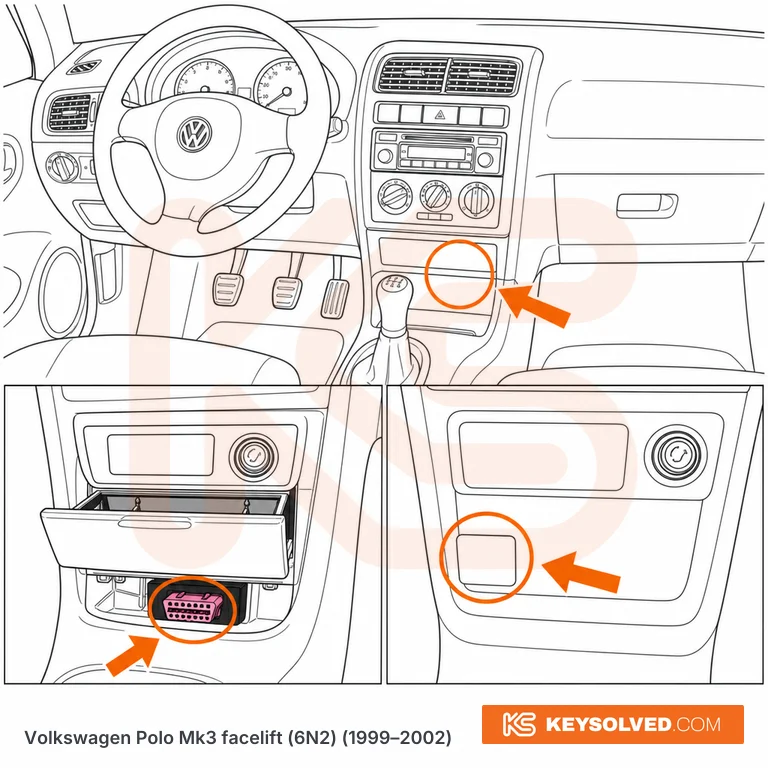
Centre console, low down, behind the ashtray. One UK 6N2 owner describes an odd-shaped pink connector there. Another reference puts the socket at the bottom of the centre console, behind a plastic cover to the left of the cigarette lighter. Position may vary by trim or year — not confirmed.
Questions
Step-by-step add-key and all-keys-lost procedures for every Polo, which of your tools will do it, and what catches people out.
Subscribe