Driver's side, below the dashboard, behind the fuse box cover panel. Pull the fuse panel cover to reveal the OBD-II connector underneath. The port faces downward and is flush with the lower dash panel — easy to miss without looking up from beneath. Located directly below the steering column above the footrest.
No diagram for this one yet. Ask for one and we'll draw it. The more requests, the sooner.
Driver's footwell, below the steering column, adjacent to the fuse box. Accessible without removing any trim. On LHD markets the port is on the left side of the steering column.
No diagram for this one yet. Ask for one and we'll draw it. The more requests, the sooner.
Driver's side (right), below the dashboard, behind the fuse box cover panel. Pull the fuse panel cover to reveal the OBD-II connector underneath. The port faces downward and is flush with the lower dash panel — easy to miss without looking up from beneath.
SL (3rd gen) 2010–2016
Driver's side footwell, above the accelerator pedal and to the right of the fuse box, below the steering column. The port is partially concealed by the lower dashboard trim and faces downward — kneel and look up from beneath the dash to locate it. The fuse panel cover does not need to be removed. Consistent with all Kia SL-generation models across LHD and RHD variants.
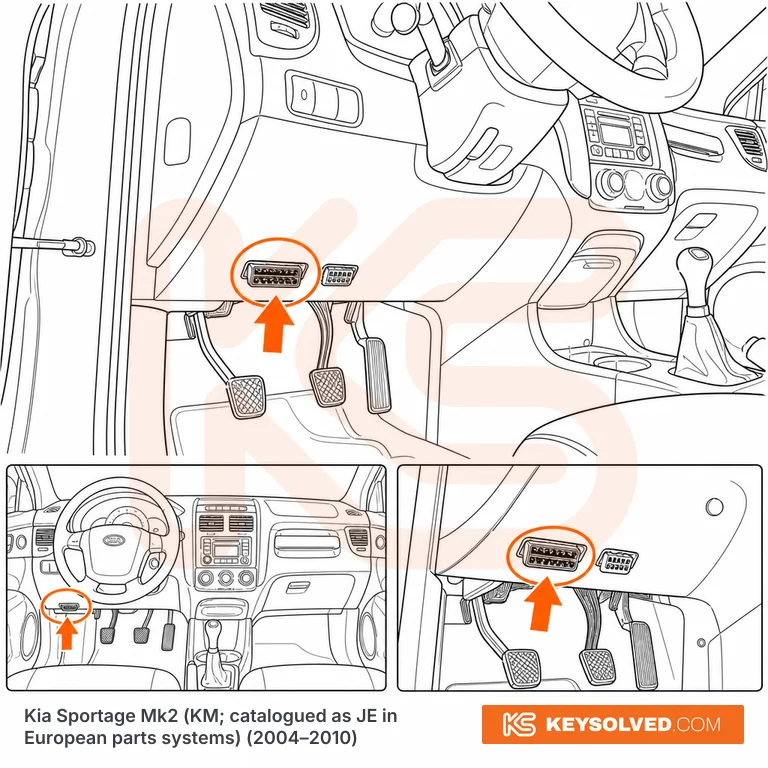
Mk2 (KM) 2004–2010
Driver's-side footwell, in the underside of the lower dash panel (Kia's own term is the crash pad lower panel), directly below the steering column and just above the pedal box. The 16-pin connector faces downward and is exposed — you can reach up and plug in from the driver's seat without pulling any trim. Kia mirrors the whole fascia for right-hand drive, so on a UK RHD car the socket sits under the right-hand side of the dash, inboard of the fuse panel that lives behind the pull-off cover at the driver's end of the dashboard; on LHD cars it is the mirror image on the left. Same position on every UK trim — XE, XS, XR, Xi, Titan and the First Edition run-out cars — and unchanged by the September 2008 facelift. A second, smaller 10-pin multi-purpose check connector sits immediately beside it; that one is not the OBD socket, but some older Hyundai/Kia remote-learning routines are driven from it, so don't mistake one for the other.
North American models
NQ5 (5th gen) 2023–2024
Driver's side footwell, under the lower dashboard panel to the left of the steering column. The 16-pin OBD-II connector is located behind the lower dash fuse box cover — pull the fuse panel cover downward to expose the port. The connector faces downward and slightly inward. Standard SAE J1962 Type A 16-pin OBD-II. No tools required to access the port once the fuse panel cover is opened. Consistent position across all 2023-2024 US NQ5 production. Note: confirmed via Kia forum reports for NQ5 Sportage 5th gen and consistent with established Kia SMARTRA-platform OBD port positioning on preceding QL generation.
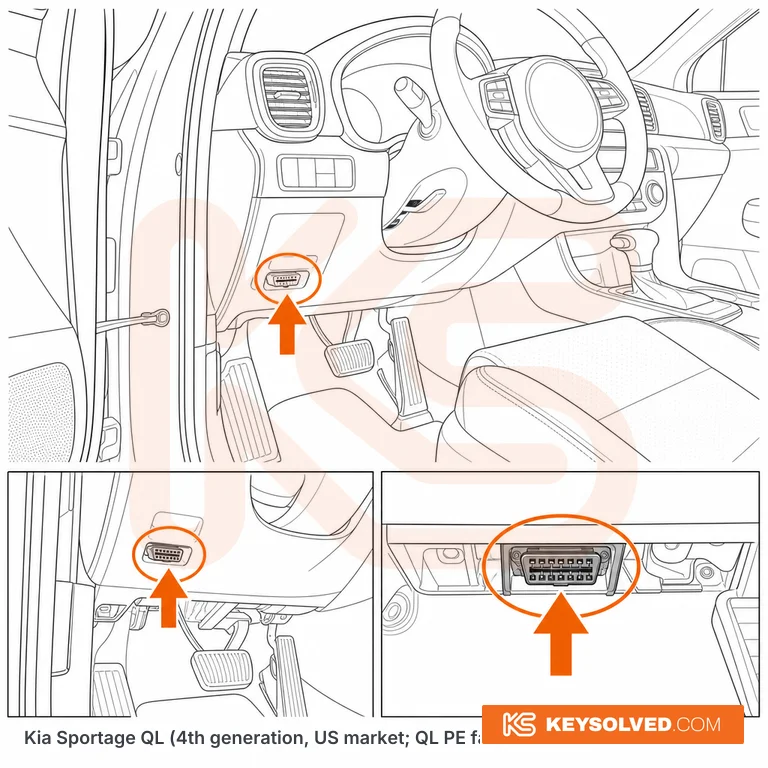
QL 2017–2022
Driver's side, under the lower-left dash below the steering column, just left of centre above the pedals. The 16-pin connector is recessed under the lower dash trim and faces down, so crouch at the open driver's door and look up towards the base of the column. Same position on every 2017-2022 US QL trim. US market is left-hand drive only.
SL (3rd gen) 2011–2016
Driver side, under the lower dashboard panel to the left of the steering column (LHD US market). The 16-pin OBD-II connector is located in the driver's footwell area below the steering column, near the pedal cluster. The port is accessible without removing trim panels — look under the lower dash edge in the footwell area. Confirmed for 2011-2016 SL generation by the Kia forums OBD port thread (kia-forums.com, 3G 2011-2015 Sportage section) and automotive diagnostic guides (scegliauto.com Kia Sportage SL MK3 2010-2016 OBD guide) all describing the footwell area below the steering column.
Questions
Kia Sportage OBD questions
NQ5 (2022–2024): Driver's side, below the dashboard, behind the fuse box cover panel. On a right-hand-drive NQ5: Driver's side (right), below the dashboard, behind the fuse box cover panel. V (2021–2025): Driver's footwell, below the steering column, adjacent to the fuse box. On a right-hand-drive V: Driver's footwell (right side), below the steering column on the right, adjacent to the fuse box. QL (2015–2022): Driver's side, below the dashboard, behind the fuse box cover panel. On a right-hand-drive QL: Driver's side (right), below the dashboard, behind the fuse box cover panel. SL (2010–2016): Driver's side footwell, above the accelerator pedal and to the right of the fuse box, below the steering column. Mk2 (2004–2010): Driver's-side footwell, in the underside of the lower dash panel (Kia's own term is the crash pad lower panel), directly below the steering column and just above the pedal box.